- The Activist Museum Award
- Addressing the museum attendance and benefit gap
- Articulate
- Birmingham Museum Trust Vision
- Books connect 2
- Building inclusive museums
- Buried in the footnotes
- Cabinet of Curiosities
- A Catalyst for Change
- Advancing equity: Challenging embedded whiteness in London Museum
- The Cinematic Musée Imaginaire of spatial cultural differences [CineMuseSpace]
- Contested Desires Constructive Dialogues
- Cultural activity within historic houses
- Developing learning advocates in the East Midlands
- Developing learning advocates in the North West
- Developing new audiences and promoting social inclusion
- Disorder, dissent and disruption
- Encountering the Unexpected
- Engage, learn, achieve
- Engaging archives with Inspiring Learning for All
- Engaging the City
- Cultural value of engaging with museums
- Cultural value of engaging with museums
- EuNaMus
- Evaluating Creativity
- Everyone Welcome 2019-2021
- Everywhere and Nowhere
- Exceptional & Extraordinary
- EXILE at Kingston Lacy
- Generic learning outcomes
- girl.boy.child
- Growing social role of botanic gardens
- HumanKind
- Impact of generic learning outcomes
- Imperial War Museum North
- Including Museums
- Inspiration, identity, learning: the value of museums
- Inspiration, identity, learning: the value of museums, second study
- Leaders in Co-creation?
- Learning impact research project
- Learning through Culture
- The Madonna of the pinks
- Making Meaning in Art Museums 1
- Making Meaning in Art Museums 2
- Mapping the change phase 2
- Mindful Museum
- Mirror
- Museu do Samba, Brazil
- Museums and an ageing population
- Museums and social inclusion: the GLLAM report
- Museums health and wellbeing
- Co-production Framework at National Museums Liverpool
- New Walk Museum vision
- Not for the likes of you
- Open House
- Open minds
- Participatory practices at the Science Museum
- Permissible Beauty
- Prejudice & Pride: exploring LGBTQ lives at the National Trust
- Prisoners, Punishment and Torture
- Redefining the Role of Botanic Gardens
- Research network to advance museum ethics
- Researching Learning in Museums and Galleries 1990-1999
- Rethinking Disability Representation
- shOUT
- Small museums and social inclusion
- Stories of a Different Kind
- Supporting Decolonial Futures
- Talking statues
- TCS project
- The Museum as a Space of Social Care
- The Queer Heritage and Collections Network
- Their Past Your Future 2
- Seeing the museum through the visitors’ eyes
- Trans-Inclusive Culture
- Museums and the Transgender Tipping Point
- Unfinished portrait at Felbrigg Hall
- “In the past we would just be invisible”
- What did you learn at the museum today?
- What did you learn at the museum today? Second study
- Generic Learning Outcomes Refresh
- Inclusive Transformation at the National Portrait Gallery
- Return to the start of the menu
- RCMG
-
Research archive
- The Activist Museum Award
- Addressing the museum attendance and benefit gap
- Articulate
- Birmingham Museum Trust Vision
- Books connect 2
- Building inclusive museums
- Buried in the footnotes
- Cabinet of Curiosities
- A Catalyst for Change
- Advancing equity: Challenging embedded whiteness in London Museum
- The Cinematic Musée Imaginaire of spatial cultural differences [CineMuseSpace]
- Contested Desires Constructive Dialogues
- Cultural activity within historic houses
- Developing learning advocates in the East Midlands
- Developing learning advocates in the North West
- Developing new audiences and promoting social inclusion
- Disorder, dissent and disruption
- Encountering the Unexpected
- Engage, learn, achieve
- Engaging archives with Inspiring Learning for All
- Engaging the City
- Cultural value of engaging with museums
- Cultural value of engaging with museums
- EuNaMus
- Evaluating Creativity
- Everyone Welcome 2019-2021
- Everywhere and Nowhere
- Exceptional & Extraordinary
- EXILE at Kingston Lacy
- Generic learning outcomes
- girl.boy.child
- Growing social role of botanic gardens
- HumanKind
- Impact of generic learning outcomes
- Imperial War Museum North
- Including Museums
- Inspiration, identity, learning: the value of museums
- Inspiration, identity, learning: the value of museums, second study
- Leaders in Co-creation?
- Learning impact research project
- Learning through Culture
- The Madonna of the pinks
- Making Meaning in Art Museums 1
- Making Meaning in Art Museums 2
- Mapping the change phase 2
- Mindful Museum
- Mirror
- Museu do Samba, Brazil
- Museums and an ageing population
- Museums and social inclusion: the GLLAM report
- Museums health and wellbeing
- Co-production Framework at National Museums Liverpool
- New Walk Museum vision
- Not for the likes of you
- Open House
- Open minds
- Participatory practices at the Science Museum
- Permissible Beauty
- Prejudice & Pride: exploring LGBTQ lives at the National Trust
- Prisoners, Punishment and Torture
- Redefining the Role of Botanic Gardens
- Research network to advance museum ethics
- Researching Learning in Museums and Galleries 1990-1999
- Rethinking Disability Representation
- shOUT
- Small museums and social inclusion
- Stories of a Different Kind
- Supporting Decolonial Futures
- Talking statues
- TCS project
- The Museum as a Space of Social Care
- The Queer Heritage and Collections Network
- Their Past Your Future 2
- Seeing the museum through the visitors’ eyes
- Trans-Inclusive Culture
- Museums and the Transgender Tipping Point
- Unfinished portrait at Felbrigg Hall
- “In the past we would just be invisible”
- What did you learn at the museum today?
- What did you learn at the museum today? Second study
- Generic Learning Outcomes Refresh
- Inclusive Transformation at the National Portrait Gallery
Research Centre for Museums and Galleries (RCMG)
Generic Learning Outcomes Refresh
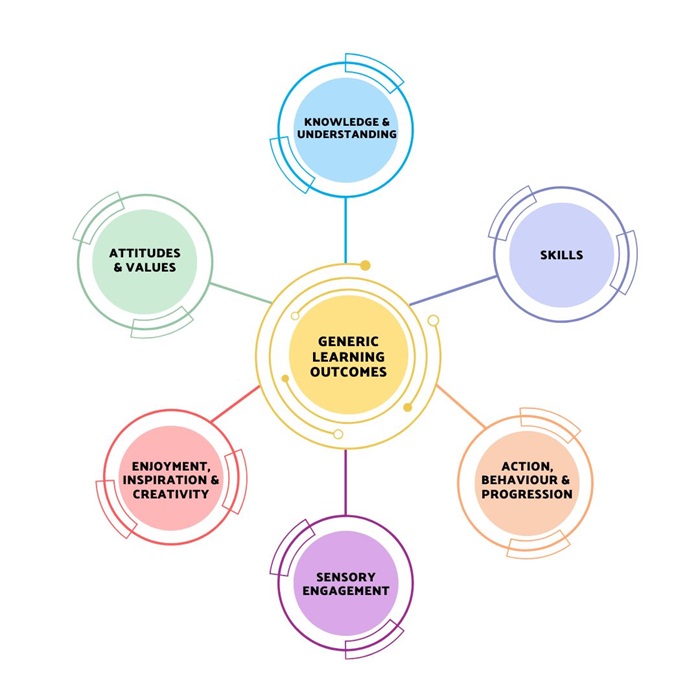
The Group for Education in Museums (GEM), working in partnership with the Research Centre for Museums and Galleries (RCMG) at the University of Leicester, launched a refreshed Generic Learning Outcomes (GLOs) framework in 2026. This marks the next chapter for one of the cultural sector’s most widely used evaluation tools. Originally developed over 20 years ago by RCMG, the framework has been updated to better reflect contemporary museum, library and archive practice while remaining true to its core purpose of evidencing the impact of learning.
Originally established in 2003 with five interconnected areas, the GLOs framework revolutionised the way in which visitors’ experiences are understood by practitioners, government and funders. After more than two decades of implementation and research, it has expanded the traditional understanding of museum, library or archive learning.
The learning experiences offered through museums, libraries or archives are unique: often holistic, bodily engaged activity, supporting participants’ sensory engagement as well as cognitive development. More than that, when it’s done well, the learning experience is embedded through every aspect of the organisation’s work, is open to everyone and should offer something of value for every participant, of any age or ability. The Generic Learning Outcomes framework (GLOs) continues to be a useful tool for museum practitioners supporting them to demonstrate the extent of the impact museum experiences have on all types of learners.
The newly refreshed 2026 GLOs framework represents a significant evolution, expanding to six interconnected categories with the addition of Sensory Engagement. This updated framework reflects contemporary understanding of multisensory learning while enhancing existing areas to emphasize interdisciplinary connections, social-emotional learning, cultural belonging, and inclusive practice.
The framework can be used in a number of ways, including:
For planning: Focussing on addressing several of the six GLO elements as you plan your programme will help you to create formal and informal learning experiences which are open-ended and flexible, and inclusive of different types of learners.
For evaluation: Collecting structured qualitative feedback and mapping it across the GLO elements will enable you to assess the impact of those experiences on different aspects of people’s learning.
You can find out more about the refreshed framework by visiting the GEM website here. You can also download helpful documents with test case studies (1.2MB PDF), examples (255KB PDF), and background information (2MB PDF) on how the framework has been refreshed, alongside document templates (50KB zip file), to show you how you might use the GLOs in your own work.
The refresh was undertaken in partnership with Sam Bowen (SEND in Museums), and Cultural Engagement Consultant Jenni Waugh, as well as being informed by extensive consultation across the museums, libraries and archives sectors. The updated framework was tested by a group of museums, with their experiences captured in a series of case studies that accompany the core GLOs resources.