
Engineering for Innovation and Entrepreneurship MEng
4-5 years
Become the engineer who turns ideas into impact. This integrated Master's degree blends technical engineering with innovation, strategy and entrepreneurship, helping you to design, develop and commercialise engineering innovations and lead in technology-driven industries and start-ups.
Course information

Typical offer ABB

Institute code L34

Taught by School of Engineering

9th in the UK for Engineering (UniCompare, 2027)
Course description
Course description
*Please note this course is currently being advertised subject to approval*
Modern engineering is increasingly about innovation: turning technical possibility into products, services and ventures that create value. Organisations need engineers who can not only work across technical and commercial boundaries but lead at that interface. This integrated master’s degree is designed to develop that capability, taking you beyond a bachelor’s level of study to examine critically how technology, innovation and strategy interact.
The course combines a rigorous engineering foundation with a dedicated core spine in operations, innovation management, business and technology strategy, entrepreneurship and geopolitics. Over four years, it develops the depth of technical knowledge expected of a professional engineer alongside the ability to judge where engineering-led ideas can create value, and how to take them towards commercial reality.
At Leicester, this course is delivered collaboratively by the School of Engineering and the School of Business. Alongside core engineering principles, you will study sustainability, design and project work, building your commercial and organisational understanding year by year. In your third year, you will undertake a substantial individual project under the supervision of an academic, bringing together the knowledge and skills you have developed to address a current engineering challenge or improve an existing product. You will also study entrepreneurship theory and practice, applying opportunity recognition, venture creation and entrepreneurial finance to engineering contexts.
The final year is studied at master’s level. You will take advanced engineering modules and lead an interdisciplinary group project that addresses a real business or societal need, working with complexity, ambiguity and incomplete information as you would in industrial research and development. Alongside this, you will study engineering leadership and geopolitics for business and strategy, critically evaluating how states and firms pursue technological leadership and how global competition shapes strategic decisions in engineering and technology firms.
Teaching combines theory with applied case studies, design activities and real examples from industry and research. Throughout the degree, you will develop skills valued across engineering and technology-driven sectors: solving complex problems, communicating technical and commercial information to specialist and non-specialist audiences, leading multidisciplinary teams, and reflective professional practice.
You can apply for the MEng directly, or transfer from the BEng route during your studies, subject to the usual academic requirements.
Entry requirements
Entry requirements
- A/AS-levels: ABB including Maths. Two AS-levels considered in place of one A-level.
- EPQ with A-levels: BBB + EPQ at grade B. A-level subjects to include Maths.
- GCSEs: Grade C/4 in English Language.
- BTEC Nationals: DDM in Engineering including Further Maths at Distinction.
- International Baccalaureate: Pass Diploma with 30 points, with grade 5 in Maths HL. Must include minimum of grade 4 in English A or 5 in English B if minimum of grade 4/C not held in English Language at GCSE.
- Access to HE Diploma: Pass Engineering Diploma with 45 credits at level 3, 30 of which are at Distinction. To include all level 3 Maths modules at Distinction.
- T Levels: Distinction in either: Design and Development for Engineering and Manufacturing or Engineering, Manufacturing, Processing and Control or Maintenance, Installation and Repair for Engineering and Manufacturing (plus Maths test).
Other official national and international qualifications considered from across the world. You can review some of the qualifications we accept on our countries page and English Language equivalencies.
If your qualification or country is not listed, please contact us for more information, including the name and result of the qualification you have studied.
If you do not meet the entry requirements for this course, you can apply for Engineering with Foundation Year BEng.
Second year entry may be possible with suitable qualifications.
Flexible entry requirements
We welcome applications from motivated students whose predicted grades are slightly below our standard entry requirements. We understand that predicted grades are not always an accurate reflection of your final results, and we’re happy to consider your application. Although we can’t guarantee an offer due to the high volume of applications, if you’re eligible, we may still offer you a place based on our standard requirements.
Contextual offers
The University of Leicester is committed to providing equitable opportunities for all applicants from all backgrounds. We make contextual offers to support students who may be impacted by the area they live in, their personal circumstances or who have completed one of our progression programmes. These offers are usually one or two grades lower than the standard entry requirements. To qualify for a contextual offer, you must apply for an eligible course and meet specific criteria – check if you’re eligible.
Selection process
When considering your application, we will look for evidence that you will be able to fulfil the objectives of the course and achieve the standards required. We will take into account a range of factors including previous exam results.
Interview and maths assessment test may be required. If you receive an offer you will be invited to visit the School.
English Language Requirements
IELTS 6.0 or equivalent. If your first language is not English, you may need to provide evidence of your English language ability.
If you do not yet meet our requirements, our English Language Teaching Unit (ELTU) offers a range of courses to help you to improve your English to the necessary standard.
International Qualifications
Find your country in this list to check equivalent qualifications, scholarships and additional requirements.
Countries listFees and funding
Fees and funding
UK Students
Starting in 2027
For the 2027/28 academic year, the Home UK tuition fee is expected to be £10,050.
Further increases are anticipated to be implemented automatically through government legislation; therefore, it is likely that your tuition fees will rise for each subsequent year of your studies.
Find out more about tuition fees, including year abroad, placement years, scholarships and funding.
International Students
Starting in 2027
Tuition fees for 2027/28 are yet to be confirmed. As an indication of what you might pay, the fees for students who started in 2026/27 were: £25,100 per year.
If you are resident outside the UK and the Republic of Ireland, you will need to pay a deposit to secure your place. This will be subtracted from your total tuition fee.
Find out more about tuition fees, including year abroad, placement years, scholarships and funding.
Careers and employability
Careers and employability
This degree is designed to develop the blend of technical, commercial and entrepreneurial skills that employers increasingly value in engineering-led sectors. Alongside core engineering, you will build transferable skills that apply across any career: communication, teamwork, leadership, problem-solving, planning and organisation, and the enterprising mindset to recognise opportunities and turn ideas into action. These are developed progressively through group design projects, innovation and strategy modules, and substantial individual project work, and are reinforced by 100 hours of employer-informed, work-related learning embedded across the course, including industry-informed briefs, case studies and engagement with industry experts.
The combination of engineering and entrepreneurial thinking opens opportunities across a wide range of professional environments. Graduates may move into areas such as product development, engineering operations, technology consultancy, project management, and innovation or technology management, or apply their skills within engineering-led organisations and start-ups.
You will also benefit from personalised support from the University's Careers and Employability Service and can apply for an optional Year in Industry to gain industrial experience, though places are not guaranteed.
Careers and Employability Service
Get career-ready at Leicester with guidance from our award-winning Careers and Employability Service. We're here to give you a lifetime offer of support, even after graduation. Our team of specialist careers advisers and mentors will help you every step of the way. From supporting you with CVs and interviews, to volunteering opportunities and placements, we’re here to help you reach your professional goals.
Sustainable Development Goals
Sustainable Development Goals
We are committed to providing skills and knowledge to help prepare you tackle global challenges. We have mapped our undergraduate degrees for learning which aligns to the 17 UN Sustainable Development Goals.
This degree includes learning which relates to the following UN Sustainable Development Goals:
- Goal 13: Climate action
Integrated AI
Integrated AI
At Leicester, you will study with full access to Microsoft 365 Copilot through our collaboration with global tech leader, Microsoft. As one of the first Microsoft Frontier Universities in the UK, we are helping to shape how AI is used in higher education and the workplace.
You will build practical, transferable skills that employers value. From analysing information and solving problems to communicating ideas and working collaboratively, you will learn to apply your knowledge in a digital world.
When you graduate, you will leave with more than a degree. You will have the skills and confidence to work with the technologies shaping your future.
100 hours work-related learning
100 hours work-related learning
Your future career starts right here, whilst you study. On all of our undergraduate courses you are guaranteed 100 hours of real, employer‑informed work‑related learning, built directly into your course.
You will gain a range of skills and grow in confidence through a mixture of activities, aligned closely to your subject. This could range from placements, clinics, laboratory work, field work and “real-world” projects such as live briefs, consultancy challenges, simulations, and virtual internships (discipline aligned and interdisciplinary).
By the time you graduate you'll be able to articulate and demonstrate to future employers you have the skills they are looking for as well as the understanding of your subject.


Course structure
Year 1
Year 1
Core modules
- Engineering Mathematics with programming 1
- Solid Mechanics
- Principles of Electrical Engineering
- Engineering Mathematics with programming 2
- Fluid Mechanics
- Thermodynamics and Heat Transfer
- Sustainable Engineering Design
- Digital Electronics and Communications
This is the same as the first year of the BEng.
The modules listed reflect those currently available to students starting in the next intake and may differ from the modules available to current students. Every year, we review our modules and their content to ensure that our courses maintain the best academic and student experience possible. Whilst this does mean elements of your course may change in future academic years, it ensures your course is giving you a research-inspired education and preparing you for your future.
Year 2
Year 2
Core modules
- Engineering Management
- Mechatronics
- Materials and Structures
- Operations Management
- Computational Engineering Methods
- Electric Machines and Drives
- Integrated Engineering Design
- System Dynamics and Control
This is the same as the second year of the BEng.
The modules listed reflect those currently available to students starting in the next intake and may differ from the modules available to current students. Every year, we review our modules and their content to ensure that our courses maintain the best academic and student experience possible. Whilst this does mean elements of your course may change in future academic years, it ensures your course is giving you a research-inspired education and preparing you for your future.
Year Abroad or in Industry (optional)
Year Abroad or in Industry (optional)
If you want to, you can spend the third year of the MEng studying abroad at one of our partner institutions or working in an industrial placement. Alternatively, you can opt to continue studying at the University and complete your degree in four years.
Year Abroad
We’ll make sure you have everything you need for your future career: not just by awarding you a high quality degree, but also by helping you to develop the skills, knowledge and confidence you need to make your mark in the world as a Citizen of Change. One way you can do this is by opting to take a Year Abroad between Years 2 and 3 of your degree.
Studying abroad is not just for people who are interested in travelling and meeting new people. It is about acquiring life skills that are becoming increasingly significant for a wide range of jobs in our modern globalised society. Whether you go on to a career in the private, public or third sector - or plough your own furrow as an entrepreneur – you will find the experience invaluable.
For more information, including a list of destinations, please visit our Study Abroad website.
Please note
- A year spent abroad still incurs a tuition fee, but this is much lower than for a normal year at Leicester. See the Fees and Funding tab of this page for details.
- You may be eligible for a travel grant from Student Finance England.
- Places are offered on a competitive basis, and eligibility is dependent on your academic performance in Years 1 and 2.
- Language courses, at beginners or advanced level, are available through our Languages at Leicester scheme.
Year in Industry
If you choose a 'With Industry’ degree you will spend a year on an industrial placement with a sponsoring company between your second and third years at Leicester. You will undertake a programme of training and practical experience that is agreed between the sponsoring company and the University. Recent placements have included: Rolls-Royce, Force India F1 Team, Ford Motors, Intel UK, Network Rail, Porsche Engineering Services, Aero Engine Controls, Babcock International, Auto Electrical Services and Jaguar Land Rover.
A member of staff will be individually assigned to you as your industrial placement tutor, who will be in contact with you throughout your placement and will visit the sponsoring company. During the year you will return to Leicester to present details of your placement to other students studying for 'With industry' degrees.
A year in industry is a great opportunity which can give you first-hand experience of working in an engineering-related career while also enhancing your employability skills and allowing you to network with people in industry.
A year in industry still incurs a tuition fee, but this is much lower than for a normal year at Leicester. See the Fees and Funding tab of this page for details.
The modules listed reflect those currently available to students starting in the next intake and may differ from the modules available to current students. Every year, we review our modules and their content to ensure that our courses maintain the best academic and student experience possible. Whilst this does mean elements of your course may change in future academic years, it ensures your course is giving you a research-inspired education and preparing you for your future.
Year 3/4
Year 3/4
In your third year (or fourth year if you take a year out) you have a wide choice of option modules in which to specialise in your particular interests across the School. Your individual project is a significant part of this year, giving you the opportunity to investigate a specific engineering concept or challenge.
Core modules
- The Management and Shaping of Innovation
- Entrepreneurship Theory and Practice
- Machine Learning for Engineers
Plus your Individual Project
Option modules
Choose two option modules from:
Then choose one option module from:
This is the same as the final year of the BEng.
The modules listed reflect those currently available to students starting in the next intake and may differ from the modules available to current students. Every year, we review our modules and their content to ensure that our courses maintain the best academic and student experience possible. Whilst this does mean elements of your course may change in future academic years, it ensures your course is giving you a research-inspired education and preparing you for your future.
Final Year
Final Year
Project work forms a substantial part of your final year mark, reflecting your development into an engineering professional. Your group project will give you the freedom to investigate an engineering challenge, often alongside students from other engineering subjects. Alongside this you will consider the business elements of engineering, such as leadership and project management, and have the opportunity to take further specialist modules.
Core modules
- Systems Engineering
- Geopolitics for Business and Strategy
- Signal Processing
- Leadership and Project Management
Plus your Group Project
Option modules
Choose one option module from:
Then choose one option module from:
The modules listed reflect those currently available to students starting in the next intake and may differ from the modules available to current students. Every year, we review our modules and their content to ensure that our courses maintain the best academic and student experience possible. Whilst this does mean elements of your course may change in future academic years, it ensures your course is giving you a research-inspired education and preparing you for your future.
Why Leicester?
A shared first year allows you to swap between any of our Engineering degrees at the start of Year 2, providing flexibility.
Study one of the few UK engineering courses built around innovation and entrepreneurship.
Benefit by learning from experts in different fields, with engineering taught by the School of Engineering and innovation, strategy and entrepreneurship taught by the School of Business.
Graduate with a strong technical engineering foundation, 100 hours of work-related learning, and the innovation and entrepreneurial skills to work across technology-driven industries and start-ups.
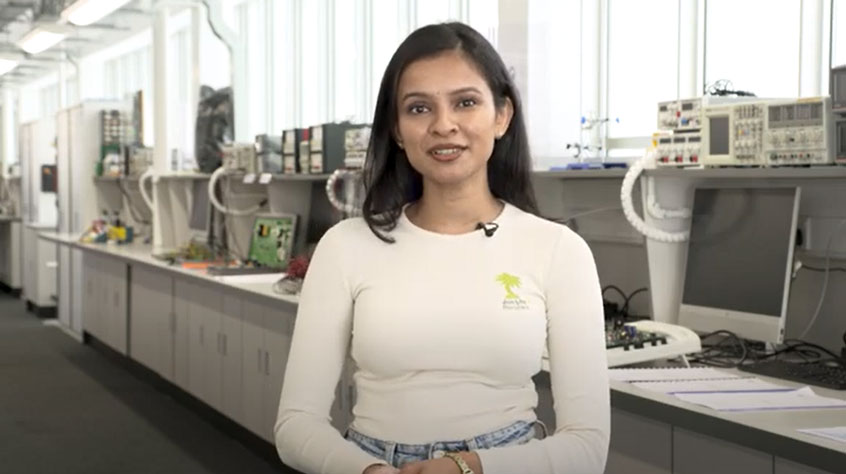
Engineering at the University of Leicester
Teaching and learning
Teaching
Teaching includes lectures and lab classes together with tutorials. For the practical aspects of the course you will work, with a partner or as part of a small team, in our well-equipped engineering labs. On your final year project you will work individually under the supervision of an academic member of staff.
Assessment
Continuous assessment of your experimentation, computing, design and project work will contribute about 30-50% of your overall mark, with the rest based on your performance in exams for each module. You will also be expected to give presentations about your work.
Independent learning
When not attending lectures, seminars or other timetabled sessions you will be expected to continue learning independently through self-study. Typically, this will involve reading journal articles and books, working on individual and group projects, undertaking research in the library, preparing coursework assignments and presentations, and preparing for exams. To help with your independent learning, you can access the Library and our social study spaces in halls of residence.
Academic support
Our Centre for Academic Achievement provides help in the following areas:
- study and exam skills
- academic writing
- presentations
- dissertations
- numerical data skills
- referencing sources
Our AccessAbility Centre offers support and practical help for students with dyslexia or other specific learning difficulties, including physical, mental health or mobility difficulties, deafness, or visual impairment.
Teaching staff
You will be taught by an experienced teaching team whose expertise and knowledge are closely matched to the content of the modules on the course. PhD research students who have undertaken teacher training may also contribute to the teaching of seminars under the supervision of the module leader. Our teaching is informed by the research we do. You can learn more about our staff by visiting our staff profiles.
Apply now
| Course | Qualification | Duration | Availability |
|---|---|---|---|
| Course Engineering for Innovation and Entrepreneurship | Qualification MEng | Duration 4 years full-time | Availability Find out more |
| Course Engineering for Innovation and Entrepreneurship with Year Abroad | Qualification MEng | Duration 5 years full-time | Availability Find out more |
| Course Engineering for Innovation and Entrepreneurship with Year in Industry | Qualification MEng | Duration 5 years full-time | Availability Find out more |


The Department’s close links with industry mean I can do projects relevant to the research happening in industry today.