Over €2 million EU funding for Leicester scientists to explore the giant planets with JWST
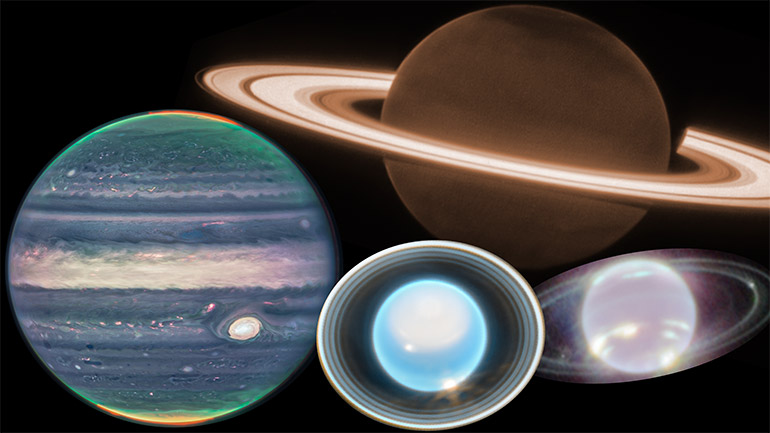
Credit: NASA, ESA, CSA, STScI, Image Processing: Joseph DePasquale (STScI), Montage: Leigh Fletcher (Univ. Leicester)




University of Leicester scientists will turn the James Webb Space Telescope (JWST) onto the giant planets of our solar system, in a project that aims to recapture the spirit of the pioneering Voyager missions.
The European Research Council (ERC) has today (23 June) announced the winners of its latest Advanced Grant competition. The funding, worth €838 million, will go to 319 leading researchers across Europe. The Advanced Grants give senior researchers the opportunity to pursue ambitious, curiosity-driven projects that could lead to major scientific breakthroughs. The grants are part of the EU’s Horizon Europe programme and with a 9.6% success rate for proposals, are extremely competitive.
‘JWST as the New Voyager: A Chemical Inventory of the Giant Planets’ is a new five-year project led by Professor Leigh Fletcher of the University of Leicester’s School of Physics and Astronomy, one of 62 UK-based researchers to receive this award and one of only 13 awarded by the ‘Universe Sciences Panel’. This prestigious award brings €2.5 million from the ERC to support Fletcher and a team of planetary science researchers.
Next year marks the 50th anniversary of the launches of the Voyager spacecraft, which completed flybys of Jupiter, and of Saturn and its moon Titan, while Voyager 2 sailed on to encounter Uranus and Neptune in the 1980s, as part of a ‘Grand Tour’ of the outer planets of our solar system.
Now, Fletcher’s project will use JWST as a ‘New Voyager’ to construct a comprehensive chemical inventory of the giant planets Jupiter, Saturn, Uranus and Neptune. Taking advantage of the telescope’s exceptional spectroscopic capabilities and sensitivity, they aim to open a window into the hidden depths of the atmospheres of the giant planets to understand the processes that shape their bulk composition, climates, and weather patterns.
By analysing the composition of our distant planetary neighbours we can learn more about the dusty, icy, and gaseous materials from which the planets of our solar system originally formed. For Jupiter, the programme will help scientists better understand the giant planet’s shifting climate, enlisting observations from JWST, NASA’s Juno spacecraft. and ground-based telescopes to develop a ‘weather forecast’ ahead of the arrival of ESA’s Jupiter Icy Moons Explorer (Juice) in 2031, for which Fletcher serves as Interdisciplinary Scientist for the mission.
Data from all three spacecraft will be used to test our understanding of the giant planet circulation and meteorology that creates the colourful stripes that can be readily seen through telescopes. Indeed, Fletcher’s research programme frequently engages with amateur astronomers turning their telescopes to these giant worlds, providing valuable support to the spacecraft observations.

Professor Leigh Fletcher of the School of Physics and Astronomy at the University of Leicester.
The ERC grant also coincides with a new five-year programme to monitor Uranus with JWST as it approaches northern summer solstice in 2030, a unique moment in the seasonal cycle that occurs once every 42 years. Both projects are led by Professor Leigh Fletcher of the School of Physics and Astronomy at the University of Leicester and will inform one another.
Professor Fletcher said: “I’m so grateful to the European Research Council for supporting this ambitious research programme. Over the past four years, JWST has become a cornerstone in the current phase of planetary exploration, and of our work here in Leicester. This new award, alongside our 5-year JWST programme for the Uranian system, is a dream come true, unlocking tremendous possibilities for new discoveries, and I can’t wait to get started.”
Professor Richard Thomas, Pro Vice-Chancellor for Research and Enterprise at the University of Leicester, said: “This prestigious European Research Council award is another recognition of the world-leading research environment at Leicester, and of Professor Fletcher’s exceptional leadership in planetary science. The project exemplifies the ambition, creativity and international collaboration that define frontier research, using cutting-edge facilities like the James Webb Space Telescope to address fundamental questions about our solar system. It is particularly fitting that Leicester will play such a central role in a programme, building on our 65-year heritage in space missions and echoing the transformative impact of the Voyager missions, to push the boundaries of discovery for a new generation.”
President of the European Research Council, Professor Maria Leptin, said: “The new Advanced Grant projects demonstrate the creativity, ambition, and intellectual boldness that frontier research requires. The ERC’s role is to support researchers who are asking difficult scientific questions and want to venture into unexplored territory in pursuit of new knowledge. Congratulations to all our new grantees. They are of 33 different nationalities - testament to Europe's strength as a destination for outstanding scientific talent, regardless of origin. We need to step up investment for Europe to lead in science and innovation.”