Space kit for future away missions tested in Scotland
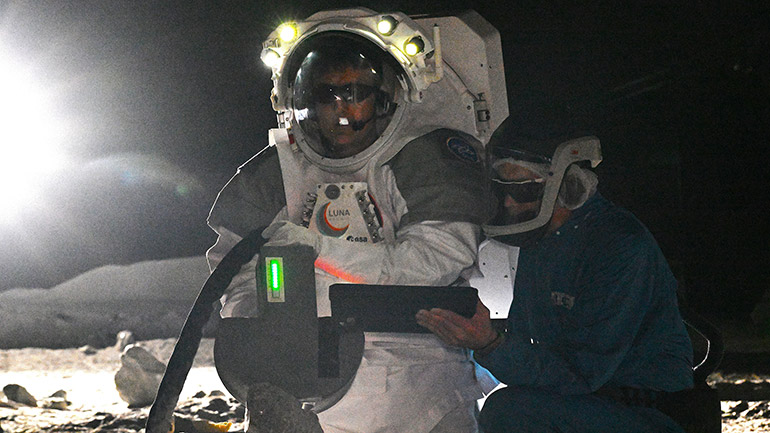




UK scientists have been testing cutting edge equipment for the astronaut ‘away teams’ of the future.
Researchers from the University of Leicester and the University of Aberdeen have carried out a series of field demonstrations in Portsoy, Scotland to test cutting-edge handheld analytical instruments.
Designed for use by astronauts on the Moon, and eventually Mars, these would support them in working as field scientists when exploring these worlds.
The campaign focused on an advanced portable spectrometer developed by the University of Leicester team in collaboration with INTA (Spain), Mission Control (Canada) and University of Valladolid (Spain) as part of the European Space Agency funded PHOENIX programme. Through this programme, two scientific handheld devices have been developed that combine multiple analytical techniques to enable rapid identification of rocks and minerals during future human exploration missions.
Built with spacesuit ergonomics in mind for astronauts working on the lunar and martian surface, these spectrometers have been supported by ESA’s ExPeRT (Exploration Preparation, Research and Technology) team and the CAVES & PANGAEA teams within ESA’s Human and Robotic Exploration directorate. While PANGAEA’s primary mission is to give astronauts the fundamental knowledge and training they need to act as field scientists on the Moon and Mars, it also plays a key role in helping engineering teams trial new exploration technologies such as those developed under PHOENIX.
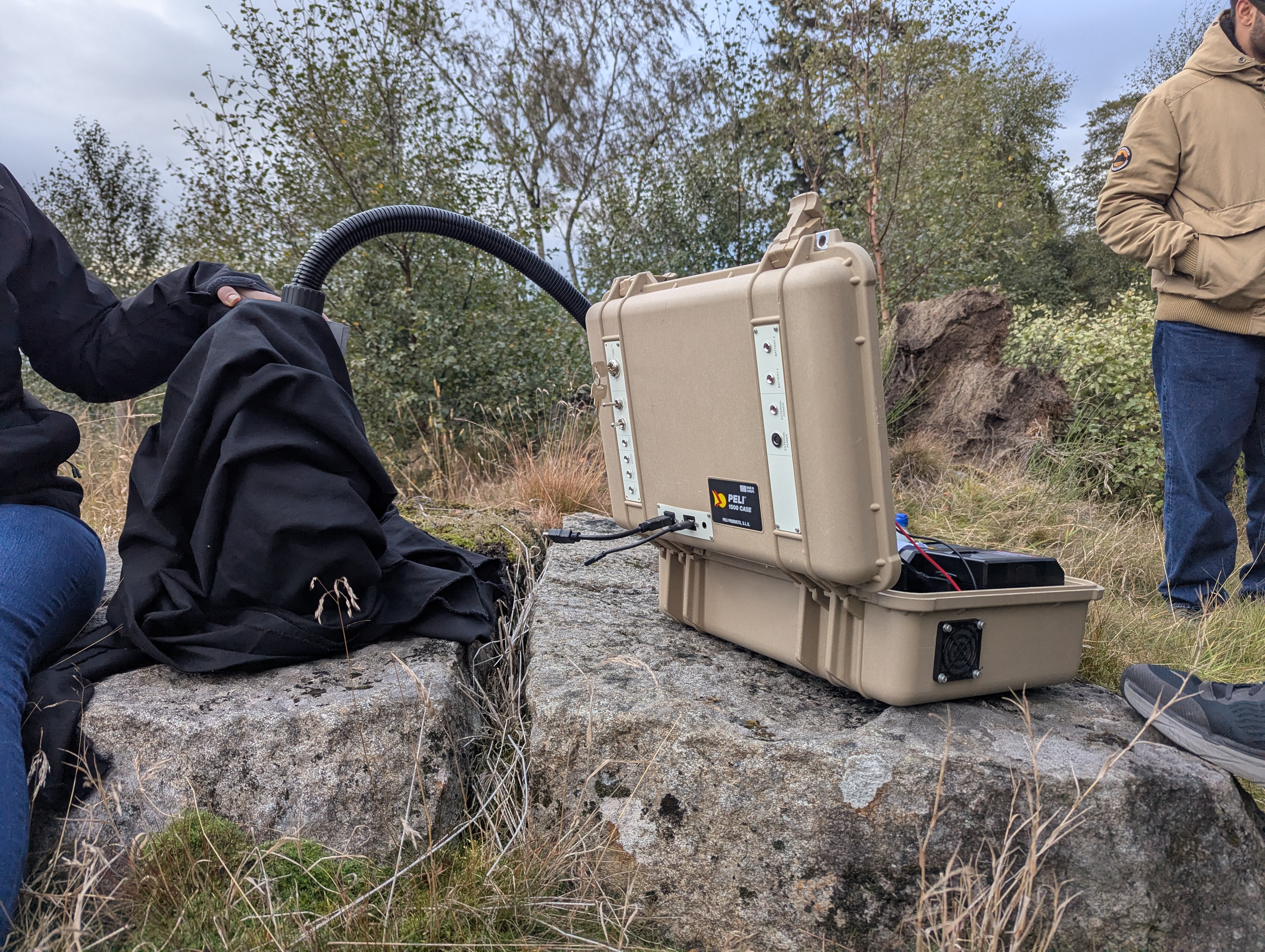
The portable spectrometer (built by the teams to train astronauts) being tested in locations in Scotland that resemble the lunar surface.
During their fieldwork in Scotland, the university researchers simulated lunar exploration scenarios, using the handheld instruments to analyse rocks directly in the field. The tests demonstrated how astronauts could use flight-ready versions of tools to quickly assess geological samples, search for resources, and identify signs of past water activity without the need to return samples to Earth in upcoming human lunar missions.
Portsoy was selected as the test site due to its uniquely diverse geology, which closely resembles the composition of the lunar surface. The area contains a rare combination of rock types, mirroring those found on the Moon and making it an ideal natural laboratory for validating space technologies.
Dr Hannah Lerman from the University of Leicester School of Physics and Astronomy said: “We are moving ever closer to astronauts setting foot on the Moon again, and when they get there, they will need the tools to gather as much insight as they can into the type of resources available on the moon. By taking our technology into real-world analogue environments like Portsoy in Scotland, we can optimise the instrument’s performance, usability, and scientific output in readiness for exploration on the Moon and beyond.
“This collaboration showcases UK’s leading role in developing next-generation space instrumentation, bridging laboratory innovation with field-based testing to support humanity’s return to the Moon.”
The work builds on recent international demonstration campaigns, including trials at the DLR-ESA LUNA Analog Facility in Germany, where the PHOENIX spectrometers were successfully evaluated under controlled Moon-like conditions. LUNA is jointly operated by the German Aerospace Center (Deutsches Zentrum für Luft- und Raumfahrt; DLR) and ESA in Cologne.