University of Leicester experts take climate research to the world stage at COP31
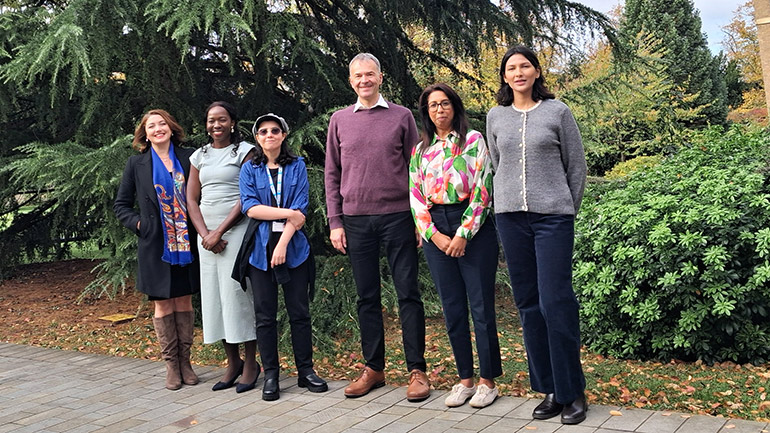
University of Leicester staff involved in COP31 this year, including (L-R) Dr Ayse Yildiz, postgraduate student Fiona Imbali, Dr Nezha Acil, Professor Heiko Balzter, Heena Curtis and Dr Asima Khan.


A delegation of climate experts from the University of Leicester will take research spanning Earth observation, sustainable land management, climate resilience, green finance and food security to COP31.
Nine Leicester researchers will contribute to exhibitions, panel discussions and events, including in the conference’s Blue Zone, presenting practical ways in which science, finance and digital innovation can support global climate action.
This year, COP31 (31st Conference of the Parties) takes place in Antalya, Türkiye, from 9 to 20 November. It is the latest session of the supreme decision-making body of the United Nations Framework Convention on Climate Change (UNFCCC) and the world’s foremost forum for international negotiations on climate change.
Professor Heiko Balzter, Director of the University’s Institute for Environmental Futures, will join the Space for Climate Action exhibit during the second week of COP31. The exhibit will demonstrate how observations from space can identify systematic changes in the climate and environment, support the Paris Agreement and turn regional and global environmental data into practical evidence for decision-makers.
He will also moderate a Higher Education Pavilion event on co-designing environmental digital twins for climate action. The session will bring together representatives from higher education, government, industry, agencies and youth organisations to explore how Earth observation, artificial intelligence and digital modelling can produce actionable intelligence for governments, businesses and communities.
Professor Balzter, Director of the University of Leicester Institute for Environmental Futures, said: “Universities and other research and innovation organisations are hugely important as accelerators of climate action in support of the Paris Agreement. The research that we do and our co-development of solutions with policy and businesses enable faster progress towards a more resilient future. As Citizens of Change we contribute to emission reductions and enhancing removals of greenhouse gases as well as adaptation to already committed climate change impacts. I am proud of the wide range of expertise that the University of Leicester delegation is bringing into the beating heart of the COP31 climate summit - from green finance to satellite Earth observation, from improving climate resilience for young people to genetics of farm animals and crops.”
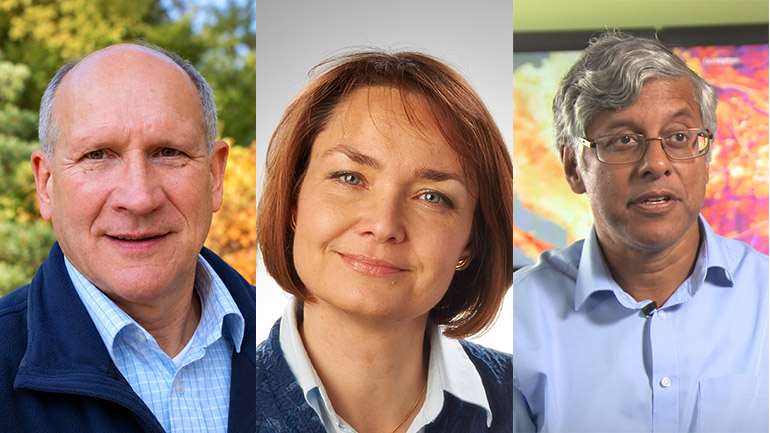
Professor Pat Heslop-Harrison from the Department of Genetics and Genome Biology, Professor Ania Zalewska from the School of Business, and Professor John Remedios from the National Centre for Earth Observation
Also heading to the conference will be Professor Pat Heslop-Harrison from the Department of Genetics and Genome Biology, who will be presenting a 90-second film ‘Science into Action for Net Zero: Agriculture, Adaptation and Mitigation’ which has been selected for screening at the British Pavilion as part of a rotating programme of around 20 videos. It will make the case for placing science at the heart of climate adaptation and mitigation, demonstrating how research can help farmers produce reliable food while responding to changing growing conditions, pests and diseases.
Professor Ania Zalewska from the School of Business, Director of the Centre for Finance, Governance and Sustainable Growth and lead for the Green Finance Thematic Advisory Group at the Land Use for Net Zero, Nature and People Hub, investigates how financial markets, institutions and regulation can support climate mitigation and adaptation. She will highlight the need to combine public and private resources, expertise and incentives so that investment in natural capital can become viable at scale.
Professor John Remedios, from the School of Physics and Astronomy and Director of the National Centre for Earth Observation, is supporting the agenda around the use of systematic observations to provide information on global climate, hazards and risks which could be mitigated by early warning, and assessments of mitigation and adaptation responses from physical satellite data sets. He will be highlighting the latest satellite information on methane, urban heat islands and extreme events alongside plans for future satellite missions.
Research Associate at the National Centre for Earth Observation and Fellow of the Institute for Environmental Futures, Dr Nezha Acil, specialises in biodiversity conservation, optical remote sensing and global forest dynamics. Her current research models changes in forest biomass as an indicator of global carbon fluxes, and she will showcase Leicester’s work in the Blue Zone alongside colleagues from the European Space Agency.
Dr Asima Khan from the School of Chemical, Earth and Environmental Sciences develops environmental digital twins that use geospatial artificial intelligence to give land managers data-driven support for net-zero delivery and sustainable land management. She will help present Leicester’s Digital Twin for sustainable land management at the Space for Climate Action exhibit and contribute to a Higher Education Pavilion panel exploring how universities, governments, young people and industry can co-design digital twins for climate action.
Dr Ayse Yildiz, Assistant Professor in Risk in the University of Leicester School of Business and a Fellow of the Institute for Environmental Futures, researches how knowledge about climate and disaster risk can be turned into decisions that protect lives. At COP31, she will convene and moderate the official Blue Zone side event ‘Children and Youth at the Frontline of Climate Resilience’, bringing together young people, researchers and civil society to examine how children’s experiences can inform climate adaptation and disaster preparedness.
Postgraduate student Fiona Imbali from the School of Chemical, Earth and Environmental Sciences researches how Earth Observation data is communicated to farmers, and why it so often fails to reach them. Her transdisciplinary study looks at two case studies: West Pokot, Kenya, with the Fens in the UK, examining the accessibility, usability and co-creation of climate information, and how satellite data and indigenous knowledge systems can complement each other to enhance climate resilience and food security. She will attend COP31 to connect with organisations using Earth Observation data across Africa, to understand their challenges and discussions on early warning systems across various thematic groups and to support her colleagues in the side events.
Postgraduate student Mateus de Souza Macul, also from the School of Chemical, Earth and Environmental Sciences, focuses on Earth Observation, tropical forest dynamics, and land-use change in the Amazon. He will be attending COP31 as part of the University delegate team, supporting their exhibit stall and tracking developments in the Tropical Forest Forever Facility (TFFF) finance mechanism, zero-deforestation roadmaps, and Article 6 carbon mechanisms across key thematic pavilions, official negotiations and side events.
Dr Tim Neff, Lecturer in Journalism in the School of Arts, Media and Communication and CSSAH Director of Sustainability, will once again be attending COP and writing about side events that take place during the summit. His participation deepens his research on media and environmental issues and enables his students to ask front-line journalists about their work during COPs, which he has attended since 2018. He has covered the conference as a writer for Earth Negotiations Bulletin since COP27 in 2022.
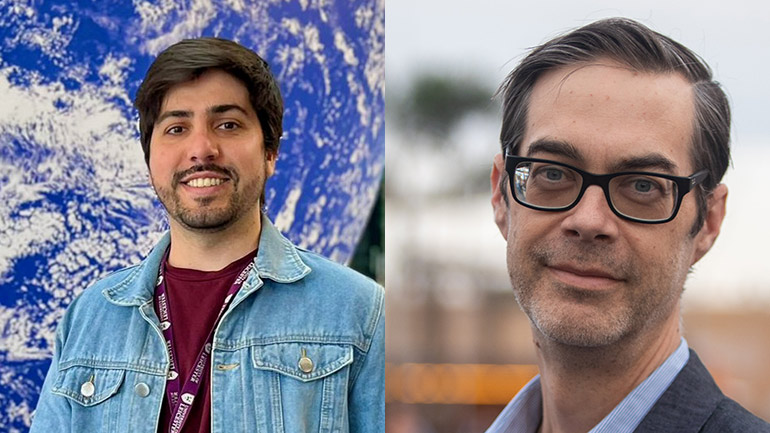
Postgraduate student Mateus de Souza Macul from the School of Chemical, Earth and Environmental Sciences, and Dr Tim Neff from the School of Arts, Media and Communication.