Space Park Leicester welcomes Government space Minister to world-leading facilities
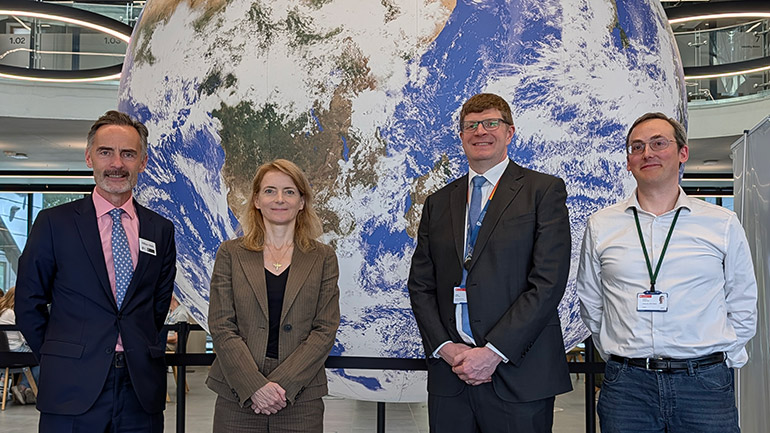




Space Park Leicester recently hosted a Government science Minister for a tour and showcase of its cutting-edge facilities and out-of-this-world achievements.
Baroness Lloyd of Effra CBE, Parliamentary Under-Secretary of State in the Department for Science, Innovation and Technology, made a visit to the University of Leicester’s £100 million space research and innovation hub on Monday 6 July, as part of a tour of leading local space organisations.
Beginning with a visit to University of Leicester spin-out Perpetual Atomics, the Minister’s tour then took in Space Park Leicester followed by the National Space Centre, which marked 25 years since its launch last week. The National Space Centre is one of many attractions taking part in the Great British Summer Savings scheme, a government initiative cutting VAT on days out to help families make memories for less this summer.
On arrival the Minister was welcomed by Will Wells, CEO of Space Park Leicester, and was accompanied on her visit by Dr Adrian Martindale, Head of Space Project Instrumentation; and Nicola Deards, Project Manager for the Midlands Space Cluster.
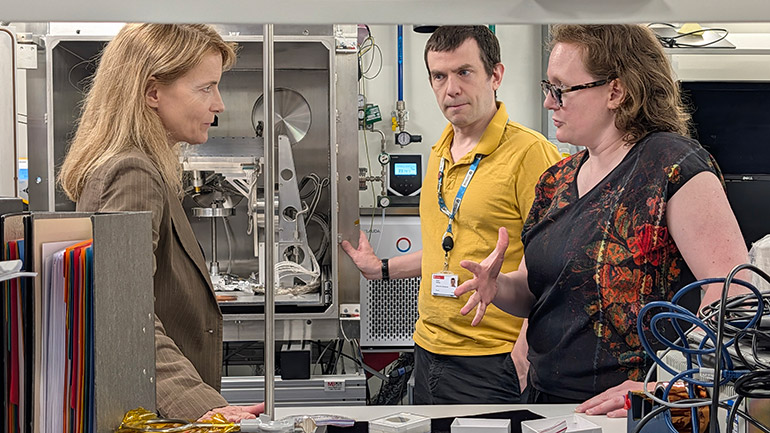
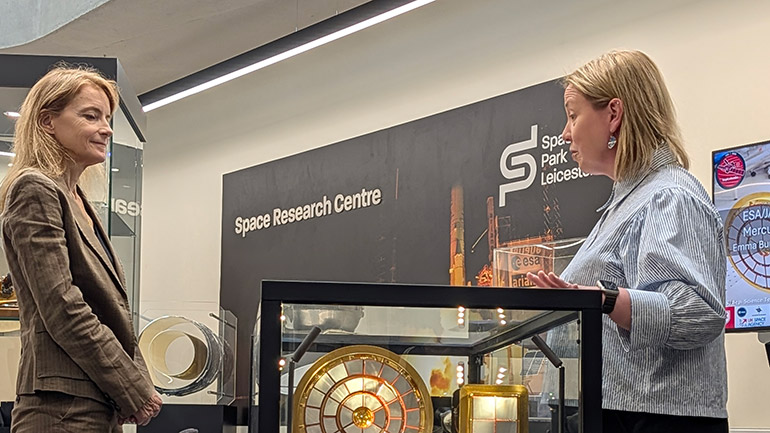
During a tour of Space Park Leicester’s facilities, the Minister learnt about the University’s involvement in high profile space missions such as the ESA/JAXA BepiColombo mission that is due to arrive at Mercury this year. Professor Emma Bunce, Director of the Institute for Space, detailed Leicester’s leading role in the Mercury Imaging X-ray Spectrometer (MIXS) which promises unprecedented X-ray observations of Mercury and its environment.
The University’s role in the Solar Wind Magnetosphere Ionosphere Link Explorer (SMILE), a joint mission between the European Space Agency (ESA) and the Chinese Academy of Sciences (CAS), was also discussed. The Soft X-ray Imager (SXI), a wide-field X-ray telescope that uses micropore optics to spectrally map the location, shape, and motion of Earth’s magnetospheric boundaries, is the first instrument to be delivered using facilities at Space Park Leicester.
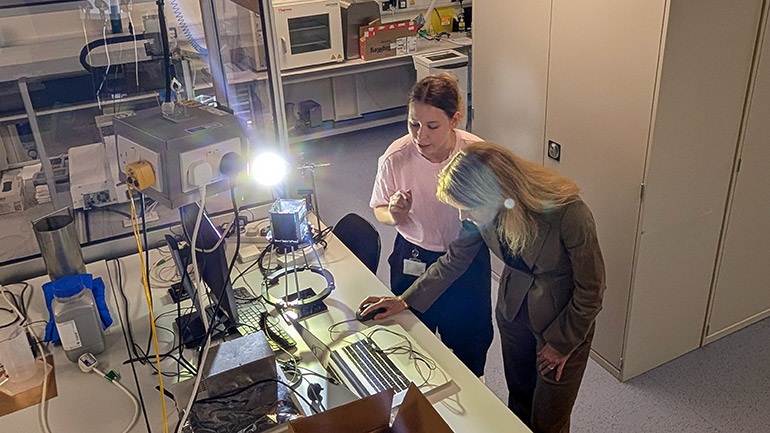
The Minister also viewed the Electronics Workshop, where one recent project saw Leicester scientists working with colleagues at the University of Exeter and funded by the UK Space Agency to launch a crew of microscopic worms to the International Space Station. They designed and built a miniature space laboratory called a Petri Pod that will allow scientists on Earth to study biological organisms in space to help better understand how humans can travel through space safely.
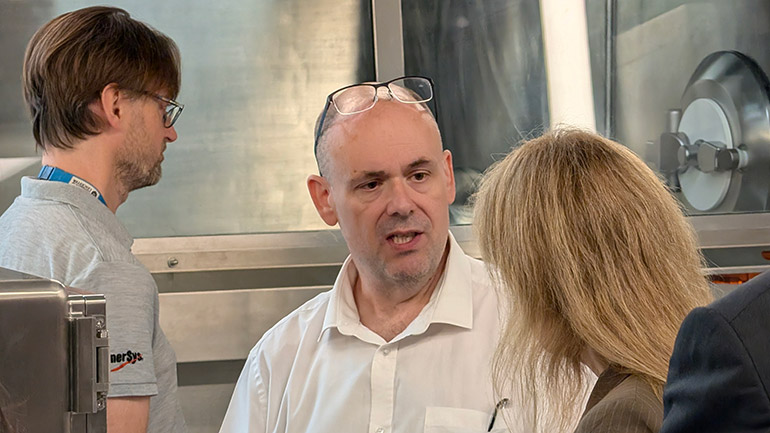
Space Minister Liz Lloyd said: “Space Park Leicester shows how scientific excellence can drive economic growth. This £100 million hub is creating high-skilled jobs, attracting global partnerships, and helping position the Midlands at the heart of the UK’s growing space economy.
“Alongside it, the National Space Centre is helping to inspire families this summer by taking part in the government's Great British Summer Savings Scheme, making days out more affordable. Together, they show how space can grow the economy, spark ambition in young people and open up opportunity.”
Will Wills, CEO of Space Park Leicester, said: “We were delighted to have the opportunity to host Baroness Lloyd at Space Park Leicester and to showcase how the University and city are driving forward the UK space sector. Our presence can be seen in projects in our own planetary orbit such as SMILE, to either ends of our solar system in the BepiColombo mission to Mercury and ESA’s Jupiter Icy Moons Explorer. And with exciting developments in space nuclear power systems from our spinout Perpetual Atomics, Leicester is playing a pivotal role in the UK’s space ambitions.”