New satellite to give global view on Earth’s ‘magnetic shield’, thanks to Leicester-built telescope
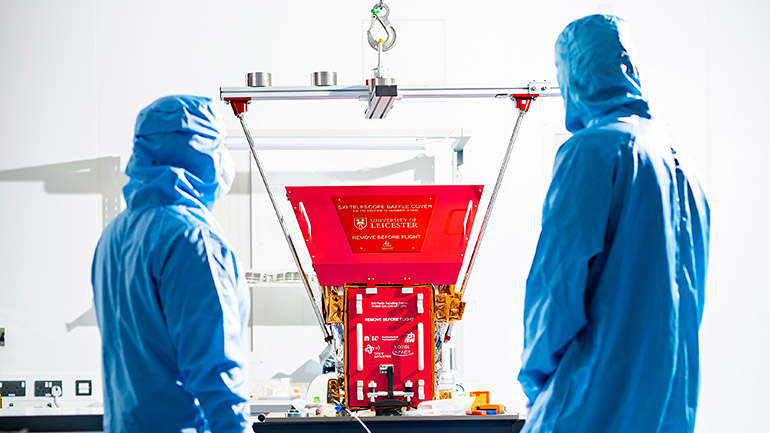
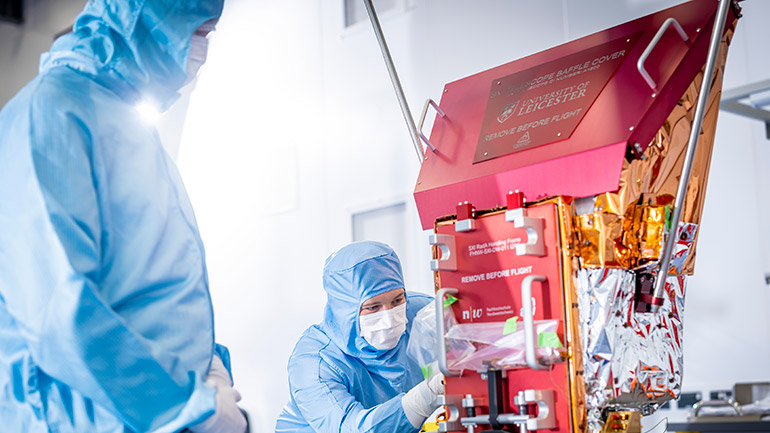
Soft X-ray Imager (SXI) at Space Park Leicester.




Space scientists at the University of Leicester are eagerly awaiting the launch of a new satellite that promises to reveal the inner workings of the Earth’s ‘magnetic shield’ that protects us from our Sun’s radiation.
The Solar Wind Magnetosphere Ionosphere Link Explorer (SMILE) is planning to study how the solar wind, a high energy particle stream from our sun, interacts with the earth's magnetic environment. Among the range of instruments on board is the Soft X-ray Imager (SXI), a wide-field X-ray telescope led by the University of Leicester that uses micropore optics to spectrally map the location, shape, and motion of Earth’s magnetospheric boundaries.
It is the first instrument to be delivered using facilities at the University’s £100 million research, innovation and teaching hub, Space Park Leicester.
SMILE is a joint mission between the European Space Agency (ESA) and the Chinese Academy of Sciences (CAS) and is slated to be launched from Kourou, French Guiana on Thursday 9 April. It is set to give humankind its first complete look at how Earth reacts to streams of particles and bursts of radiation from the Sun.
The solar wind travels at a million miles per hour from the sun towards Earth, which is protected by its magnetic field like a kind of bubble. SMILE is going to take the first long duration images of this interaction and reveal how the protective shield of our magnetic field changes in shape and orientation as the solar wind blows stronger or weaker.
Interactions between the solar wind and the magnetic field are the cause of space weather such as the spectacular displays of the Northern Lights, or Aurora Borealis. Space weather also brings potential risks such as radio blackouts, disruptions to satellites and power grid failures.
Dr Jenny Carter from the University of Leicester School of Physics and Astronomy said: “SMILE is a mission that's going to revolutionise our idea of near-Earth space and how the solar wind interacts with Earth's magnetic field. At the moment in the solar terrestrial physics field we often send spacecraft into one particular point to take what's called an in situ measurement around the spacecraft. By taking an image, you've got this instantaneous global picture about what's going on, and that's a real novel way of looking at the system. The kind of the revolution that SMILE is going to bring to the field of solar terrestrial physics is that instantaneous cause and effect that we're going to get by using two cameras.”

The SXI has been developed and built in collaboration between the University of Leicester, Mullard Space Science Laboratory (MSSL) and the Open University within the UK and several institutions across Europe. The UK Space Agency has supported the delivery of this instrument with approximately £13m of funding, building on the agency’s mission to invest in cutting-edge technologies and world class science that bring the benefits of space back to citizens on Earth.
Andy Cheney, principal engineer for space projects and instrumentation at Space Park Leicester, said: “The SXI is different from anything we previously developed, mainly because of the size and complexity of the instrument. We've got 12 different subsystems from teams across Europe and the US and we've had to design and develop and maintain interfaces between those to make sure everything's compatible. We have a history of building instruments for X-ray astronomy, but SXI is by far the most complex. It's loaded with technology and features that are needed for its unique mission environment.
“A really exciting part of the mission is that we will have a data centre here at the University of Leicester, which means that we'll have first access to the data products that come from the instrument and from the spacecraft. So there will be a team of engineers and operations mission scientists on site and we'll be looking at that data as it comes down first-hand.”
Dr Steven Sembay, SMILE SXI Principal Investigator at the University of Leicester, said: “At Leicester, we have a long heritage in developing a particular type of X-ray optics called micropore optics. For the type of science that we want to do, we want to take a global image of the interaction of the solar wind with the Earth's magnetic field and we need a wide field of view which these ‘lobster-eye' micropore optics allows us to do, while still keeping the instrument lightweight.
“To build an instrument like this, you need world-class facilities. You need advanced clean rooms, you need advanced equipment, and you also need very skilful people. And Space Park Leicester brings all of these things together. Space Park Leicester is a facility which fundamentally integrates the academic science aspirations of the University with also building collaborations with industrial partners.”