To settle harsh environments, early humans needed friends – new findings
Credit: Kyra Pazan, California State University, Stanislaus




Archaeologists have identified the earliest sustained human occupation in highland southern Africa, and suggest it evidences collaborative and organizational behaviors at just the time when we were becoming humans.
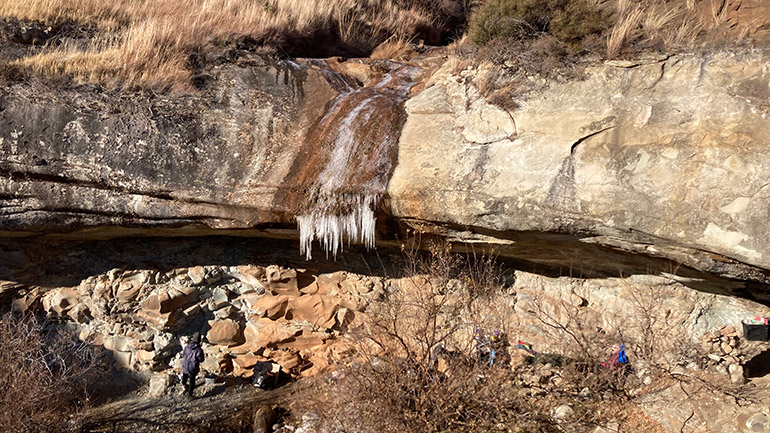
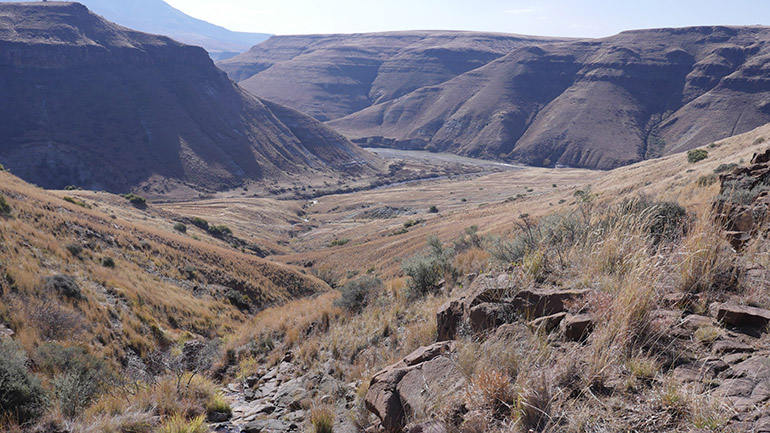
Researchers from the University of Leicester, University of Michigan and California State University, Stanislaus, have discovered that a rock shelter in the highlands of Lesotho, a tiny country enveloped by South Africa, was occupied by humans as early as 242,000 years ago. This coincides with the time that Homo sapiens began to emerge and more than triples the age of similar sites in the region. The finding is also significant because the higher elevation of this site means humans traveling to the shelter would have successfully navigated harsh winter conditions.
Their findings are published in Archaeological and Anthropological Sciences, and were supported by the National Science Foundation and CSU, Stanislaus.
While the earliest occupations of the site were ephemeral—humans appeared to be visiting seasonally and were not staying long enough to build fires, or visiting during times they weren't needed—the rock shelter became more frequently occupied over the next 200,000 years. Occupation of the site appears to intensify during a warm period 130,000 years ago, but also continued through about 90,000 years ago, during one of Earth's ice ages.
Dr Andrew Carr from the University of Leicester worked on the dating of the site, with samples analysed at Leicester’s luminescence dating laboratory. The Optically Stimulated Luminescence (OSL) dating technique was used to determine the burial age (the time elapsed since last daylight exposure) of the sediments deposited with and around the archaeology. These samples are far too old to be dated using more routine methods like radiocarbon dating, which is limited to less than 50,000 years and covers only a very small part of human history.
Dr Carr, from the University of Leicester School of Geography, Geology and the Environment, said: “When we analysed the deepest deposits, it was clear from the first measurements that this was a really significant site of considerable antiquity. Establishing the site age range was vital, as it demonstrated that the earliest - and probably briefer - occupations of the site were significantly older than later phases, by which time people appeared to be better prepared to live in this tough environment for prolonged periods.
Credit: Kyra Pazan, California State University, Stanislaus
“We also carried out geochemical analyses of sediments, which gave us clues as to how prolonged or intensive the occupation of the site was – for example, when people were there for extended periods and in particular making fires for cooking and warmth, this altered the physical and chemical properties of the sediment within the shelter.”
"Likonong is one of the only sites we know of from this time period, and it's really interesting that we're seeing success in this environment at the same time that we ourselves are becoming human," said Kyra Pazan, assistant professor of anthropology at California State University, Stanislaus, and U-M alum.
That humans were able to survive in these conditions suggests that they were highly collaborative and able to adapt to harsh environments, says study coauthor Brian Stewart, associate professor in the U-M Department of Anthropology.
"There is an evolutionary story here, and that is that Homo sapiens were very, very good at settling new habitats. The question is: When and in which selective contexts in Africa did these things begin?" Stewart said. "It's pretty suggestive of some major changes happening, if not cognitive then in how societies were organized and networked, and also perhaps in how such changes affected technologies: innovation in terms of cold weather clothing or those types of things. Time will tell, but there seems to be a change in sequence at Likonong."
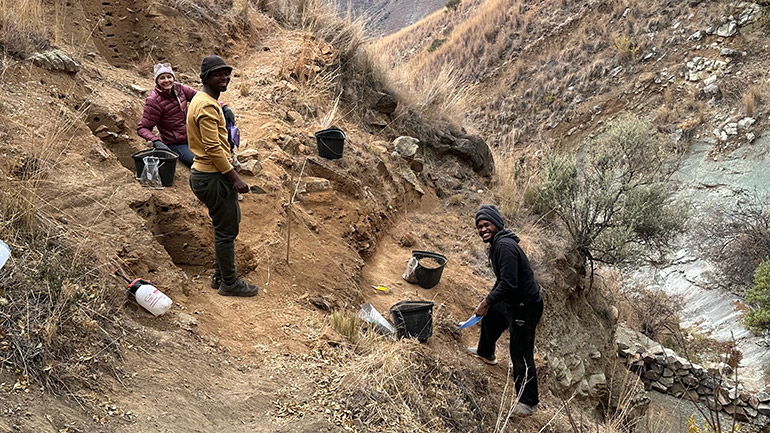
Likonong, pronounced "Dikonong," was discovered in 1995, but Pazan delved more deeply into the site in 2023. It's a site that challenges previous assumptions about why humans and human ancestors were slow to settle mountainous regions, Pazan says. Archaeologists have generally thought the low oxygen, or hypoxia, of high-altitude regions may have limited early human success in these areas. But Homo erectus, one of our ancestors, settled high altitude sites in Ethiopia as early as 2 million years ago, and at 6,000 feet, Likonong is at an elevation where oxygen isn't as scarce.
"The fact that Likonong and Lesotho in general didn't see any sustained occupation until Homo sapiens came around is significant because it suggests that maybe hypoxia was not the issue. Maybe it was temperature and knowing what's available at specific times of the year," Pazan said. "I think Ethiopia shows that we can be at high altitudes if it's warm enough and if resources are predictable. But it takes a little extra adaptive ability to live in a place that gets so cold and has these really dramatic swings in resource availability, even if there's plenty of oxygen there."
Something that made Homo sapiens highly successful was our ability to adapt to different environments, Stewart says. But human adaptation is much more than just biological: people need other people.
"We came to be a successful species by creating long-lasting, very deep friendships that spread over land," Stewart said. "You need to have clothing, ready access and instant ability to make fire, and you probably need cooking techniques that soak every last fat out of the kind of food you're getting. But these things are not the be-all, end-all. Social cooperativeness, having fallbacks, and having a risk distribution across the landscape if things go wrong are just as critical."
It's a lesson that Pazan hopes we won't forget.
"From the very beginning, we were only able to solve these environments by working together as a group and collaborating toward better solutions," Pazan said. "If that's how we began as a species, then perhaps that is key toward our survival here on Earth today. If we forget that, we're forgetting a little bit about what it is to be human in the first place."
- Evolving entanglements with highland southern Africa: Site formation, initial chronology, and occupational pulsing during the Middle Pleistocene at Likonong Shelter, Lesotho is published in Archaeological and Anthropological Sciences, DOI: 10.1007/s12520-026-02459-9
Credit: Kyra Pazan, California State University, Stanislaus