University of Leicester and Perpetual Atomics achieve major qualification milestone for the Americium Radioisotope Heater Unit
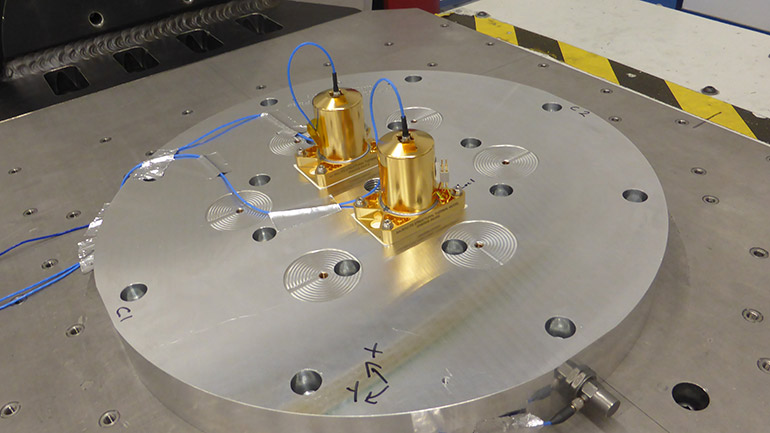
Am-RHUs on shaker table for vibration qualification testing.




A significant milestone has been passed in the development of a new radioisotope power technology to support future space missions.
The University of Leicester and Perpetual Atomics have successfully completed critical vibration and thermal vacuum testing of their Generation 5 Americium Radioisotope Heater Unit (Am-RHU) in a standardised mechanical holder proving its resilience under the extreme forces of a rocket launch as well as the operational environments on planetary surfaces. These tests are part of the Am-RHU development supported by the European Space Agency in the framework of its ENDURE Project.
A fully representative structural thermal model of the Am-RHU passed rigorous testing at levels exceeding 25 G (Sine) and 28 Grms (Random) and was thermally cycled between +80 °C and -70 °C while operating in vacuum. This achievement clears another vital hurdle for deploying nuclear power in deep-space missions.
“This milestone is another example of our focus on hardware, testing and rapid maturation cycles,” said the project’s technical lead Dr Ramy Mesalam at Space Park Leicester, the University of Leicester’s £100 million science and innovation park. “By proving this system can survive the challenges of launch and broad operational environments in space, we are unlocking the ability to use these systems on spacecraft accessing the darkest, coldest regions of our solar system.”
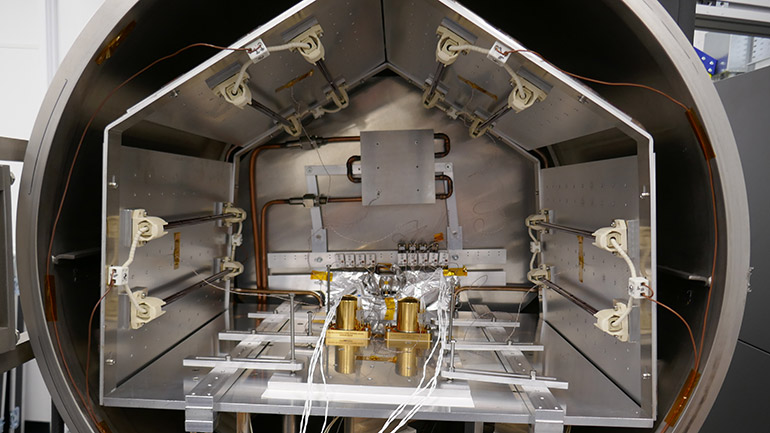
Am-RHUs in thermal vacuum chamber for thermal cycling qualification testing.
The University of Leicester has led the development of these systems since 2010 and more recently spun-out Perpetual Atomics to commercialise this technology. Unlike traditional power sources, americium-based units provide continuous power even in extreme cold, making them essential for survival in permanently shadowed lunar craters or during the long lunar night.
“This success is a testament to the technical depth of the engineering team,” added the program lead Professor Richard Ambrosi. “Reliable thermal management is the foundation of long-term exploration. Without these units, the goal of establishing a sustainable human presence on the Moon or exploring the Martian surface would be significantly constrained.”
With launch resilience and operational flexibility proven, the team is accelerating the possibility to integrate this technology into upcoming missions.