Technique will turbocharge new medicines to combat antimicrobial resistance
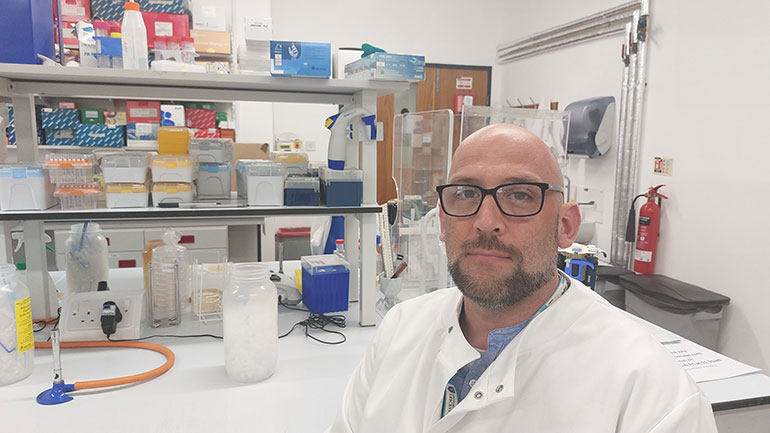
Dr Andrew Millard




Scientists at the University of Leicester have developed a new technique that will turbocharge the use of phages for medicinal purposes.
The pioneering technique uses a rapid and low-cost method for phage development - a viable alternative to current medicines which are not working due to growing antibiotic resistance.
Phage therapy uses viruses known as bacteriophages to infect and destroy bacteria. Unlike antibiotics, which often kill good bacteria, phages are highly specific and only target particular strains of bacteria to treat disease in humans and animals. The difficultly is often not finding phages but finding and identifying the right ones.
While scientists can isolate many phages from environmental samples, sequencing and characterising their genomes to get key information is currently slow, expensive, and needs large amounts of phage solution to extract purified viral DNA.
As a result, many potentially useful phages are never fully analysed or added to therapeutic libraries.
Now, scientists at the University of Leicester’s Becky Mayer Centre for Phage Research have worked out how to sequence phage genomes directly from individual plaques – the small clear zones formed when phages kill bacteria on an agar plate.
Their work has just been published in Microbiology Society.
The approach combines minimal DNA input and amplification using Oxford Nanopore sequencing, enabling phage genomes to be analysed rapidly and reliably.
Doctor Andrew Millard, Co-lead of the University’s phage centre, explained: “Because the method works from very small amounts of material, it eliminates the need for large-scale phage purification and transforms the speed at which hundreds of genomes can be analysed from months, to less than a week.
“This pioneering breakthrough means that there is potential to find and understand many more bacteriophages to fight disease and scale up the quantities available and allow us to focus on the best phages.”
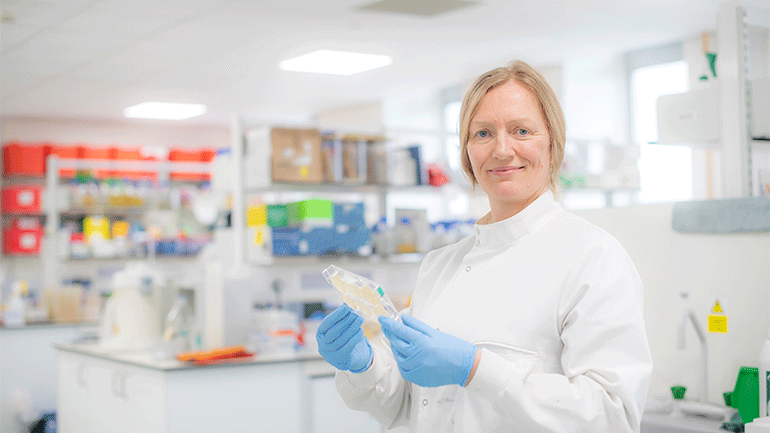
Professor Martha Clokie
Professor Martha Clokie, who also leads the University’s Becky Mayer Centre for Phage Research, added: “This is a vital step towards making phage therapy a practical reality. Antimicrobial resistance is already responsible for around five million deaths each year globally, and without new solutions this will only increase.
“By enabling us to rapidly identify and develop the best phages, this approach brings us much closer to delivering a new class of precision medicines.”
The team is now using this approach to build large, fully characterised libraries of bacteriophages, dramatically expanding the number of candidates available to tackle drug-resistant infections.
Ultimately, the team’s goal is to bring phage therapies into routine healthcare, providing new, targeted treatments in the global fight against antimicrobial resistance.