Can smart t-shirt technology improve diagnosis of breathing disorders?
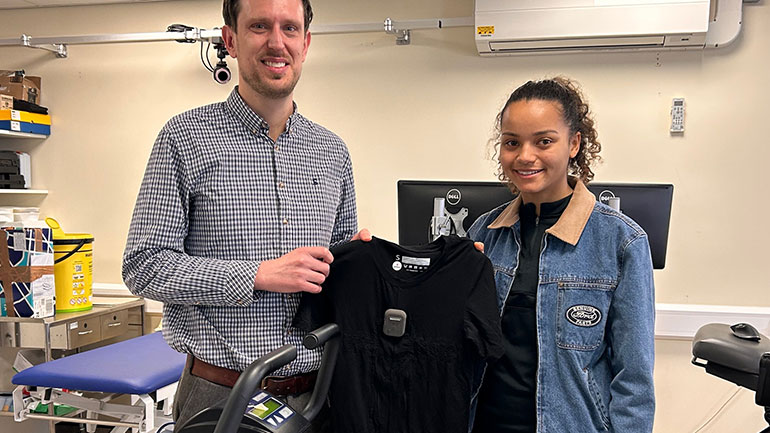
Dr Tom Ward and student Megan Harper with the T-shirt




Leicester researchers are testing whether an innovative smart t-shirt can help clinicians more accurately diagnose breathing pattern disorders - a group of conditions that are difficult to identify using current methods.
The advanced prototype, developed by Dutch-Greek wearables technology company Atride, is now being trialled with patients at the National Institute for Health and Care Research (NIHR) Leicester Biomedical Research Centre (BRC) at Glenfield Hospital.
Atride specialises in wearable devices designed to accelerate clinical research and translate life saving physiological insights from the laboratory into everyday life. Their flagship product, the first-generation CE-marked Anasa® system Smart Shirt, combines nanotechnology and stretchable electronics woven directly into the fabric to deliver continuous, respiratory monitoring without the need for masks, mouthpieces or bulky equipment.
Breathing pattern disorders (BPDs) are characterised by persistent over breathing or a breathing pattern that is inefficient, where the depth and rate of breaths exceed what the body actually requires. Symptoms can mimic other conditions, making diagnosis challenging.
Dr Tom Ward, Associate Professor at the National Institute for Health and Care Research (NIHR) Leicester Biomedical Research Centre (BRC), and Honorary Consultant in Respiratory Medicine at the University of Leicester explained: “Breathing pattern disorders can be difficult to diagnose because the breathlessness patients report may be put down to other conditions – asthma, for example. This can result in people receiving unnecessary medication and can mean it takes longer for them to receive effective physiotherapy support."A tool that can capture subtle changes in how a patient is breathing could make a meaningful difference to how we assess and support these patients.
“We’re really excited for our patients to test the Anasa® shirt here in Leicester. The t shirt measures breathing patterns using two discreet sensor bands positioned across the sternum and abdomen and provides an exciting opportunity to measure breathing pattern in people’s day-to-day life.
“We ‘re comparing the data it collects with our current gold standard method, which involves motion capture photography to observe chest and abdominal movement. If the t shirt proves comparable, it could offer a simpler, more comfortable and more accessible alternative for patients.”
Loughborough University student Megan Harper, 21, was invited to take part in the study after a history of respiratory illnesses led her to be hospitalised at University Hospitals of Leicester NHS Trust.
She said: “I’ve had asthma since I was very young. My attacks were getting very serious a couple of years ago, and as well as taking lots of steroid medication I was hospitalised. I was referred to a physiotherapist who realised that I wasn’t breathing effectively, and was diagnosed with Breathing Pattern Disorder.
“Being part of this study has been really interesting and it’s helped me to better understand my condition. Being treated for Breathing Pattern Disorder has really helped and I’ve been much better.
“Hopefully what the researchers find out will help them to develop the t-shirt so it can be used to diagnose more people in the future.”
The project has been made possible through an NIHR Invention for Innovation (i4i) award, which supports the development of cutting edge medical technologies with the potential to transform care pathways.
Maria Kontogiorgou, CEO of ATRIDE, said: “We are proud to collaborate with the outstanding teams at National Institute for Health and Care Research, whose expertise and commitment ensure this research meets the highest clinical standards. Together, we are advancing a new way to understand and monitor breathing.
“We’re capturing respiratory intelligence with remarkable consistency through a t-shirt that feels almost invisible. This study asks an essential question: Can continuous, wearable monitoring achieve the same level of accuracy as established gold standards while remaining effortless for the patient? Precision without intrusion. Insight without compromise.
“This is the future we are building at ATRIDE, where rigorous science and thoughtful design come together to create technology that fits naturally into everyday life: trusted, meaningful, and genuinely loved by the people who wear it.”
The NIHR Leicester BRC is part of the National Institute for Health and Care Research and is hosted by the University Hospitals of Leicester NHS Trust, in partnership with the University of Leicester, Loughborough University and University Hospitals of Northamptonshire NHS Group.
The centre brings together world leading investigators, clinicians, and research facilities to drive innovation in prevention, diagnosis and treatment of major health conditions.