New asteroid catalogue allows glimpse into Solar System’s rock history
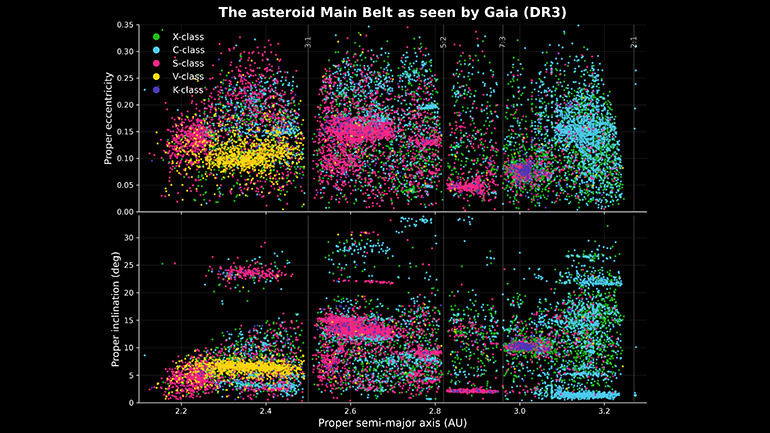
The figure illustrates the structure of the main asteroid belt revealed by Gaia DR3 spectroscopic data, where each asteroid is coloured according to their spectral type.




An algorithm to classify asteroids from satellite data could help reveal the story of the formation of our solar system.
In a new study published in Frontiers in Astronomy and Space Sciences an international team of researchers from the University of Leicester and the Observatoire de la Côte d’Azur in France demonstrate the development of an automatic probabilistic taxonomic classification for the rocky bodies that make up the asteroid belt.
Using visible reflectance spectra of more than 60,000 asteroids in our solar system provided in ESA’s Gaia mission’s Data Release 3, they have made it possible to map the composition of the belt with greater precision than ever before.
Reflectance spectra, derived using light reflected from the asteroid, are the composition fingerprint of planetary surfaces that give insights into their mineralogy and record the effects of evolutionary processes. Scientists have developed methods to identify and group similar spectra, classifying them in broadly-used taxonomic schemes. These schemes are essentially the alphabet that scientists use to describe the small body composition.
The data from Gaia represents an unprecedented sample of asteroids compared to previous ground-based surveys. By cataloguing this data, the scientists have provided a fresh resource for studying the compositional structure of the main belt, as well as revealing new insights. For example, the catalogue shows that S-type asteroids that are linked to more processed types of meteorites (e.g. ordinary chondrites) dominate the inner belt, while C-type asteroids that are linked to dark, primitive, water and organic-rich carbonaceous meteorites are more common in the outer belt.
Asteroids originate from the original planetesimals that formed in our early Solar System. In their mineralogical and physical properties is a record of the processes that occurred in the early Solar System, providing a unique window into the conditions and mechanisms that led to the formation of the planets.
The team was led by Dr Marco Delbo, Director of Research at Observatoire de la Cote d’Azur and Leverhulme Trust Visiting Professor at the University of Leicester. The team includes members of staff, PhD and Master’s students from the Hard Rocks team of the School of Physics and Astronomy and School of Natural Sciences.
Dr Marco Delbo said: “We are now working towards the fourth data release from Gaia, and I and other members of the Gaia Data Process and Analysis Consortium are looking forward to studying new spectra for about 100,000 asteroids. This will be the largest spectroscopic dataset to date, and combined with the future SPHEREx near-infrared spectra will revolutionise the view of the solar system’s small bodies.”
Co-author Dr Chrysa Avdellidou from the University of Leicester School of Physics and Astronomy said: “The spectrum of an asteroid is the fingerprint of its composition. Having such a large dataset allow us to look inside the planetesimals by studying their collisional fragments which could sample different internal layers. Our Hard Rocks team is working on combining visible Gaia spectra with those at longer wavelengths (near-infrared) from large ground-based facilities such as the NASA Infrared Facility in Hawaii. This allows us to compare them with the laboratory spectra of known meteorites and understand the asteroid materials, the building blocks of planets.”
- Gaia DR3 supervised classification of asteroid reflectance spectra is published in Frontiers in Astronomy and Space Sciences, DOI: 10.3389/fspas.2026.1774478