Space Park Leicester event to reveal role in groundbreaking deep space biology investigation
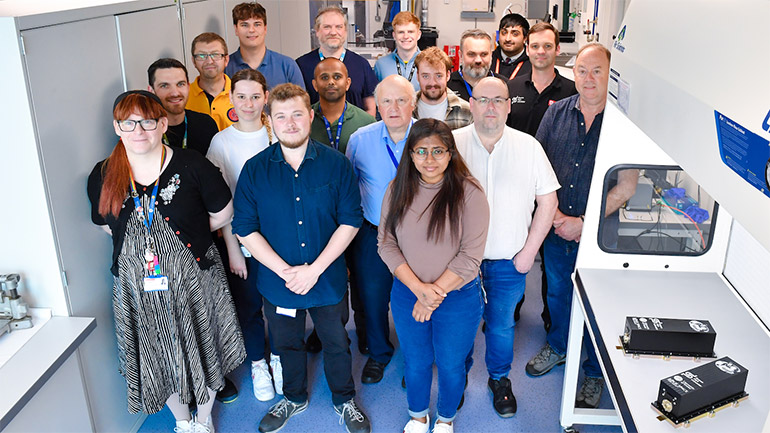




Scientists from The University of Leicester who helped send microscopic worms to the International Space Station as part of a pioneering experiment investigating the biological effects of the future of long duration space travel will share the story behind the mission at a public talk next month.
John Holt, Scientist and Engineer, from the University of Leicester’s School of Physics and Astronomy will be joined by esteemed Professor Mark Sims, Professor of Astrobiology and Space Instrumentation to reveal the science, instrumentation, design and mission of the Fluorescent Deep Space Petri Pod (FDSPP) experiment at the next Space Park Conversations talk 'Worms, the ISS and Space Park Leicester' on Wednesday, 17 June, between 2pm and 3pm.
The FDSPP is a miniaturised hardware solution for performing remotely operated biological experimentation on multiple types of organisms, including the use of fluorescent and white light imaging capabilities. It is the University of Leicester’s first microgravity mission in deep space and was recently launched and installed on the International Space Station.
The biological science investigation is led by the Principal Investigator Tim Etheridge, now at Ohio University, which includes the University of Exeter, his former location. The instrumentation platform originates from, and is led by, the University of Leicester, with hardware design and development undertaken at Space Park Leicester, the University of Leicester’s £100 million space research and innovation hub.
Alex Wheldon, Head of Strategic Communications and Marketing at the University of Leicester and Space Park Leicester said: “This is an exciting opportunity for people to hear directly from the team behind a live experiment on board the International Space Station.
“Our involvement with this experiment demonstrates the strength of innovation and collaboration taking place at Space Park Leicester and the University of Leicester and highlights how local research is contributing to the future of global space exploration.”
The FDSPP is part of a growing effort to develop practical biological systems that can support human life beyond Earth, including sustainable methods of food production and waste management in extreme environments.
Space Park Conversations “Worms, the ISS and Space Park Leicester” will take place on Wednesday 17 June from 2pm to 3pm. Free tickets are available from the Space Park Leicester Eventbrite page.
- Explore Space Park Leicester partnerships, missions, residents, facilities, training programmes and innovation products or learn more about holding events at the venue.