UROKODIA! 518-million-year-old fossil shows beginning of spider’s bite
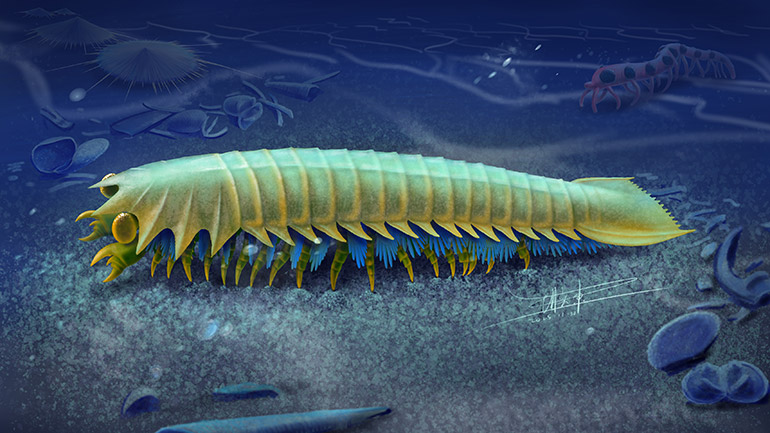
Artist’s impression of Urokodia. Credit: Xiaodong Wang




The earliest evidence of spiders’ fangs has been identified in a 518-million-year-old fossil by scientists at the University of Leicester and Yunnan University.
From the infamous Black Widow spider to the radioactive spider that gave Spider-Man his superpowers, the arachnid’s bite has been a key part of its enduring image and chilling reputation.
Now, the evolution of the powerful fangs that make spiders such formidable hunters has been traced back to its earliest known appearance in the fossil Urokodia, detailed in a new study for the journal Nature published today (1 July).
Spiders, along with scorpions and ticks, form part of a group of invertebrates known as chelicerates, currently comprising over 100,000 described species. They have jointed limbs and external skeletons but are particularly noted for the specialised limbs called chelicerae at the front of the animal which are used as pincers or fangs for stabbing prey.
The fossils of Urokodia were recovered from the famous Chengjiang fossil site of Yunnan Province in southern China and this latest study is published on the 42-year anniversary of the discovery of the site. Urokodia was quite small at around 2-3 cm long with large eyes protruding on stalks from the front, a segmented skeleton and jointed limbs strung from the underside of its slender body. At first glance, it doesn’t resemble the spiders and scorpions that are its modern-day descendants.
Using X-ray analysis, the team of scientists at Yunnan University, China, and the University of Leicester probed the rock in which the fossil was entombed, revealing that most of its soft anatomy was still mummified after hundreds of millions of years.
Their analysis also revealed two pincer-like limbs emerging just behind its eyes that are the beginnings of chelicerae. Urokodia also shows some features on its legs that suggest they were acting as book gills for breathing, similar to modern aquatic chelicerates like the horseshoe crab.
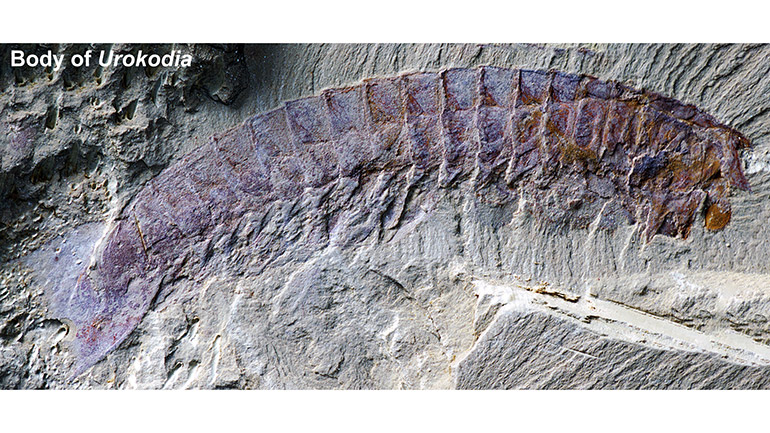
General body shape of Urokodia under macrophotography.
Chelicerates are one of the most successful groups to live on the land and in the sea. On land they have become remarkable hunters and the fossil record shows that their ancestors have been doing this for hundreds of millions of years.
But while monster movies such as Arachnophobia portray spiders as a horrifying threat to humans, most spiders are completely harmless to us because their bites and venom are designed for much smaller prey.
The study was led by Professor Yu Liu of Yunnan University who is also a Visiting Professor at the University of Leicester.
Professor Liu said: “We were using x-ray tomography analysis of these fossils to reveal their soft anatomy buried in the rocks for hundreds of millions of years, when suddenly we noticed the pincer-like limbs at the front of the animal. We knew immediately that this was a very exciting fossil and indeed a distant ancestor of living chelicerates like scorpions and spiders.”
Co-author Professor Mark Williams from the University of Leicester School of Geography, Geology and the Environment said: “Urokodia was part of an ancient ecosystem of over 200 different types of animals living in the seas over 500 million years ago. These spectacularly preserved fossils provide real insights into how life was evolving on our planet at the very dawn of animals.”
- Urokodia sheds light on the origin of chelicerae and book gills of Chelicerata is published in Nature, DOI: 10.1038/s41586-026-10713-2
- This study was supported by a grant from the Department of Science and Technology of Yunnan Province (202401BC070012) to Professor Yu Liu, who is further funded by the Yunnan Revitalization Talent Support Program.
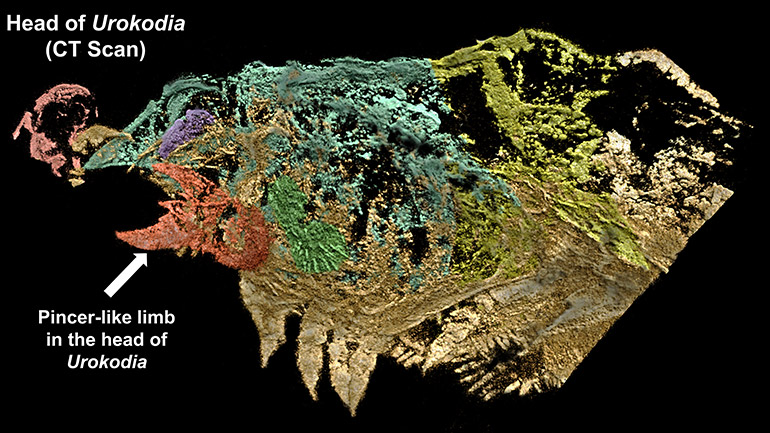
Soft anatomy in the head of Urokodia exposed under X-ray analysis.