Spider-Man origin story goes back 518 million years
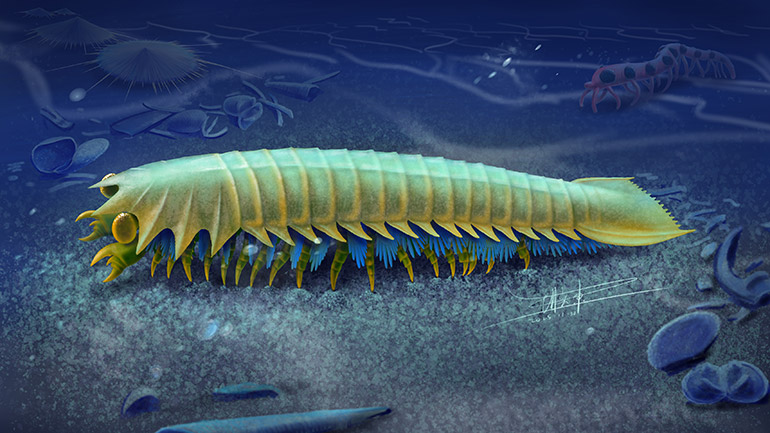
Artist’s impression of Urokodia. Credit: Xiaodong Wang




Spider-Man famously gained his powers from the bite of a radioactive spider, but it may be a small prehistoric sea creature he should thank for them instead.
As the webslinger returns to cinemas this week in Spider-Man: Brand New Day, scientists from the University of Leicester and Yunnan University have highlighted their discovery of an ancient ancestor of the spider that displays the earliest evidence of what would become spiders’ fangs.
The 518-million-year-old fossil named Urokodia was detailed earlier this month in the journal Nature and is helping scientists to better understand the evolution of the feature that made them formidable predators – not to mention the source of Peter Parker’s superhuman abilities in the comicbook and feature film franchise.
Spiders, along with scorpions and ticks, form part of a group of invertebrates known as chelicerates, currently comprising over 100,000 described species. They have jointed limbs and external skeletons but are particularly noted for the specialised limbs called chelicerae at the front of the animal which are used as pincers or fangs for stabbing prey.
The fossils of Urokodia were recovered from the famous Chengjiang fossil site of Yunnan Province in southern China. Urokodia was quite small at around 2-3 cm long with large eyes protruding on stalks from the front, a segmented skeleton and jointed limbs strung from the underside of its slender body. At first glance, it doesn’t resemble the spiders and scorpions that are its modern-day descendants.
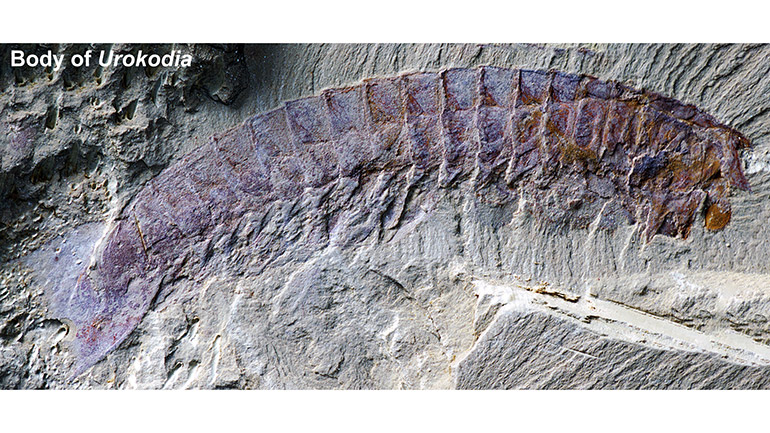
General body shape of Urokodia under macrophotography.
X-ray analysis revealed two pincer-like limbs emerging just behind its eyes that are the beginnings of chelicerae. Urokodia also shows some features on its legs that suggest they were acting as book gills for breathing, similar to modern aquatic chelicerates like the horseshoe crab.
Chelicerates are one of the most successful groups to live on the land and in the sea. On land they have become remarkable hunters and the fossil record shows that their ancestors have been doing this for hundreds of millions of years.
The study was led by Professor Yu Liu of Yunnan University who is also a Visiting Professor at the University of Leicester.
Professor Liu said: “Urokodia is one of those very special fossils you find in a scientific career, revealing the deep roots of a whole group of living animals that includes spiders and scorpions, and which number tens of thousands of species.
“We were using x-ray tomography analysis of these fossils to reveal their soft anatomy buried in the rocks for hundreds of millions of years, when suddenly we noticed the pincer-like limbs at the front of the animal. We knew immediately that this was a very exciting fossil and indeed a distant ancestor of living chelicerates like scorpions and spiders.”
Co-author Dr Tom Harvey from the University of Leicester School of Geography, Geology and the Environment said: “The Chengjiang fossils of China provide a bonanza of early sea creatures for palaeontologists to study, providing real insights about how animal life evolved hundreds of millions of years ago.”
- Urokodia sheds light on the origin of chelicerae and book gills of Chelicerata was recently published in Nature, DOI: 10.1038/s41586-026-10713-2
- This study was supported by a grant from the Department of Science and Technology of Yunnan Province (202401BC070012) to Professor Yu Liu, who is further funded by the Yunnan Revitalization Talent Support Program.