Scientists make century-old mathematical problem visible for the first time
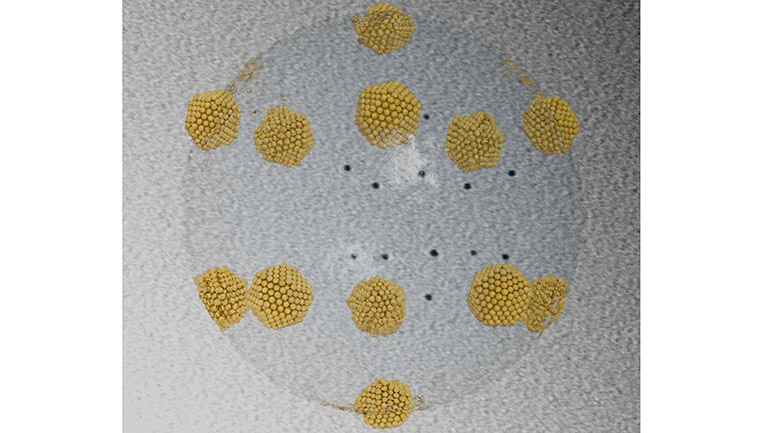
Illustrative projection of a 3-D Thomson configuration onto a substrate.


A mathematical problem that has challenged researchers for more than a century can now be explored as a physical system in the laboratory, after scientists found a way to reveal how electrical charges organise on the surface of a sphere.
A collaborative research team led by Professor Shengfu Yang at the University of Leicester and Professor Paul Scheier at the University of Innsbruck has developed a way to reveal the arrangement formed by electrical charges on the surface of a sphere, creating a new experimental route to studying a mathematical problem first posed more than 120 years ago.
The Thomson problem grew out of Nobel laureate J. J. Thomson’s 1904 attempts to understand atomic structure, associated with his famous ‘plum-pudding’ model of the atom. Although that atomic model was later superseded, the mathematical problem it posed has endured: if identical electrical charges repel one another while confined to the surface of a sphere, how will they arrange themselves to minimise their total energy?
The question is simple to state, but the problem becomes increasingly difficult as the number of charges grows.
Its mathematical significance was recognised in 1998 when renowned mathematician Stephen Smale included the closely related problem of distributing points on a sphere as Problem No. 7 in his influential list of 18 major mathematical problems for the 21st century. There is no general formula that gives the lowest-energy arrangement for an arbitrary number of charges.
The research, bringing together scientists at the University of Leicester, the University of Innsbruck and the University of Cambridge, turns this abstract optimisation problem into a system that can be investigated experimentally. The Cambridge contribution provides expertise in the energy landscapes and theoretical structures against which the experimentally observed patterns can be compared.
The researchers used superfluid helium nanodroplets as tiny spherical laboratories. Electrical charges localise close to the surface of the ultracold droplets and were tagged with singly charged gold nanoparticles. When the droplets were deposited onto a transmission electron microscopy grid, the helium evaporated, leaving behind nanoscale imprints of the original charge arrangements that could then be imaged.
For droplets containing up to 36 charges, the experimentally observed arrangements closely reproduced the lowest-energy configurations predicted theoretically. With larger numbers of charges, the team observed locally hexagonal ordering interrupted by fivefold defects, revealing how geometrical frustration develops when an ordered structure is forced to cover a curved surface.
Professor Shengfu Yang, from the University of Leicester School of Chemical, Earth, Environmental Sciences, said: “For more than a century, the Thomson problem has largely been explored through mathematics and, more recently, computation. What we can now do is realise these charge configurations physically and recover their arrangements in real space.
“What excites me most is that this experiment can now play an active role: rather than simply comparing observations with existing theoretical predictions, we can begin to reveal configurations that challenge mathematicians and theoreticians to explain why they form.
“For a problem that began with J. J. Thomson in 1904 and later became connected with one of Smale’s mathematical challenges for the 21st century, that is a remarkable change in perspective.”
Professor Paul Scheier, from the University of Innsbruck, said: “Superfluid helium nanodroplets give us an exceptionally clean and cold environment in which up to several thousand charges can organise on a curved surface with very little external disturbance. By tagging the charge centres with gold nanoparticles, we can preserve and image the resulting arrangements after the helium has evaporated. This opens a new experimental route to studying how charge ordering evolves from small, well-defined configurations towards much larger systems on curved surfaces.”
The new platform could allow researchers to investigate increasingly complex charge configurations, competing low-energy structures and the emergence of order and defects in larger systems. It could ultimately also provide experimental tests of how interacting particles organise on different surfaces and complex energy landscapes.
By combining helium-nanodroplet experiments in Innsbruck, nanoparticle imaging and analysis involving Leicester, and theoretical expertise from Cambridge, the collaboration creates a direct experimental connection between mathematics, physics and nanoscale science. A problem originating in Thomson’s early model of the atom can now be explored as a physical many-body system more than a century later.
- The research was supported by the UK Engineering and Physical Sciences Research Council (EPSRC), the Leverhulme Trust, the Austrian Science Fund and Land Tirol.
- Real-Space Imaging of Thomson Charge Configurations in Superfluid Helium Nanodroplets is published in Physical Review Letters, DOI: 10.1103/qby4-bm6q