New nanoparticle ‘skin’ gives polymers new surface functions
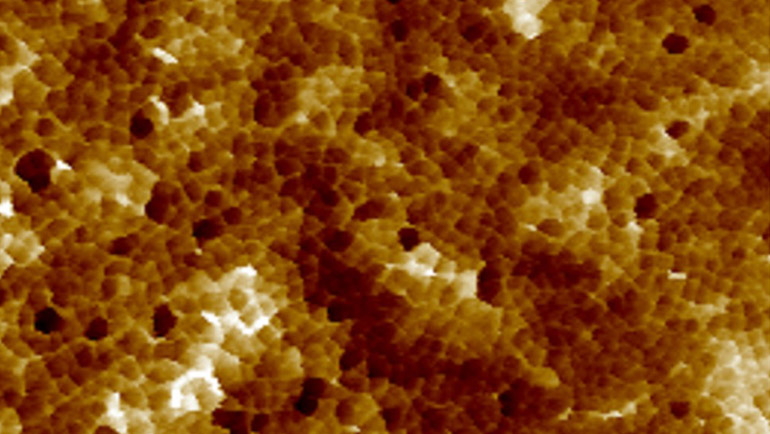
CeO2 nanoparticles on the surface of Belzona 5721 paint, the top coating used for wind turbine leading blades.




A new technique to partially embed different types of nanoparticles into the surface of polymer materials such as plastics has been developed by University of Leicester scientists.
The technique could allow relatively inert polymer materials to be given a wide range of active surface functions, including catalytic or photocatalytic activity, chemical or environmental sensing, antimicrobial properties, protection against degradation, and functions for energy or electronic applications, while preserving the desirable properties of the material underneath.
The research is published in Communications Materials, a Nature Portfolio journal. The University of Leicester team has also filed a patent covering the technique and is seeking industrial partners for collaboration, co-development and licensing opportunities.
Researchers led by the University of Leicester developed a simple way to give plastics and protective coatings a new “skin” made from nanoparticles. With gentle heating, the tiny particles become partly embedded in the surface: deep enough to stay in place, but exposed enough to keep working. The approach could allow familiar materials to gain new surface functions while preserving desirable bulk properties such as low weight, mechanical strength and chemical resistance, without having to redesign the material itself.
Nanoparticles can give ordinary materials useful new abilities, such as catalysing or controlling chemical reactions, providing antimicrobial activity, interacting with light, or adding useful electrical and magnetic properties. But there is a catch: leave them sitting on the surface and they can be washed or rubbed away. Bury them inside the material and they can no longer interact effectively with the outside world.
The Leicester team found a surprisingly simple way around this trade-off. When a nanoparticle-coated polymer is gently warmed, the particles touching the surface sink only part-way in and then stop. Extra particles above them can be washed away, leaving a tightly packed layer just one particle thick. In effect, the polymer itself grips the nanoparticles without the need for an added adhesive, binder or chemical-grafting step.
Dr Shengfu Yang, from the University of Leicester’s School of Chemical, Earth and Environmental Sciences, said: “The idea is simple: rather than making a completely new material, we give the surface of an existing one a new functional skin. The polymer holds the nanoparticles in place, but leaves enough exposed to do their job. Getting that balance right is the key.”
Polymers include familiar materials such as polyethylene and many other everyday plastics, but also resins, coatings, adhesives, elastomers/rubbers and the polymer matrices used in fibre-reinforced composites. Polymer materials are therefore found almost everywhere, including packaging, cars, aircraft, electrical equipment, medical devices, construction materials and renewable-energy technologies.
To put their idea to a demanding test, the researchers added cerium oxide nanoparticles to a commercial epoxy coating used to protect wind-turbine blades. The particles settled roughly halfway into the surface and stayed there even after vigorous washing, treatment with ultrasound and repeated tape peeling.
Crucially, the exposed part of the particles remained active. Cerium oxide can react with damaging oxidising chemicals and then recover its chemical state, allowing the protective effect to be renewed. In accelerated laboratory tests, the nanoparticle-covered polymer suffered much less damage than the untreated coating. Short-term outdoor weathering in Leicester and artificial seawater tests also showed improved resistance to degradation.
Tianrun Qin, the University of Leicester PhD researcher who carried out the experiments, said: “What is particularly useful is that the process naturally stops with the nanoparticles both anchored and exposed. Instead of mixing large amounts of nanoparticles throughout a material, we can put the function exactly where it is needed: at the surface.”
The researchers also demonstrated the approach using silver nanoparticles on two common forms of polyethylene. This suggests the method is not tied to one particular particle or plastic, and that different nanoparticles could eventually be chosen to give surfaces different functions.
Dr Yang added: “The wind-turbine coating shows what the idea can do in a demanding real-world material. The wider opportunity is to choose nanoparticles for different jobs and add those functions where they matter most, at the surface. That could lead to materials that resist damage, sense their surroundings or carry out useful chemistry while retaining the desirable properties of the underlying material.”
Dr Josef Walker, Commercial Manager at the University of Leicester, said: “Innovations like this demonstrate the strength of research being developed at Leicester and their potential to address real-world challenges. As a partner in the £13.6 million Research England-funded Forging Ahead collaboration with 16 Midlands universities, we're working to help more promising technologies like this make the journey from the laboratory to commercial and societal impact."
- Self-limiting thermal embedding creates surface-accessible nanoparticle monolayers on polymers is published in Communications Materials, DOI: 10.1038/s43246-026-01320-9
- This work was supported by the UK Engineering and Physical Sciences Research Council and the Leverhulme Trust.