New investment to tackle antimicrobial resistance in farming and food production
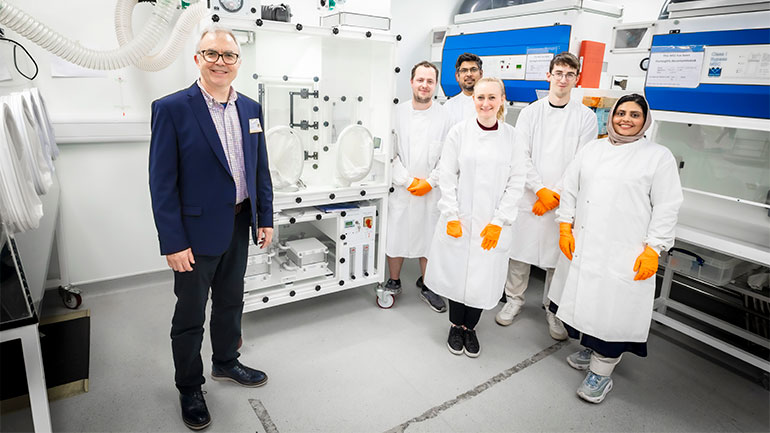
Dr John Pearl alongside fellow researchers, from left: Keiran Dewing, Dr Mrinal Das, Megan Atherton-Frisby, Luke Newman, and Sadaf Sulman




Leicester researchers are among a UK-wide network which has secured funding to tackle antimicrobial resistance across the agrifood sector.
The AMAST (Antimicrobial Resistance in Agrifood Systems Transdisciplinary) Network which brings together farmers, veterinarians, industry, researchers and policymakers, will spend the next five years developing and testing practical ways to help UK food producers use antibiotics more responsibly.
AMAST is one of 18 research and innovation projects that will receive a share of £54million from a joint UK government and UKRI investment to tackle a range of biosecurity threats, such as antimicrobial resistance (AMR).
Since AMAST was established in 2024, more than 250 members from farming, veterinary practice, industry, government and academia have collectively helped identify where further progress towards effective antimicrobial use is needed and barriers to achieving it.
The network has worked directly with different sectors to build shared priorities around animal health, antimicrobial use, diagnostics, data, behaviour and the environment.
Dr John Pearl from the University of Leicester’s Department of Respiratory Sciences is among the researchers helping to develop clearer understandings of complex avian diseases that require antimicrobials to treat bird flocks.
This work, in turn, is informed by Dr Pearl’s research program in which he investigates the basis for complex chronic pulmonary diseases such as Tuberculosis and Non-tuberculous Mycobacterial Pulmonary Disease [NTM-PD] caused by various related species of bacteria.
He said: “Combatting antimicrobial resistance requires vigilance across both clinical practice and in our nation’s agricultural food chain. The potential impact of antimicrobial resistance, however, extends into our wild spaces and throughout our environment. Because of this, the work we do with AMAST is essential and I’m privileged to be able to contribute.”
UK agriculture has already made major progress in reducing antimicrobial use while protecting animal health and productivity. The new programme will focus on some of the remaining challenges and on turning evidence and sector experience into approaches that can work in everyday practice.
One example is AMAST's work with the sheep and cattle sector, bringing together farmers, vets and industry experts to develop a practical plan for improving how antibiotic use is recorded and monitored on farms across the UK. The resulting UK Ruminant Antibiotic Stewardship Roadmap will be launched at the British Cattle Veterinary Association (BCVA) Congress later this month (15 October).
AMAST’s latest programme aims to focus on three key areas:• Pigs: working with farmers, veterinarians and advisers on farms facing sustained disease and antimicrobial-use challenges, using swine dysentery as a model to connect better diagnostics, biosecurity, farm management and decision-making.
• Ruminants: putting the UK Ruminant Antibiotic Stewardship Roadmap into practice. Led by the Royal Veterinary College, Royal Holloway University of London and the Royal Agricultural University, this work will co-design trusted ways to collect and use antimicrobial data so farmers and veterinarians can understand their own use, benchmark progress and make informed stewardship decisions.
• Across agrifood: identifying approaches that work across livestock, aquaculture, gamebirds and crops, and bringing international experience into UK stewardship.Across all three areas, the programme will also address environmental aspects of AMR, including antimicrobial residues in manure, soil and water.
It will train the new generation of early-career researchers and set up an international expert panel to share UK learning globally.
AMAST is led by Dr Matthew Gilmour at the Quadram Institute, with co-directors Dr Marie McIntyre and Professor Alex Hughes at Newcastle University.
Dr Gilmour said: “UK agriculture has already made major progress on antibiotic stewardship. The next gains will not come from simply telling farmers and vets to use less; they will come from solving the real problems that still drive antimicrobial use: disease pressure, availability of alternative medicines, diagnostic uncertainty, data gaps, economics and trust.
“AMAST brings the people who deal with those challenges every day together with researchers and policymakers to design solutions that work in practice. This investment lets us move from identifying the barriers to testing and embedding what works, while protecting animal health and keeping antibiotics effective for the future.”
The funding is part of a £54million investment in biosecurity from a coalition of UK government partners to help tackle AMR, prepare for future epidemics and develop next-generation livestock vaccines.
The programmes aims to strengthen the UK’s ability to prevent, detect and respond to biological threats affecting people and their livelihoods, wildlife, and ecosystems.
Researchers will work with international partners, taking an approach that recognises the links between human, animal and environmental health, and draws on multiple disciplines to tackle complex challenges in a rapidly changing world.
Together, the work will help build resilience against emerging biosecurity threats, strengthen prevention and response capabilities, enhance food security, and support sustainable economic growth.This public investment is coordinated through UK Research and Innovation (UKRI), with co-funding from partners including the Department for Environment, Food and Rural Affairs (Defra), the Foreign, Commonwealth and Development Office (FCDO), and the Department for Health and Social Care (DHSC).
UKRI Executive Champion for Tackling Infections and BBSRC Executive Chair, Professor Anne Ferguson-Smith added: “This investment reflects UKRI's central role in delivering government priorities and our long-standing commitment to convening and working with partners across government to fund vital One Health research into human, animal, and plant health.
“By pooling expertise from across the research and innovation ecosystem in the UK and globally, we can tackle related infectious disease challenges in a more coordinated way to get ahead of emerging biological threats and help protect people, animals, plants and the environment, both in the UK and internationally. Ultimately, it will advance knowledge, improve lives, and drive growth.”