COP31: insights from the conference as discussions turn to AI and implementation
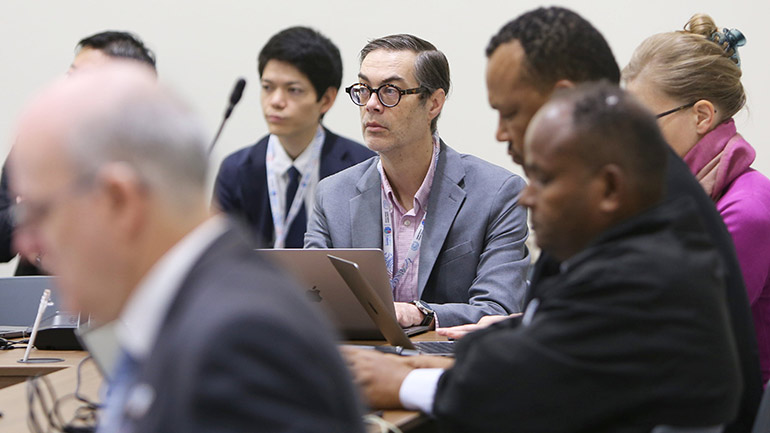
Dr Tim Neff from the School of Arts, Media and Communication working at COP31. Credit: IISD/ENB I Angeles Estrada Vigil


Once again, Dr Tim Neff from the School of Arts, Media and Communication is writing from COP31 for Earth Negotiations Bulletin, as well as deepening his research on media and environmental issues. At the halfway point of the conference, he gives his reflections so far.
Climate “COPs” – the big annual UN conferences where diplomats negotiate international actions to address the intensifying global crisis of climate change – never unfold in a straight line, and this year's COP31 in Antalya, Türkiye, is no different.
In a very literal, logistical sense, it hasn't been a straight line. As world leaders arrived to deliver their statements during the first week, COP31 became a tangle of road closures and security measures that snarled traffic and created social media memes about delegates stuck on buses. One bus ride became a more than two-hour odyssey for our Earth Negotiations Bulletin team, as we slowly snaked through narrow back roads before arriving for a busy day of covering side events.
In a more substantive sense, negotiation rooms across the venue are scenes of non-linear, four-dimensional chess, as diplomats try to achieve agreements on a huge and ever-growing range of interconnected issues. To name just a few: achieving a just transition to greener economies; scaling up funding for adaptation to climate shocks; starting the second “Global Stocktake” to assess progress – or lack thereof – on curbing climate change; unlocking more finance to help developing countries meet their climate ambitions and getting that money to people on the ground and on the frontlines of climate action.
It has been more than 10 years since the Paris Agreement of 2015, and with that agreement’s “rulebook” in place, COP delegates essentially know what needs to be done. The crucial questions are how it will be done and how that work will be funded. COPs are now focused on “implementation,” relying on stakeholders to step up their voluntary actions and commitments and forging partnerships across different sectors to achieve an urgently needed shift from planning to on-the-ground responses. Those goals are increasingly pressured by the rise of global temperatures, expected to exceed 1.5° Celsius average warming over pre-industrial levels this year.
Unsurprisingly, discussions at COPs are increasingly about the peril and potential of artificial intelligence (AI) for combating climate change. On the peril side, the energy used to run data centers that fuel AI systems is estimated to constitute a staggering 1.5% of global energy consumption, representing a huge contributor to greenhouse gas (GHG) emissions that fuel climate change. On the potential side, AI systems can unlock new efficiencies in our use of energy and possibly reduce GHGs.
I covered a side event last week where Bertrand Piccard, known for his historic flight around the world in a solar-powered aircraft, spoke about these contrasting futures. His speech compared the peril side of the equation to the animated film Fantasia, where a sorcerous Mickey Mouse conjures brooms to do his work for him, only to see the situation spiral out of control. Yet Piccard emphasised that this is just one possible future, and there are many more in which AI may help us achieve greener economies and societies. People at COPs are very much aware of the peril and potential of AI, and they recognise that climate action will be shaped by how people decide to put this technology to use – for good or for ill.
Now at the halfway point, negotiators are entering into a period of intense final negotiations as they drive toward a final agreement. COP31’s legacy will be what that agreement includes and how it shapes our climate responses and our future.