Leicester battery recycling innovation to underpin £5 million of UK circular economy projects
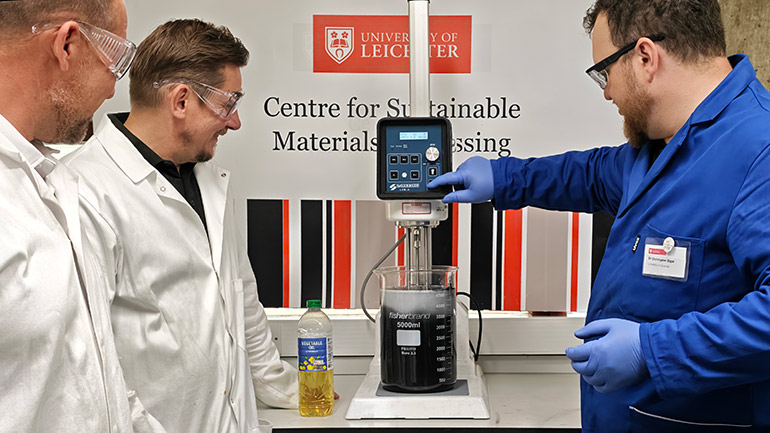
Pilot-scale battery waste separation MVP demonstration at Centre for Sustainable Materials Processing. Left to right: Ben Dawbarn (Lithium Battery Recyclers Ltd/Ecoshred), Anthony Hulmes (Lithium Battery Recyclers Ltd/Ecoshred), and Dr Chris Elgar (CSMP).


Two major battery recycling projects worth more than £5 million in combined value will use University of Leicester expertise and patent-pending technology to help establish a more sustainable and secure UK battery supply chain.
They have secured funding through the Battery Innovation Programme, funded by the Department for Business, Innovation, Science and Trade (BIST) and delivered by Innovate UK. The projects will support the development and industrial deployment of advanced recycling technologies capable of recovering valuable materials from end-of-life lithium-ion batteries, supporting the UK’s transition to a globally competitive battery sector.
The two industry-led collaborations, STOCKMAN (Strategic Treatment Of Critical materials: Keeping value And Materials Nationally) and RECLAIM (Recovery and Circularity of Lithium-ion Assets Into UK Manufacturing), will build on innovation developed through the Faraday Institution's ReLiB project at Leicester.
Together, the projects will validate complementary industrial recycling routes using a Leicester-developed "drop-in" separation technology at the forefront of battery waste processing that enables the recovery of critical battery materials and, separately, battery minerals while reducing processing costs and environmental impact.
Dr Jake Yang, Lecturer in Physical Chemistry at the University of Leicester School of Chemical, Earth, Environmental Sciences and lead researcher on the University's battery recycling activities, said: "The UK is not only heavily reliant on imported critical minerals to support the transition to electric vehicles, but when these materials reach the end of their life, much of these materials are lost to over-sea refiners. This largely reflects the economic challenge of battery recycling within the UK where energy and chemical processing costs are among the highest globally.
“By utilising the oil-water nanoemulsion separation technology developed at Leicester, we can separate battery black mass into highly enriched material streams that reduce processing costs for both long-loop recycling, where critical minerals are recovered, and short-loop recycling, where battery materials can be directly regenerated and reused. This has the potential to strengthen UK battery circularity, reduce reliance on imported raw materials, and support compliance with forthcoming EU Battery Regulation requirements for recycled content from 2031."
STOCKMAN
The £3.7 million STOCKMAN project unites five industry partners with the University of Leicester’s Centre for Sustainable Materials Processing to develop a low-waste and proprietary long-loop hydrometallurgical process for end-of-life battery materials.
The project will upgrade hazardous lithium-ion battery black mass into higher-value product streams and address a significant gap in the UK's battery mid-stream processing capability. The approach aims to retain strategic materials, including lithium, nickel, cobalt and graphite, within the UK economy rather than exporting them for overseas refinement.
RECLAIM
The £1.7 million RECLAIM project, led by Ecoshred and Lithium Battery Recyclers Limited, aims to validate a direct recycling route capable of regenerating battery-ready materials from recycled feedstocks.
The project will validate the University’s patent-pending oil-water separation technology for low-energy recovery and repair of valuable battery materials without taking it all the way back to precursor salts.
Initially focused on batteries containing nickel manganese cobalt (NMC) cathode materials, the technology also has the potential to be applied to lithium iron phosphate (LFP) batteries. Working alongside Solus, leading insurer Aviva's wholly-owned vehicle damage repair centres in the UK, the project will develop provenance-assured recovery routes for cathode and anode materials from electric vehicle write-offs.
Professor Richard Thomas, Pro Vice-Chancellor for Research and Innovation at the University of Leicester, said: "This is an exceptional achievement and a powerful example of how university research can drive industrial innovation, economic growth and environmental sustainability. Through STOCKMAN and RECLAIM, University of Leicester research is helping to build the foundations of a UK circular battery economy and strengthening national capability in a strategically important sector.
“We are committed to supporting translational research that delivers real-world impact, and these projects demonstrate how academic excellence can be converted into technologies that support industry, inform policy and contribute to a more sustainable future."
Together, STOCKMAN and RECLAIM signals an urgent market pull for Leicester’s battery recycling technologies. The projects provide a pathway for translating world-leading research into industrial impact while supporting future opportunities for University spin-out activities, job creation and critical materials recovery in the UK.