Siberian methane emissions have doubled in a decade, study by Leicester scientists finds




Methane emissions from Siberia have more than doubled over the past decade, according to new research involving National Centre for Earth Observation (NCEO) scientists at the University of Leicester.
The study, initiated as a collaborative project with researchers from the Chinese Academy of Sciences during their stay at the University of Edinburgh, reveals that rapid warming, alongside increasing wildfires and shifting wetland activity, is driving a sharp rise in methane emissions from the vast permafrost regions of northern Russia.
The findings raise concerns that these accelerating emissions could undermine effects to meet global climate targets.
The international research team, including NCEO scientists based at the universities of Leicester and Edinburgh, analysed satellite and atmospheric data spanning 2010 to 2023. They found that methane emissions across Siberia have been rising by around 5% per year, with emissions during the summer growing season now more than twice as high as in 2010.
Methane is a particularly potent greenhouse gas, trapping significantly more heat than carbon dioxide over short timescales, and is a major contributor to global warming.
NCEO scientists at the University of Edinburgh played a leading role in the study, using advanced atmospheric modelling and satellite observation techniques to quantify methane emissions and understand their drivers. NCEO scientists at the University of Leicester provided the long-term methane data retrieved from the Japanese Greenhouse gases Observing SATellite (GOSAT).
The Edinburgh-based researchers helped interpret complex satellite datasets and link observed increases in atmospheric methane to changes in atmospheric circulation, soil conditions, and fire activity across Siberia. Their work provides some of the clearest evidence to date that Arctic warming is already amplifying methane emissions at a regional scale.
Siberia contains almost half of the Northern Hemisphere’s permafrost - frozen ground that stores vast amounts of carbon. As the Arctic warms at nearly four times the global average rate, this frozen carbon is beginning to thaw, releasing methane into the atmosphere.
The study, published in Science shows that this process is accelerating through two distinct pathways:
- In western Siberia, warmer and wetter conditions are boosting methane production in wetlands
- In eastern Siberia, hotter and drier conditions are fuelling wildfires, which release methane and further destabilise permafrost
Together, these processes are driving a rapid increase in emissions.
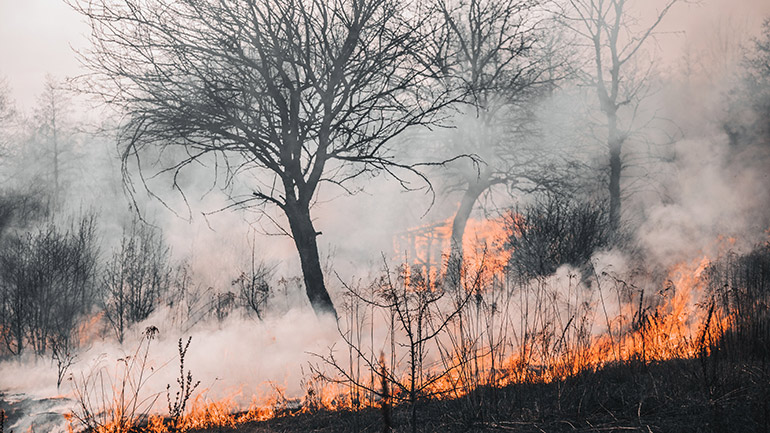
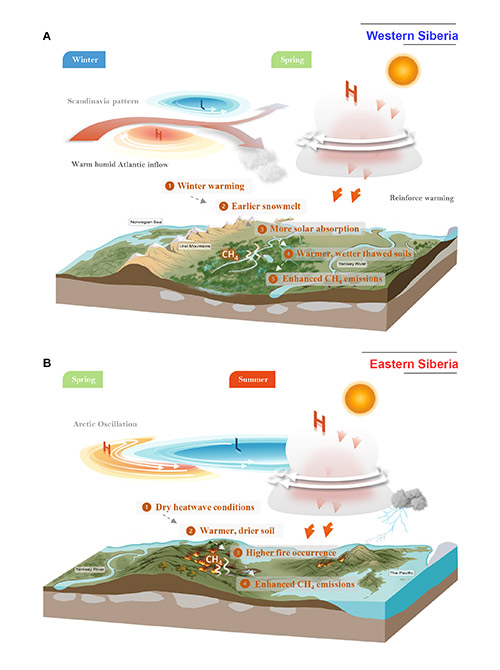 The research highlights a sharp rise in wildfire-driven methane emissions in eastern Siberia since 2019. Hotter, drier summers - linked to persistent high-pressure weather systems - are creating ideal conditions for large, long-lasting fires.
These fires release methane directly, but they also accelerate permafrost thaw, potentially leading to longer-term increases in emissions.
Although Siberia produces a small share of global methane, the increase matters worldwide -including in the UK - because methane spreads quickly through the atmosphere and significantly contributes to global warming.
The findings suggest a worrying cycle: as the Arctic warms, more methane is released, which then causes further warming.
Dr Rob Parker, based at the National Centre for Earth Observation and the School of Physics and Astronomy at the University of Leicester, produces the atmospheric methane data from the Japanese GOSAT satellite that underpins the analysis in this study. This long time series of data, now exceeding 17 years, is one of the longest satellite-based records of methane and gives valuable insight into how this important greenhouse gas is responding to climate change.
Dr Parker said: “Satellites allow us to constantly monitor the globe which is especially important for methane as some of the most significant changes are being observed in places where it is very challenging to monitor in-person, such as tropical wetland areas and as in this case, Arctic regions.
“As huge efforts are made internationally to introduce policies to reduce the human-made emissions of methane (e.g. from oil and gas use), understanding the natural emissions and how they are being affected by climate change becomes even more important.”
Professor Paul Palmer, NCEO Science Director at the University of Edinburgh, said: “What we are observing is a direct consequence of the Arctic warming, driven by rising greenhouse gases. As previously frozen ground begins to thaw, stored carbon becomes available for microbes, which can produce methane as they break it down. In other regions, warmer and drier conditions are increasing the risk of wildfires, which release additional greenhouse gases, including methane and carbon dioxide.
“This research would not have been possible without the UK’s national Earth observation capability at NCEO, with satellite data providing the only practical way to monitor methane emissions across Siberia’s vast and inaccessible landscape.”
- The National Centre for Earth Observation (NCEO) is a UK research centre delivering world-leading science using satellite data to understand environmental change.
- The study analyses methane emissions from 2010 to 2023 using satellite and atmospheric datasets.
- Methane is over 25 times more effective than carbon dioxide at trapping heat over a 100-year period.
- The Arctic permafrost region stores around 1,700 billion tonnes of carbon, roughly twice the amount currently in the atmosphere
- The research was funded by NCEO via NERC.