Royal Society recognises University of Leicester colleagues’ outstanding contributions to science
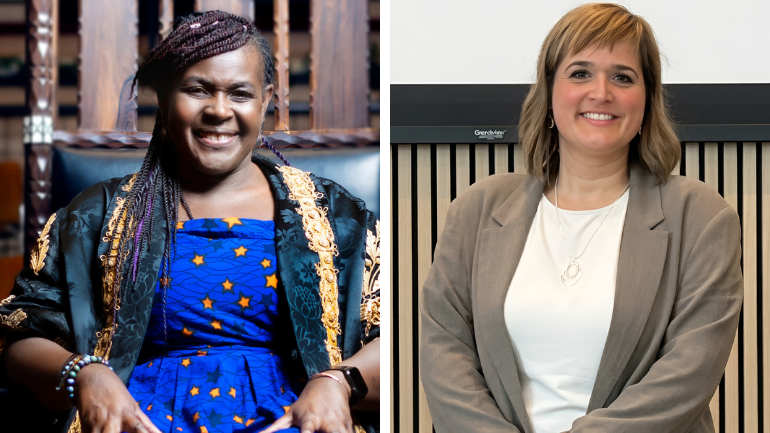
Dame Dr Maggie Aderin DBE, left, and Dr Patricia Rodriguez-Macia




Two University of Leicester colleagues have been recognised for their outstanding contributions to science by the Royal Society.
The University’s Chancellor and science educator, Dame Dr Maggie Aderin DBE, has been honoured with the society’s David Attenborough Award and Dr Patricia Rodriguez-Macia, from the School of Chemistry, the Rosalind Franklin Award.
They join 25 other Royal Society medal and award winners chosen for their outstanding contributions to scientific discovery, public engagement and research culture.
Dame Maggie was recognised for her commitment to widening participation, reshaping public understanding of space science and scientific discovery, and innovative outreach that has impacted millions.
The award-winning space scientist, broadcaster and author, who is perhaps best-known for her work as a presenter on the BBC’s The Sky at Night, was installed as Leicester’s Chancellor in 2023.
She said: “I am truly honoured to receive the David Attenborough Award, which is particularly poignant for me, given Sir David’s links to the University and Leicester, where he spent his formative years.
“My mission has always been to make science as simple and engaging as possible for the public, so I am delighted to see this work recognised by the Royal Society.”
Dr Patricia Rodriguez-Macia was honoured thanks to her achievements in developing new artificial metalloenzymes and her proposed outreach and mentorship programme that engages secondary school girls from underrepresented communities.
Dr Rodriguez-Macia’s research brings together chemistry and biology to develop new artificial enzymes that can help convert small molecules such as hydrogen and carbon dioxide into sustainable fuels.
Her outreach and mentorship programme, STEM Pathways: From Classroom to Laboratory, engages Leicester secondary school girls from underrepresented communities through sustained school workshops, immersive laboratory placements, and long-term mentoring to support their progression into STEM education and careers. By focusing on schools serving diverse communities with historically lower progression rates into STEM, this project aims to address structural barriers at an early stage.
Dr Rodriguez-Macia said: “I am deeply honoured and grateful to receive this award from the Royal Society. I have always dreamed of using science to make our world a better place.
Since the beginning of my academic journey, I have also been passionate about making academia a more inclusive and supportive environment, where people from all backgrounds, cultures and experiences can thrive.
“To me, this award recognises not only my scientific achievements, but also my commitment to building a more diverse, inclusive and equitable scientific community, one where it does not matter where you come from, but what you aspire to achieve, and where everyone has a voice.”
Sir Paul Nurse, President of the Royal Society, said: “The recipients of this year's medals and awards have made exceptional contributions to science and research culture. Their work has helped further our understanding of the world around us and will inspire generations of scientists to come.
“Celebrating excellence in science is core to the Society’s mission. I offer my congratulations to all the 2026 recipients.”
The Royal Society is a self-governing Fellowship of many of the world’s most distinguished scientists drawn from all areas of science, engineering, and medicine. The society’s fundamental purpose, as it has been since its foundation in 1660, is to recognise, promote, and support excellence in science and to encourage the development and use of science for the benefit of humanity.