New school harnesses expertise across the sciences to tackle sustainability, climate, environment and human health challenges at University of Leicester





The University of Leicester has launched a new School of Chemical, Earth and Environmental Sciences (CEES), harnessing expertise from across the sciences to help tackle issues around sustainability, climate, and human health.
The new School brings together teaching and research in Chemistry and Geography, Geology and the Environment to create a hub for cross-discipline collaboration within the University’s College of Science and Engineering.
Led by Professor Kevin Tansey, an expert in remote sensing and the use of Earth observation data, CEES is an opportunity to build on Leicester’s established strengths in Chemistry, Geography, Geology and environmental science while developing new connections between them and across the wider University.
The launch comes as the new School also welcomes the first students for its first new course, in pharmaceutical science.
Understanding climate and environmental change, developing more sustainable materials and approaches to resource use, advancing chemical biology and diagnostics, and understanding interactions between human activity and our environment all benefit from different scientific perspectives.
Chemistry, Earth and environmental sciences already intersect in fields ranging from materials and resources to atmospheric and environmental science. CEES provides an opportunity to strengthen those connections, develop new collaborations and open up new possibilities for research and partnership, while maintaining strong disciplinary expertise.
CEES will focus its research around three areas: Sustainable Materials and Resources; Chemical Biology and Diagnostics; and Climate and Environmental Futures. These build on existing strengths at Leicester and align with important national and international priorities, including net zero, life sciences and the UK’s future industrial strategy.
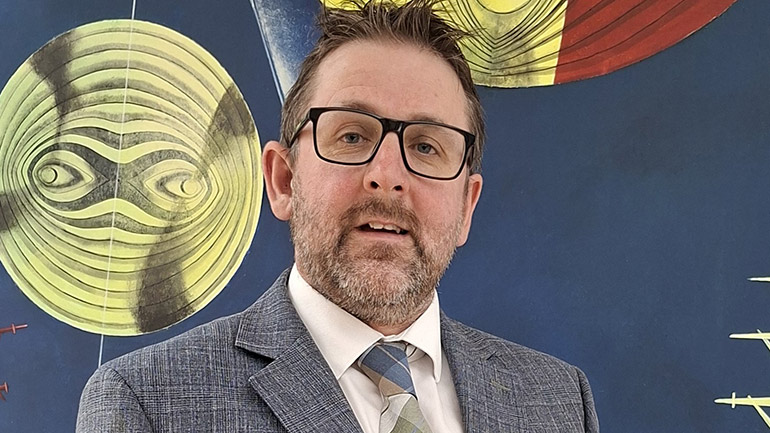
Professor Kevin Tansey, Head of the School of Chemical, Earth and Environmental Sciences.
Professor Kevin Tansey, Head of the School of Chemical, Earth and Environmental Sciences, said: “I am delighted to be offered the opportunity to lead the development of this new academic School. If we are to tackle some of the most significant issues facing society today, such as climate change, food security and live in sustainable and healthy ways, then scientists from different disciplines need to work closely together. This will naturally lead to the development of new and exciting teaching programmes and educational opportunities that will provide the necessary skills and competencies for our students to be successful and make valued contributions in a changing world. This includes understanding how AI can be used effectively to advance and embed knowledge, working closely with industry, including those at Space Park Leicester, and developing international partnerships.”
The launch of CEES also coincides with its first new course: the Pharmaceutical Science BSc will begin teaching its first students this academic year, exploring the science behind medicines that change lives. From designing molecules in the lab to understanding how drugs work in the body, the course will explore chemistry, pharmacology, biotechnology and more. It will combine rigorous scientific training with the practical skills students will need to help shape the future of healthcare.
Professor Dirk Schaefer, Pro Vice-Chancellor and Head of College for Science and Engineering, said: “Strong disciplines remain fundamental to excellent universities. At the same time, some of the most interesting scientific advances occur when expertise from different disciplines comes together around a problem or an idea.
“My ambition is that CEES becomes recognised both for the excellence of its individual disciplines and for the distinctive research, education and partnerships that develop from bringing those strengths together. I want Leicester to be ambitious in this space by building a School whose work is recognised for being distinctive, collaborative and forward-looking.”