Outstanding University of Leicester researchers secure UK Government’s prestigious leadership fellowship
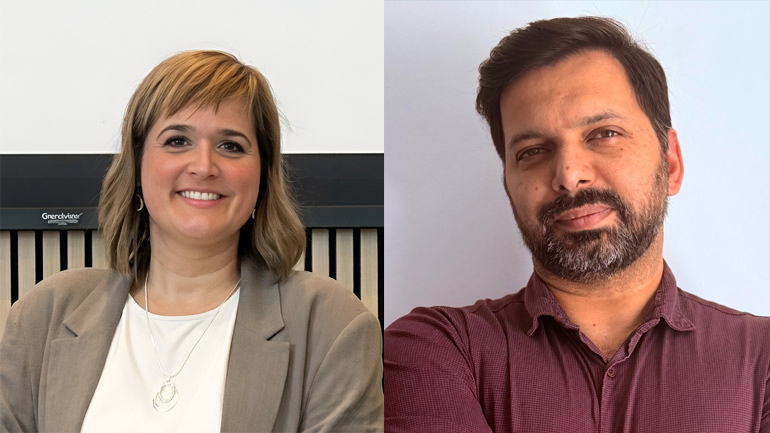
L-R: Dr Patricia Rodriguez-Macia from the School of Chemical, Earth and Environmental Sciences, and Dr Himanshu Kaul from the School of Engineering.




Two talented early career researchers from the University of Leicester will be helped to reach their potential with a prestigious leadership fellowship from the UK Government.
Dr Patricia Rodriguez-Macia, from the School of Chemical, Earth and Environmental Sciences, and Dr Himanshu Kaul from the School of Engineering, have secured the sought-after UKRI's Future Leaders Fellowship (FLF).
The scheme is one of the UK's most prestigious and competitive fellowship programmes, designed to support outstanding researchers and innovators with the potential to become future leaders in their field.
Dr Rodriguez-Macia’s fellowship will help her play her part in the acceleration of the development of technologies for clean hydrogen, carbon-neutral fuels, carbon dioxide utilisation and sustainable chemical manufacturing. Her project will help reduce reliance on fossil resources and support the transition to net zero by establishing new foundations for catalyst design, strengthening the UK's leadership in sustainable energy innovation.
This will be achieved with the development of a new platform for the generation of biohybrid catalysts by combining biology, chemistry and artificial intelligence. Using protein engineering, mechanistic studies and machine learning, the project will uncover how enzymes and synthetic catalysts work together and use these insights to design more efficient catalysts.
Dr Rodriguez-Macia said: “I am incredibly honoured to have been awarded a UKRI Future Leaders Fellowship. Ever since I first learned about the scheme after moving to the UK, it has been something I aspired to, and I have been working towards this opportunity for many years.
“What makes the FLF so special is that it represents a different vision of research leadership. It is not only about the outstanding science you want to pursue, but also about the kind of leader you want to become, the legacy you want to build, and how you will use that platform to make a positive difference.
“The fellowship provides something that is increasingly rare in modern research: long-term, flexible, and protected support to pursue ambitious ideas. It creates the space to rethink how research is done, develop innovative approaches, influence policy and industry, support the next generation of researchers, and contribute to wider societal change.”
Dr Kaul’s fellowship, co-hosted by the School of Engineering and Division of Respiratory Sciences, will see him investigate how respiratory diseases develop and respond to treatment.
Respiratory diseases such as asthma and COPD are a major global health challenge, but current models cannot fully explain how disease develops across the different biological scales of the lung. This fellowship will create the Lung Pharmacome, a digital lung that combines personalised physiological and pharmacological data to reveal disease development and treatment response.
The project will integrate computer models linking genes, cells and lung function with patient-derived lung organoids to test and validate findings. Together, these tools will provide new insights into disease mechanisms, improve prediction of patient responses to therapies, and accelerate the development of personalised treatments and new medicines.
Working with clinical and pharmaceutical partners, the Lung Pharmacome aims to transform respiratory medicine by enabling more precise treatment decisions and supporting drug development through virtual testing. Over the next decade, it has the potential to improve patient outcomes, reduce NHS costs, and significantly cut the time and expense required to bring new respiratory therapies to market.
Dr Kaul said: “I am grateful to UKRI for this recognition and significant investment in a programme that aims to innovate technologies, tools, and methodologies for delivering precision medicine at scale. This support will enable me to unite expertise across engineering, biology, data science and partners across the NHS, industry, and charity sectors to build an interoperable platform capable of predicting personalised disease progression and personalising therapies before patients are exposed to risk.
“A key ambition of this programme is to shift respiratory medicine from trial-and-error prescribing to mechanism-guided, personalised treatment. For patients and healthcare systems, this has the potential to reduce ineffective treatments, improve outcomes, and optimise NHS resources. For the pharmaceutical sector, it offers the opportunity to evaluate therapeutic strategies earlier using human-relevant models, helping derisk development and accelerate the delivery of new drugs.
“Beyond the scientific and technological opportunities, I look forward to working alongside an outstanding community of researchers, clinicians, innovators, and stakeholders. Addressing complex healthcare challenges requires collective effort, and this fellowship provides a unique platform to build the partnerships needed to deliver meaningful and lasting impact.”