Discovery of three giant planets could provide rare glimpse into early solar systems
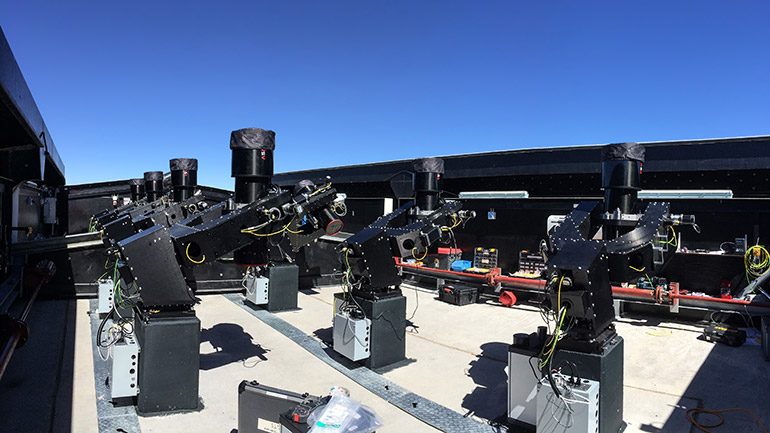
The Next-Generation Transit Survey (NGTS), located at ESO’s Paranal Observatory in northern Chile. Credit: ESO/R. West




University of Leicester scientists have identified three planets in other solar systems that could reveal clues to the early evolution of planetary systems.
Detailed in a new study for Monthly Notices of the Royal Astronomical Society, these three gas giants orbit far enough away from their host stars that their atmospheres can potentially be studied in efforts to learn more about their origins.
The three planets - TOI-4940b, NGTS-34b and NGTS-35b - were initially seen using TESS (Transiting Exoplanet Survey Satellite) and followed up by the Next-Generation Transit Survey (NGTS). These telescopes use the transit method, in which astronomers look for a ‘dip’ in the light from a star as a planet orbits around it.
Most confirmed transiting gas giants have shorter orbital periods and are closer to their host stars than these new discoveries. For longer period planets, nailing down their orbital period is challenging and so there are fewer confirmed transiting exoplanets beyond 10 day orbits. The planets in this paper join a small number of planets confirmed as a result of dedicated long period planet searches, thanks to the unique capabilities of NGTS.
Lead author Alicia Kendall, PhD student at the University of Leicester School of Physics and Astronomy, said: “Whilst these new discoveries are at relatively long orbital periods compared to most known transiting planets, our solar system gas giants orbit on much longer timescales. However, planet discoveries are pushing to longer and longer orbital periods as we hone our methods and tools. Ultimately, we want to find systems that look like our solar system, and this is a step on that road.”
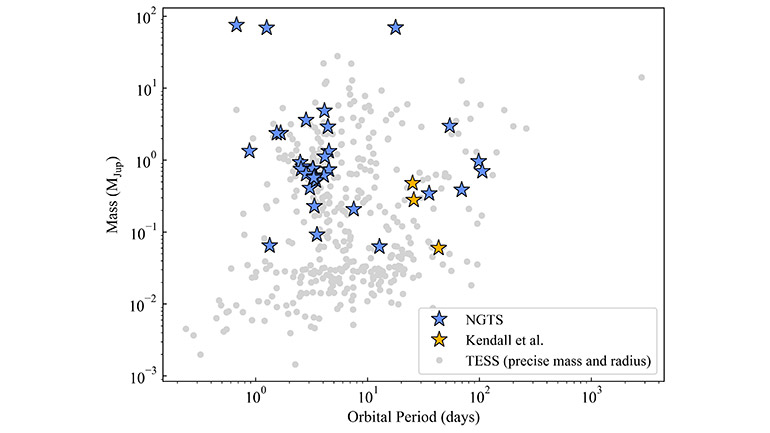
The graph shows current NGTS named planets/brown dwarfs as blue stars, while yellow stars are the three planets in the latest paper. (Credit: Amber Sedgley, University of Warwick)
All three planets have wide enough orbits that they likely experience less heating from their host stars. This is useful because it makes it simpler to understand how the planet may have formed and evolved to how we see it today.
TOI-4940b is a rare Saturn-size and -mass planet - there are fewer planets confirmed around this area of mass and radius regardless of orbital period.
NGTS-34b is one of the top few long period transiting Neptune-size and -mass planets. These are especially difficult to confirm because of their relatively small size and mass.
NGTS-35b is especially interesting because of its cooler temperature being favourable for atmospheric observations in terms of what we might expect to see.
NGTS-34b and NGTS-35b are potentially valuable as part of future atmosphere studies with the James Webb Space Telescope (JWST). Despite how far away they are from their host stars and the challenge of NGTS-34b being smaller and lighter, we would expect JWST to achieve high enough quality observations to help measure the composition of their atmospheres.
NGTS-35b is especially useful because it is among a small set of well-measured planets cold enough that nitrogen in the form of ammonia might be present in the atmosphere to allow scientists to work out how far away from the host star it originally formed. Planets similar to this will be helpful for improving understanding of how and where planets form and their evolution.
Alicia adds: “These three new planets are part of the early days of successes to come through long period planet searches. To me, the discovery of these and other longer period transiting planets is very exciting when thinking about how much we can learn about what happened gigayears ago to make them appear as they do today and how we might start to apply that to our own system.
“As an added bonus, these exciting discoveries mark 100 refereed publications with involvement from the NGTS consortium, representing over a decade of hard work across many institutes and countries!”
- A 43 d transiting Neptune and two 25 d Saturns from TESS, NGTS, and ASTEP is published in Monthly Notices of the Royal Astronomical Society, DOI: 10.1093/mnras/staf2189