Blood vessel genes could be targets for heart disease drugs: new study
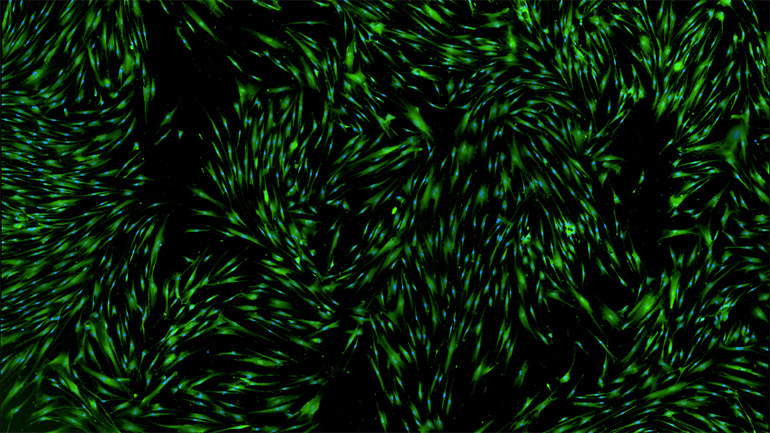
Fluorescent microscope images of cultured vascular smooth muscle cells showing the main cell body (cytoplasm) in green and the nucleus (blue) that contains the cells’ DNA.




18 genes related to multiple vascular diseases have been identified by University of Leicester scientists.
New research that investigated genes that are involved in the function of the cells that make up our blood vessels potentially paves the way for treatments that can tackle multiple heart conditions.
The study, the first by the University’s recently appointed British Heart Foundation Leicester Centre of Research Excellence (CRE) Fellows, has been published in the journal Nature Communications.
The scientists found 18 genes that are associated with two or more vascular diseases. Of these, they selected 4 genes (FES, BCAR1, CARF and SMARCA4) for further validation and confirmed their role in regulating vascular smooth muscle cell behaviour and function.
Vascular smooth muscle cells are a type of cell that forms the middle, and often the thickest, of the three layers of our blood vessels. Vascular smooth muscle cells play an important role in vascular health by relaxing and contracting in response to stimuli, altering the diameter of the vessel and in turn local blood pressure.
In some vascular diseases, vascular smooth muscle cell function is known to be altered and they become less efficient at regulating local blood pressure, often causing increases in blood pressure that can lead to hypertension. They can also proliferate and migrate and help to form atherosclerotic plaques that can contribute to diseases such as coronary artery disease, which can lead to heart attacks, and they can undergo functional changes that contribute to increased stroke or aneurysm risk.
The genes validated in this study are all associated with coronary artery disease as well as other diseases; FES is associated with hypertension, BCAR1 and SMARCA4 are associated with aneurysm and CARF is associated with stroke.
Dr David McVey, Senior Research Associate and CRE Fellow, said: “Many of the genes we have identified are potentially or known to be targetable with drugs, offering the opportunity to develop new treatments that can benefit patients with one or more cardiovascular diseases. It may even be possible to treat multiple vascular diseases in a patient using a single drug.
“Future work will endeavour to translate these findings into improved patient outcomes and also to explore other cardiovascular disease-associated cell types, such as endothelial cells, to understand how genetic variation affects their function and contributes to disease risk.”
Initially, the team identified genes that are associated with different, individual vascular diseases and then examined whether any genes are shared between different diseases. They then switched off genes at random within vascular smooth muscle cells using the CRISPR technique and measured cell division and movement. This allowed them to determine which genes affected these behaviours, which were then validated in follow-up experiments.
The four genes validated were selected based on the strength of the evidence for their role in vascular disease, including whether they are associated with multiple vascular diseases, were among the top 10 genes found in the CRISPR experiment and whether they are potentially targetable with existing drugs. The results provide valuable insights into the shared genetic underpinnings of multiple cardiovascular diseases that affect millions of people worldwide.
Dr Charles Solomon, Research Associate and CRE fellow, said: “We need to understand how genes and genetic variation (the differences in our DNA that make us unique) contribute to vascular disease risk. To do this, we need to investigate the underlying mechanism driving these associations with disease in not only smooth muscle cells but also other vascular cell types involved in disease. With this greater understanding, we will be able to translate our findings into better outcomes for patients through the development of new treatments and risk prediction tools.”
Professor Andre Ng, Consultant Cardiologist and Director of the BHF Leicester CRE, said: “This is exactly what we want to see and achieve with the BHF Centre of Research Excellence. A main aim of the CRE is to nurture the next generation of world-class cardiovascular researchers. I am extremely pleased to witness such outstanding research output from our newly appointed CRE fellows. Their discovery of key genes contributing to vascular disease risk not only highlights the importance of fundamental science in advancing our understanding of disease mechanisms but also opens exciting opportunities to develop new treatments with significant impact."
- Integrative functional genomics analysis identifies pleiotropic genes for vascular diseases is published in Nature Communications, DOI: 10.1038/s41467-026-69273-8