University of Leicester researchers take part in parliamentary roundtable on NHS staff retention
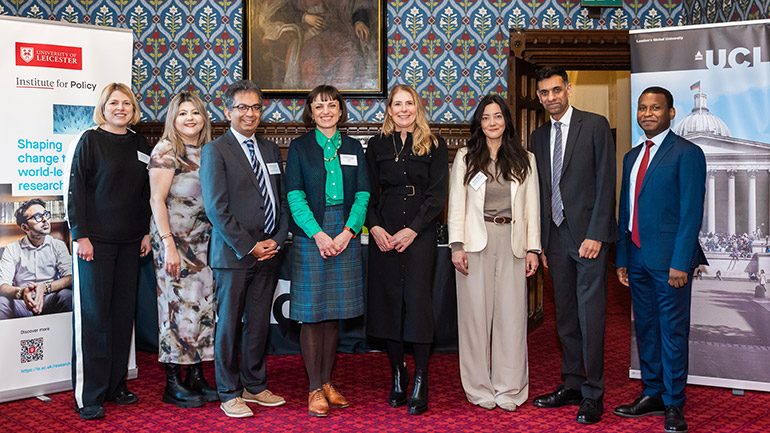




A University of Leicester health academic was invited to Westminster to discuss his research as part of a roundtable exploring strategies to retain NHS staff, particularly those from diverse and ethnic minority backgrounds.
The roundtable, which took place on Monday 8th December co-organised by the University of Leicester Institute for Policy with UCL, was hosted by Sarah Owen MP, Chair of the House of Commons Women and Equalities Select Committee, who brought together experts and policymakers to share evidence-informed research that could help develop policies at national and local levels.
Professor Manish Pareek, Clinical Professor in Infectious Diseases at the University of Leicester, joined the panel for the event, which was chaired by Professor Ibrahim Abubakar (UCL Vice-Provost Health) and included Professor Katherine Woolf (UCL Medical School), Professor Habib Naqvi MBE, Chief Executive of the NHS Race and Health Observatory, Dr Elaine Kelly, Assistant Director of the Health Foundation, Clare Teeney, Chief People Officer at the University Hospitals of Leicester NHS Trust and Kirandip Gill, Chair of a group representing patient voice.
Set in Westminster’s Grand Committee Room, the roundtable took place in the context of the UK Government’s new target to reduce overseas NHS recruitment to 10% by 2035, in a bid to restrict immigration and grow local recruitment. However, concerns remain that this could negatively impact the health service, given that one in five NHS staff in England are overseas nationals and over a third are from ethnic minority groups
Opening the roundtable, Sarah Owen, the MP for Luton North, officially welcomed attendees, and Bell Ribeiro-Addy MP also attended and gave an address.
The discussion focussed on effective strategies to support and sustain a diverse NHS workforce from ethnic minority groups, whether from the UK or overseas, and provided an opportunity for Professors Pareek and Woolf to summarise the evidence from their ongoing work on the I-CARE research project.
Funded by the National Institute for Health and Care Research (NIHR), I-CARE is co-led by Professor Pareek and Professor Woolf. The large study aims to support the sustainability of a diverse NHS workforce by improving an understanding about how and why NHS staff from minority groups leave or stay in their jobs. By working with key stakeholders, the researchers aim to support policy development and delivery.
Professor Pareek said: “To improve retention, our research suggests that the NHS needs to implement systematic cultural changes to better support staff mental health and ensure NHS staff feel valued by their employers, by patients and the government (action on pay may support the latter). It is essential to tackle discrimination and to build opportunities for healthcare workers to forge strong social links with one another.”
Professor Woolf said: “Without significant action to retain current staff from overseas and, increasingly, UK nationals from ethnic minority backgrounds, there is a real risk of a staffing collapse within the NHS. Experienced staff, including those from overseas who are already working in the NHS, cannot easily be replaced by newly qualified staff. This isn’t just about raw numbers; it’s also about lost experience.”
After analysing over two million NHS human resources records from 2009 to 2024, interim findings from the I-CARE study showed that overseas nationals were more likely to leave the NHS than UK nationals. Concerningly, in recent years, UK nationals from ethnic minority backgrounds have been increasingly likely to leave the NHS compared to white British UK nationals.
Further interim findings from the study found that healthcare workers who migrated to the UK are more likely to leave the NHS to go overseas, whereas UK healthcare workers are more likely to leave healthcare entirely or retire early.
During the event, attendees discussed the major barriers and policy levers/opportunities for improving the retention of staff from minority ethnic groups, including the pay gap and representation at senior level.
Professor Ibrahim Abubakar, UCL’s Vice Provost (Health) said: “In an increasingly populist and polarising debate around migration, the voices of migrant healthcare workers are being lost, and they risk being further disadvantaged by racism and discrimination. Migrants make valuable contributions to the global economy, healthier societies and the health workforce, particularly against the backdrop of declining birth rates and ageing populations.
“To retain and attract talent and expertise, there is an urgent need for the NHS to address increasing workloads and visa costs for international staff, improve reward schemes and workforce development and to push back against a hostile political environment.”
The findings from the I-CARE study will be published in a full report next year, and the researchers hope that it will provide significant guidance for government and policymakers.
Sarah Owen MP said: “People from ethnic minority backgrounds make an enormous contribution to our health service but all too frequently are faced with discrimination, harassment and abuse.
“They can face abuse from patients, visitors and, alarmingly, from other colleagues. It harms careers and has been found to have significant mental health impacts. Often, it is women who bear the brunt. I welcome the important research being undertaken by UCL and the University of Leicester and look forward to seeing their final conclusions.”
Several University of Leicester academics also attended the event as observers, including:
- Dr Wen Wang
- Mrs Holly Reilly
- Dr Anna Guyatt
- Professor Thompson Robinson
- Dr Joy Spiliopoulos
- Dr Jennifer Creese
- Dr Natalie Darko
- Dr Mayuri Gogoi