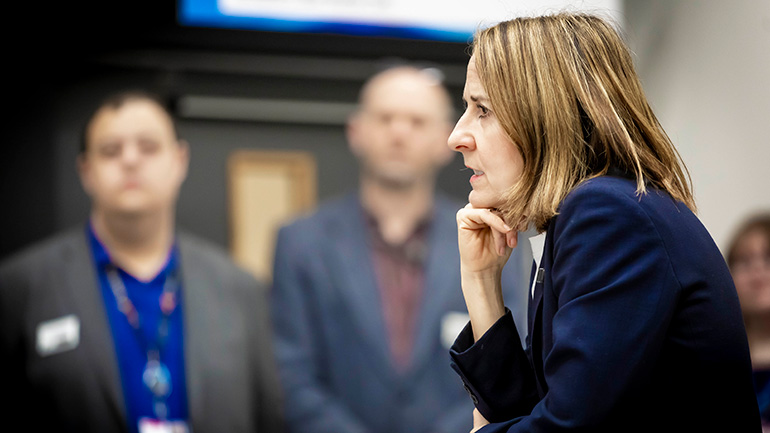
Space City Leicester welcomes Government Minister and Leicester MP to world-leading facilities
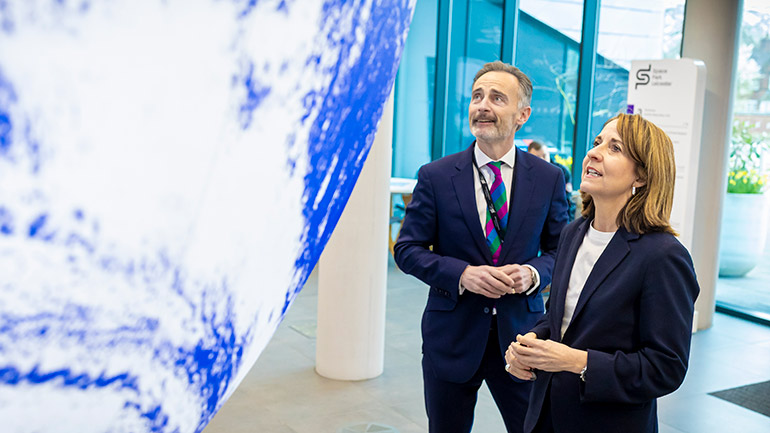




Scientists and experts at Space Park Leicester and the National Space Centre have showcased how they are venturing into the final frontier in space research and education for Government Minister and Leicester MP Liz Kendall.
As British Science Week blasted off, the Secretary of State for Science, Innovation and Technology and Member of Parliament for Leicester West visited the University of Leicester’s £100 million research, innovation and teaching hub to discover how the park is transforming the economy and providing opportunities through space.
As part of her visit to Leicester’s Space City – the wider innovation ecosystem in the area – Liz also visited the National Space Centre, where she joined a national roundtable with leading space industry experts and saw first-hand the educational outreach undertaken by the National Space Centre to encourage careers in space.
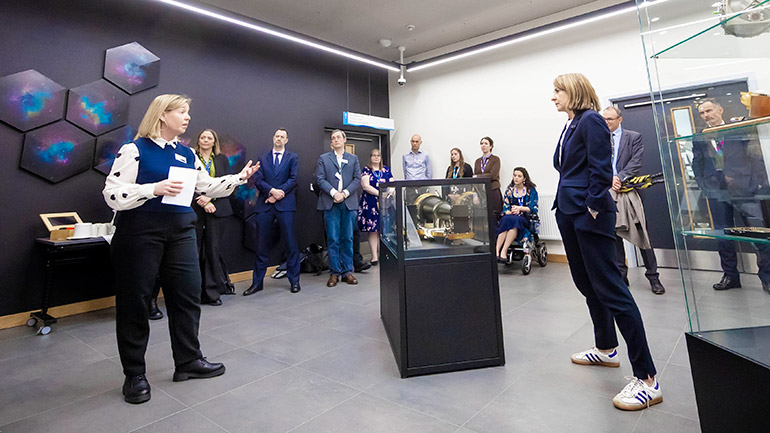
During a tour of the cutting-edge facilities at Space Park Leicester, the Minister spoke to key figures in some of the current and upcoming space missions that the University of Leicester has contributed to, including the BepiColombo mission to Mercury and the SMILE (Solar wind Magnetosphere Ionosphere Link Explorer) mission due to launch in April. She also learned how Space Park Leicester is creating business from transformative research conducted at the University from Professor Richard Ambrosi, Director of spin-out company Perpetual Atomics, which is set to revolutionise the application of nuclear technology in space.
Space Park Leicester’s unique approach to developing education and skills that underpin the rapidly expanding space and space-enabled sectors was showcased by current students and their lecturers. The Minister saw how students had unprecedented access to facilities used for these space missions, while also meeting with a graduate working with one of Space Park Leicester’s community of partner businesses.
The Minister also learnt about the University’s new Leverhulme Centre for Humanity and Space and its Humanising Space work, that aim to increase the understanding of how humans engage with and experience space by engaging with the arts, humanities and social sciences.
Will Wells, Chief Executive Officer of Space Park Leicester, said: “It was an honour to welcome Liz Kendall MP to Space Park Leicester and showcase our role in Leicester’s Space City. Leicester truly is the UK’s space city. The University’s heritage in space research stretches back over 60 years, with at least one piece of Leicester-built equipment operating in space since 1967. Together with our close neighbours in Space City, including the National Space Centre and the Dock incubators, we have become one of the UK’s most vibrant space clusters and building the region’s place in the space sector through real-world impact, high-value jobs and tangible impact on our economy.”
Chas Bishop, Chief Executive of the National Space Centre said: “Hosting the Secretary of State for Science, Innovation and Technology at the National Space Centre was a wonderful opportunity to showcase the impact of our work as both a leading visitor attraction and an educational charity. Her conversations with schoolchildren brought to life the importance of inspiring young people to see themselves in the UK’s space future. We were also proud to give her an early look at the new developments in our Outer Solar System gallery, which will form a key part of our 25th anniversary celebrations this summer. Visits like this underline how vital public engagement and education are to a thriving national space ecosystem.”
Professor Emma Bunce OBE, Director of the University of Leicester Institute for Space, said: “This was a fantastic opportunity to talk with the Minister about Leicester’s involvement in exciting upcoming missions like BepiColombo and SMILE, as well as the long heritage that the University and city has in supporting space exploration. Space Park Leicester builds on that tradition with its leading-edge work to advance our knowledge of space and the world around us, and helping to boost the regional and national economy through its skills and education agenda.”