Scientists call for Anthropocene epoch to be officially formalised as evidence of its influence grows
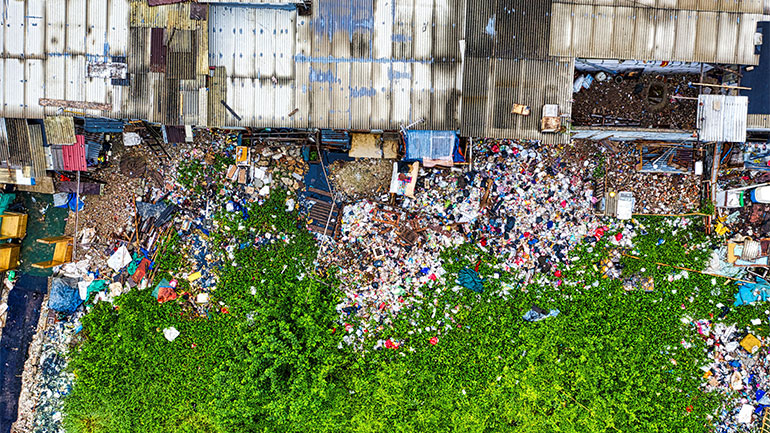
Aerial shot of a slum in Jakarta showing rooftops and large piles of waste and greenery. Source: Pexels


Experts arguing for the official recognition of the proposed Anthropocene geological epoch have published the compelling evidence they gathered to support their case for the first time.
Their message is that the Anthropocene is real: the Earth – and not just our human world – changed fundamentally in the post-WWII global boom, and scientific proof and global understanding of this realisation are growing rapidly.
Published in two major papers in Nature Reviews Earth & Environment led by University of Leicester scientists Professors Colin Waters, Jan Zalasiewicz, Mark Williams and Jens Zinke, that message is in stark contrast to the formal rejection of this proposed epoch by the International Commission on Stratigraphy in 2024.
The first paper publishes, for the first time, the evidence submitted in the proposal to formalise the Anthropocene in 2023. More than a hundred lines of evidence show that Anthropocene strata are clearly distinctive, recording a fundamental departure from the stable conditions of the Holocene Epoch, eleven millennia after the Ice Age retreated during which human civilization developed and thrived.
The abruptness of the boundary – marked by a worldwide scattering of radioactive plutonium when thermonuclear bomb tests began in 1952 – is rivalled only by that 66 million years ago, when a mighty meteorite impact ended the Cretaceous Period and the reign of the dinosaurs.
Professor Colin Waters, Honorary Professor at the University of Leicester School of Chemical, Earth and Environmental Sciences, said: “The Anthropocene is more than just a striking new geological phenomenon. It represents rapid, irreversible and intensifying change to a different kind of planet: one of hotter climate, higher sea levels, a degrading biosphere, myriad new kinds of pollution, galloping technology, and altered human hopes: it matters – to us all.”
The companion paper shows how the Anthropocene concept is growing not just in the sciences, but in the arts and humanities too. New institutes researching its implications are springing up, new connections are being made between formerly siloed kinds of knowledge, and new conversations are developing in education, law and policy circles. Even though formally rejected by the geological establishment, the concept is already making a difference.
Professor Jan Zalasiewicz from the University of Leicester School of Chemical, Earth and Environmental Sciences said: “A key message of both papers is that the Anthropocene should be made formal and become part of the Geological Time Scale. Partly because it is geologically very real, and it won’t go away. And partly because the Anthropocene, in the quarter-century since it was first proposed and used informally, has acquired a range of very different meanings. The resulting conceptual free-for-all still has its supporters. But formally stabilising the Anthropocene’s meaning so we are all talking about the same thing would help us communicate about our planet – even as it transforms around us.”
Professor Mark Williams from the University of Leicester School of Chemical, Earth and Environmental Sciences added: “Since Nobel laureate Paul Crutzen first proposed the Anthropocene in 2000, the concept has lost none of its power to reshape how we understand humanity’s relationship with the planet. Recognising the reality of the Anthropocene means recognising that a stable Earth System was the foundation on which human societies depended. Mitigating its current destabilisation and discovering alternative ways to thrive equitably on this different planet are the new goals framed by the Anthropocene concept. We need to understand that reality in order to build a truly sustainable future.”