Space Park Leicester generates over £70m in economic value annually
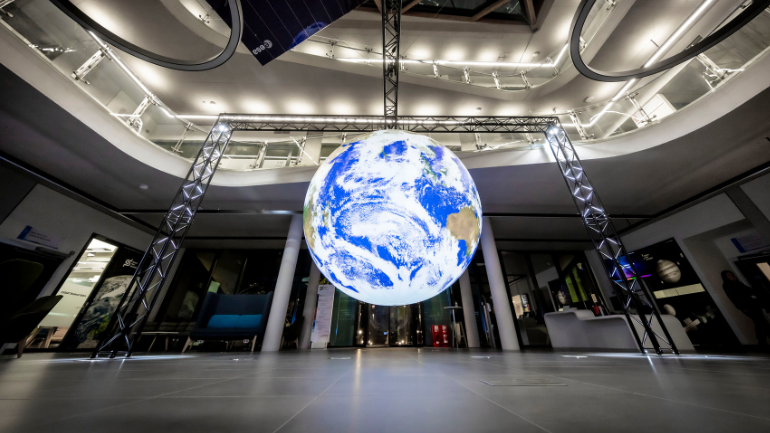
Space Park Leicester.


Space Park Leicester – the UK’s second-largest space innovation campus – is creating £73 million of goods and services for the economy annually, according to the findings of an annual review.
The University of Leicester’s internationally recognised £100m space research, innovation and teaching hub has published the findings in its annual report which also revealed the Space Park Leicester community secured a record £19.7 million in funding for space research last year.
Home to more than 25 organisations, Space Park Leicester underpins the jobs of more than 400 people who are pushing the boundaries of space exploration, satellite technology, and Earth observation to benefit society and the economy.
Space Park Leicester Chief Executive Officer, Will Wells, said: “The past year has seen significant progress for Space Park Leicester.
“Leicester researchers contributed to new satellite missions, advanced technologies for lunar and planetary exploration, developed new approaches to space power and space-based artificial intelligence, and strengthened partnerships with national and international agencies.
“The successful launch of the European Space Agency’s SMILE mission was a particular milestone as its Soft X-ray Imager (SXI) was the first complete space instrument delivered using Space Park Leicester’s facilities. This is significant because SMILE will provide the first-ever X-ray observations of Earth’s magnetic field which will allow scientists to study how the solar wind interacts with the magnetosphere and will ultimately improve our understanding of space weather.
“During the past year we have secured new international and UK investors; welcomed ministers, government agencies and international delegations; supported national discussions on the future of space science; and the US-based Universities Space Research Association established its first European base here which is a fantastic endorsement of Leicester’s growing international position in space research and innovation.
“As the region strengthens its innovation economy, Space Park Leicester is helping turn research excellence into businesses, investment, jobs and productivity, while strengthening the University of Leicester’s civic contribution and national profile.”
The release of Space Park Leicester’s annual review follows a speech by Prime Minister Andy Burnham at the Innovation Nation Summit in which he highlighted space research in Leicester as one of UK’s important assets.
Other significant highlights for Space Park Leicester during the past year have included the £10 million Leverhulme Centre for Humanity and Space continuing its development at the venue. It secured a £1 million AHRC doctoral award and has created 42 research positions to examine humanity’s relationship with space.
More than €2 million in European Research Council funding was secured for Leicester scientists to use the James Webb Space Telescope to study giant planets, building on Leicester’s internationally recognised planetary-science capability.
Leicester research helped to send microscopic worms to the International Space Station this year to support research into how spaceflight affects muscle and ageing which has potential implications for human health on Earth.
Leicester scientists identified three giant exoplanets and developed a new catalogue to classify asteroids from satellite data, contributing to our understanding of planetary systems.
A new carbon-monitoring satellite, developed with significant Leicester scientific involvement, was also launched to improve our understanding of atmospheric carbon dioxide and plant photosynthesis.
Leicester City Mayor Sir Peter Soulsby, said: “Leicester’s status as a Space City is strengthened by the coming together of world-class space research, innovation, enterprise and manufacturing. Space Park Leicester has become a powerful engine for economic growth in our city and by bringing together world-leading researchers, innovative businesses and international partners, it stands as a shining example of how collaboration between the University, the city, industry and government can deliver real benefits for Leicester as well as our region and the wider UK.”
Over the next year, Space Park Leicester plans to continue to expand its research and grow its community of businesses and international partners. It will also further develop its educational offering for UK and global markets, increase its number of student placements and graduate opportunities and continue to convene government, industry, investors and researchers around nationally important opportunities.
Visit the Space Park Leicester website to learn about partnerships, missions, residents, facilities, training programmes and innovation products.