Doctors urge people not to ignore the signs of life changing disease
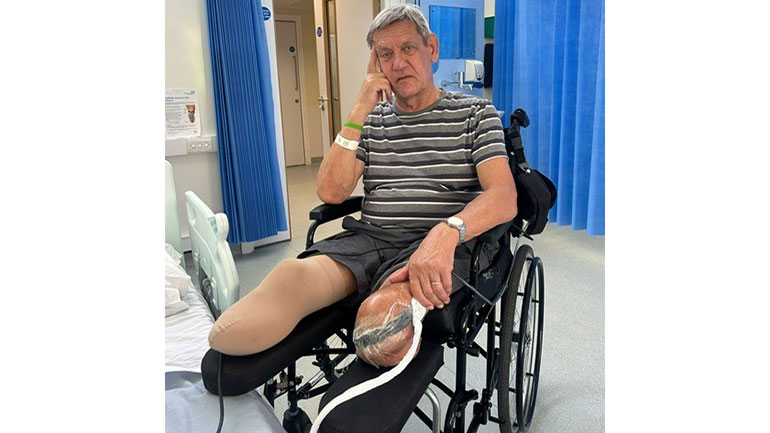
Nic Olsen has had both legs amputated because of peripheral artery disease




A man who lost both legs to a common condition is backing a new campaign by cardiovascular experts to help others spot the warning signs before it's too late.
Nic Olsen, 80, was fit and healthy, regularly exercised and enjoyed weekly bike rides but began experiencing severe pain in his feet, which became ulcerated until eventually he was unable to walk.
Following months of referrals to orthopaedics and eventually a podiatrist, he was finally offered a simple test to measure blood pressure in his feet which immediately identified Peripheral Artery Disease (PAD).
PAD describes a narrowing or blockage in the arteries of the legs or arms, usually the legs and affects approximately 20% of people over the age of 60 in the UK, although people younger than this may also be diagnosed.
Despite this, many people are not aware of the disease and its symptoms, which if untreated can lead to amputation and sudden death.
Sadly for Nic, his diagnosis came too late to save his legs and in April last year he had one leg removed, before his other was amputated in July.
He is now learning to walk using prosthetics but is unable to enjoy his previous outgoing hobbies and relies heavily on his wife, Fiona, for support in his daily care.
Nic, who lives near Market Harborough, said: “I had all the classic symptoms of PAD, pain in my toes and calves, lack of calf hair and ulcerated feet but it wasn’t immediately picked up. The pain became unbearable - it was like being stabbed between each of my toes constantly.
“When the diagnosis came, doctors did what they could to try and save my legs. I had two angioplasty procedures and two bypass surgeries but in the end they couldn’t be saved and I now have to live without my legs.
“I give my full backing to this campaign to raise awareness of PAD so that others don’t have to go through what I’ve been through.”
Nic’s wife, Fiona, said: “It’s been a devastating ordeal. Our lives and plans for our retirement have completely changed. We walked and cycled all the time and took trips, but we’re not giving up. That’s why we fully support this campaign. I’d urge anyone with symptoms to go to their doctor and raise this with them. It could be PAD and a simple test could rule it out.”
Fiona and Nic will be attending the launch of the campaign – ‘Are Your Legs Killing You?’, at Glenfield Hospital, Leicester, on Monday, 2 November. All are welcome to attend.
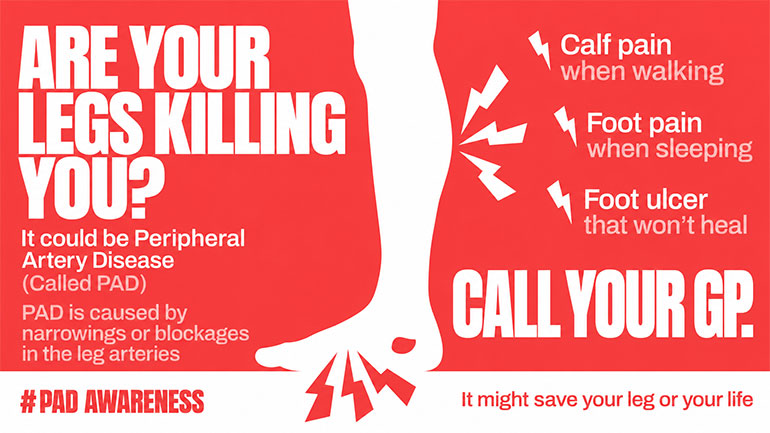
Cardiovascular experts at the University of Leicester and University Hospitals of Leicester (NHS) Trust, are behind the campaign which will feature in social media adverts as well as digital bus adverts and bus stops.
A simple test known as the ankle-brachial index (ABI) test can identify PAD. It is quick and painless and uses a blood pressure cuff and a small ultrasound device (Doppler) to measure blood pressure in your arms and ankles.
Professor Athanasios Saratzis, NIHR Research Professor of Vascular Surgery at University of Leicester, said: “Peripheral Arterial Disease occurs when arteries supplying blood to the legs become narrowed or blocked, reducing blood flow to the lower limbs. People may be familiar with this happening in the heart, where it causes heart attacks, but it can also happen in the limbs, frequently the legs.
“Common symptoms can include calf pain when walking, foot pain when resting or sleeping, and wounds or ulcers on the feet that do not heal. If left untreated, PAD can lead to serious complications including limb loss and an increased risk of heart attack and stroke.
“Our campaign's key message is simple: Are your legs killing you? It could be Peripheral Artery Disease. Call your GP.”
The launch event will bring together patients, carers, clinicians and researchers to discuss why awareness of PAD matters, the importance of recognising symptoms early, and how the campaign was developed.
Professor Athanasios Saratzis added: "Too many people live with symptoms of Peripheral Artery Disease without recognising that they may have a serious condition. Early diagnosis and assessment can make a significant difference to their outcomes. By increasing awareness we hope more people will seek help sooner and receive the care they need."
Paul Hardy, 62, from Leicester, is also supporting the campaign. After receiving a PAD diagnosis four years ago he has had angioplasty procedures to keep blood flowing to his legs and save them from amputation.
He said: “I’d advise anyone with leg pain to go and get it checked out. No one wants to lose their leg but that’s the reality of what could happen if this doesn’t get picked up or even worse. So I’d say ask for the test or face losing a leg.”
The campaign launch will take place in the Clinical Sciences Wing Lecture Theatre, Glenfield Hospital, from 11am -1pm on 2 November. It is organised by the University of Leicester and supported by funding from Association of British HealthTech Industries (ABHI), which has provided support for the development of the national campaign, along with the National Institute for Health and Care Research (NIHR) Biomedical Research Centre: Leicester.
For further information about the campaign or launch event, contact the campaign team on 0116 252 3190. To confirm attendance email [email protected] and include your name and and contact number.
Those on the ‘Community Voices in Vascular Research’ register can confirm attendance by emailing [email protected].
Nic and Fiona Olsen enjoying life before Nic's surgery