New plan to tackle unreliable research antibodies could save millions and improve medical research
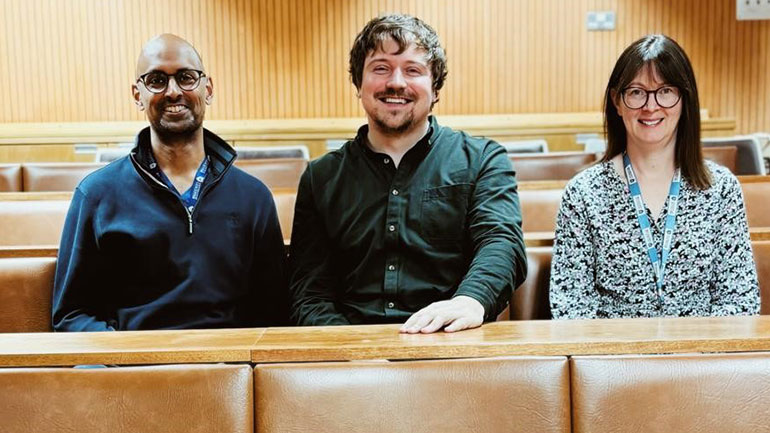
From left: Dr Harvinder Virk, Michael Biddle and Katherine Blades from the 'Only Good Antibodies' team




Millions of pounds could be saved and research quality improved under a new action plan to tackle unreliable antibodies in studies of human and animal biology.
The plan, published in PLOS Biology, has been devised by researchers at the University of Leicester from the ‘Only Good Antibodies’ team, following agreement by a panel of 32 international experts drawn from academic scientists, scientific publishers, research funders, antibody manufacturers and university leaders. The panel rated 33 proposed actions over two rounds. Fifteen were agreed to be both effective and feasible to deliver by 2030.
By making it standard practice to check that an antibody works in the specific experiment it is used for, the initiative aims to reduce waste, increase confidence in research results and support the development of more reliable scientific methods.Research antibodies are used in almost every biomedical and drug-discovery laboratory. They let researchers detect specific molecules in biological samples and underpin many diagnostic tests and therapeutic drugs. Yet a large proportion are unreliable because they do not bind only to their intended target.
Performance also varies between applications, protocols and cell or tissue types, so an antibody that works in one experiment may not work in another. Not only that but the controls needed to show that an antibody performs as expected are frequently missing from published work.
Researchers in Leicester found that just 35 antibodies that performed poorly in tests had been used in more than 700 scientific studies. In 84% of those studies, researchers did not provide evidence that the antibodies had been properly checked to show they worked as intended.
Across these studies, at least 8,000 animal samples and more than 4,400 human tissue samples were tested using antibodies that later failed independent quality checks. This means a large amount of valuable research material may have been used in studies whose results could be unreliable.
The findings come from a second Leicester study, published in PLOS Biology, which highlights the scale of the problem and the potential waste of research resources caused by poorly validated antibodies.
Dr Harvinder Virk, from the University of Leicester’s ‘Only Good Antibodies’ team who helped conduct research on both papers, said: “The proposed plan sets out 15 actions to deliver by 2030, including universities to train researchers and build it into research integrity rules; funders to require validation plans and pay for them; publishers to require full antibody reporting; manufacturers to give every antibody a unique ID. This agreed to-do list sets out who is responsible for each part of the problem, rather than simply another paper outlining how poor the situation is.”
Katherine Blades, also from Leicester’s Only Good Antibodies team, added: “Progress is held back not by disagreement about what to do, but because no single group owns the problem — so everyone waits for someone else to move first.”
Dr Mark Orme, Postgraduate Tutor at the University of Leicester, said: “Good antibody practice is a research skill like any other, and the best time to build it is at the very start of a research career. We’re working to make the OGA Academy modules a standard part of postgraduate induction, so that every student using antibodies learns to choose and validate them well before their first experiment. Embedding it in our training is how it becomes simply the way we work.”
Leicester’s work on antibody reform is being supported by Cancer Research UK as it explores how to strengthen antibody practice among the researchers it funds.
Dr Rebecca Harris, Group Leader at Cancer Research Horizons, the innovation arm of Cancer Research UK, said: "Reliable reagents are the foundation of reproducible science, and antibody validation is an obvious place to raise the bar. We're exploring how the tools developed by the Only Good Antibodies community could help the researchers we fund adopt best practice - a small shift in expectation that could have the potential to meaningfully de-risk the science.”
Dr Virk added: “Together these papers show the problem has significant impact with ethical dimensions and is solvable. Since completing this work, we have embedded champions for better practice in 14 UK research institutions, and the University of Leicester has made antibody validation training mandatory for its bioscience postgraduate researchers. We are working with two national funders — the NC3Rs and Cancer Research UK — on implementation solutions and have built free tools publishers can use to protect the integrity of what they publish.”