University of Leicester pioneer calls for universities to recognise Armed Forces talent
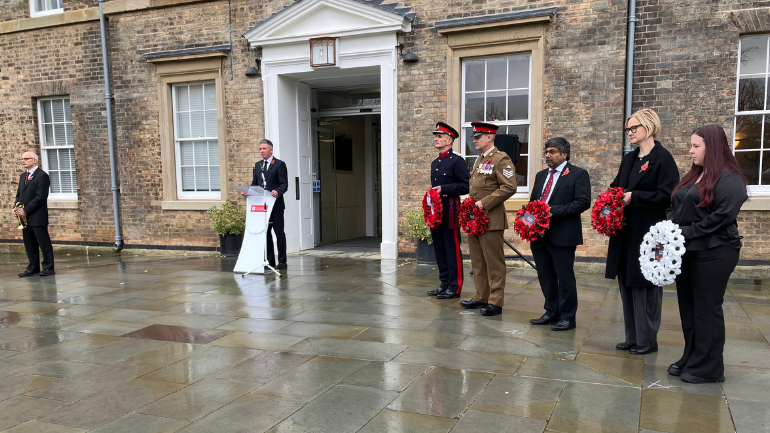
The Remembrance Day ceremony on campus.


A University of Leicester academic who developed an innovative admissions pathway for Armed Forces personnel is calling on universities across the UK to better recognise the skills, qualifications and leadership veterans bring to higher education and professional careers.
The Higher Education Pathway for Armed Forces (HEPAF), created at Leicester in 2019, has grown from a local healthcare initiative into a nationally recommended model for supporting service leavers into university study.
For Amanda Cox, Lecturer and Admissions Tutor in the School of Healthcare at the University of Leicester, the inspiration was personal. With strong family connections to the military, including a father who served in the Army and a family history stretching back to the First World War, she was struck by how often skilled veterans were overlooked because their training and experience did not fit traditional admissions frameworks.
Amanda developed HEPAF to enable former Armed Forces personnel to have their military experience, professional training and transferable skills considered alongside traditional qualifications. Applicants can have an advisory conversation with admissions tutors and, where appropriate, identify themselves as an Armed Forces applicant through UCAS so their application is reviewed through the pathway rather than rejected because their qualifications do not fit standard profiles.
Initially developed for healthcare programmes, the pathway supports applicants whose military experience aligns closely with careers in physiotherapy, nursing, operating department practice and other clinical professions, but whose qualifications may not be formally recognised through conventional routes.
Armed Forces veteran Andy Smith, now at student at the University, said: “Since my A-levels I had developed a wide range of knowledge and skills, and I was confident that if I could get a face-to-face with someone I could prove my worth. Up until then, I had received automatic rejections from most universities, with the occasional email explaining why I wasn’t suitable.
“Thanks to Amanda and her passion for helping veterans get into higher education, I was accepted onto a physiotherapy course and two years later I am on the final stretches before qualifying next year.
“It will be great to see this acceptance rolled out across universities; there is a lot of knowledge leaving the armed forces and I hope that universities and HE facilities can recognise that knowledge can occur in many forms.”
The initiative reflects the University of Leicester's longstanding connection to the Armed Forces community. Founded in the wake of the First World War as a living memorial to those who died, the University continues that legacy through its Armed Forces Covenant, which recognises the value serving personnel, reservists, veterans and military families bring to society. The pathway represents a practical example of that commitment in action, helping service leavers continue their careers while meeting the workforce needs of critical sectors such as healthcare.
The approach has since gained national attention. Following presentations at regional and national conferences, Amanda contributed to research examining the experiences of former military personnel applying to university. Supported by NHS England, the work highlighted the barriers many veterans face and recommended wider adoption of the Leicester model by higher education institutions.
Amanda has also worked with universities, NHS organisations, professional bodies and military transition partners to share the framework through webinars, conferences and sector discussions.
While many universities reference the Armed Forces Covenant, research undertaken as part of this work found that few have dedicated admissions pathways that actively recognise military experience when assessing applicants for degree programmes. Amanda believes there is a significant opportunity for the sector to do more.
Amanda said: "Service leavers bring so much to higher education: resilience, leadership, teamwork and experience of working under pressure. The challenge is that their qualifications and training do not always translate neatly into traditional admissions processes, which means talented people can be missed.
"This pathway is about fairness. It gives applicants the chance to talk through what they have achieved, how their experience relates to the course and why they are ready for university-level study. This is not about lowering standards; we are making sure the right evidence is being considered."
The University is now exploring how the approach could be expanded beyond healthcare, including adapting the model for engineering programmes so former military engineers can build on their existing expertise and progress into degree-level study. It is also considering distance learning options, including bridging modules that could be completed while personnel are still in service, to make the pathway more flexible and accessible.
Amanda added: "This was never about creating something just for Leicester. If more universities embrace these principles and more veterans are able to access higher education because of it, then we've achieved what we set out to do. The talent is already there. We simply need to recognise it."
The University of Leicester hopes the pathway will encourage wider discussion across the higher education sector about how Armed Forces experience is recognised, translated and valued. By sharing the model and continuing to work with partners, the University wants to help more service leavers see university as an accessible route into the next stage of their careers, while enabling critical sectors to benefit from the skills and experience they bring.
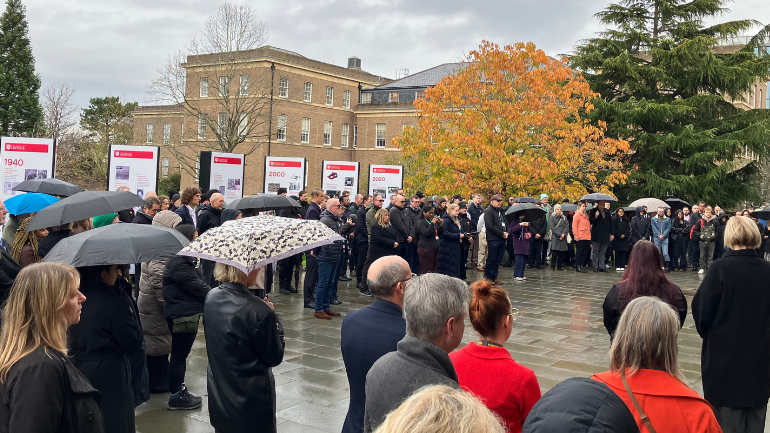
Crowds gathered outside Fielding Johnson Building for today's Remembrance Day ceremony.
University marks Remembrance Day
Today (Wednesday 11 November) saw the University mark Remembrance Day with a two-minute silence and the laying of wreaths outside the Fielding Johnson Building on campus.
The ceremony was attended by students and colleagues from the University and Students' Union, members of the Armed Forces, an Armed Forces Reservist in 103rd Regiment Royal Artillery and staff member and Leicestershire Deputy Lieutenant, Graham Smith.
Bugler Mark Penny played The Last Post during the ceremony, which was conducted by Registrar, Secretary and Interim Chief Operating Officer, Geoff Green. Wreaths were laid by University President and Vice-Chancellor, Professor Sir Nishan Canagarajah; Provost and Deputy Vice-Chancellor, Professor Henrietta O'Connor; Students' Union President, Aimee Thomas-Lane; Leicestershire Deputy Lieutenant, Graham Smith and an Armed Forces Reservist in 103rd Regiment Royal Artillery.