University of Leicester helps light up one of the world’s biggest Diwali celebrations outside India
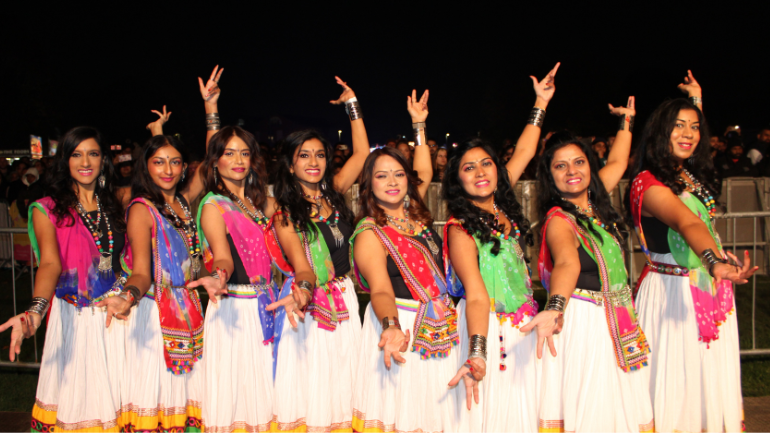


Leicester was illuminated by thousands of lights on Sunday (8 November) as crowds came together for what is believed to be the biggest Diwali celebrations outside India.
The spectacular Festival of Lights saw Leicester’s famous Golden Mile transformed as people from across the city gathered to celebrate Diwali, with the University of Leicester an official sponsor of this year’s festivities.
The celebrations have grown from humble beginnings into an event with an international reputation. Leicester’s first public Diwali lights were displayed along Belgrave Road in 1983 and the festival has developed over subsequent decades into a major celebration of the city’s South Asian heritage.
Today, the celebrations encompass thousands of lights along Belgrave and Melton Roads alongside music, dance and cultural performances.
The University of Leicester sponsored Sunday’s celebrations as part of its commitment to the city and its diverse communities. The University is also marking Diwali on campus this month through its own programme of activities, including Rangoli making and Diya painting.
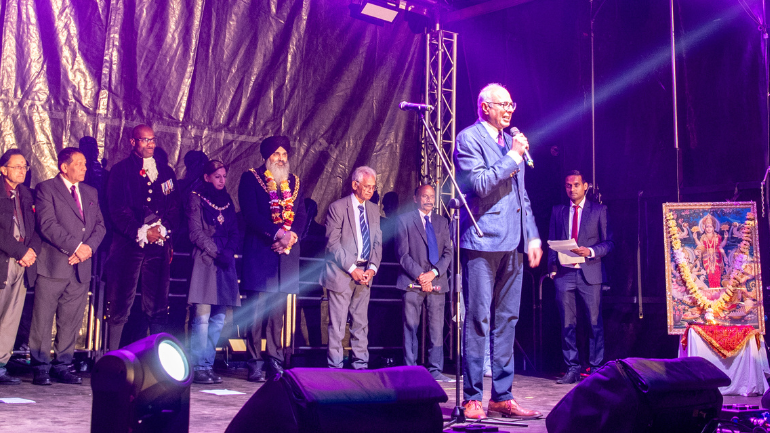
Professor Kamlesh Khunti at the Diwali celebrations.
Among those taking part in Sunday’s celebrations was Professor Kamlesh Khunti, a leading University of Leicester diabetes expert whose life and career reflect the close connections between Leicester and India.
Professor Khunti’s family originates from Gujarat in western India. Born in Uganda, he spent part of his childhood in India before coming to the UK at the age of 10 and growing up in Leicester’s Highfields area.
He has lived and worked in Leicester for more than 36 years and helped establish the Leicester Diabetes Centre. His extensive professional links with India include collaborations with leading diabetes and cardiovascular researchers and major global health programmes involving partners across India.
Speaking at Sunday’s celebrations, Professor Khunti said: “I felt deeply honoured and humbled to be invited to speak at Leicester’s Diwali celebrations. Having grown up in the city and witnessed the growth of these celebrations over many decades, it was a particularly meaningful moment for me. I wish my parents were alive to see this.
“Leicester is unquestionably my home. I grew up here, have spent most of my life here, and have worked in the city for more than 36 years.
“Being both British and South Asian has given me a deep appreciation of the unique relationship between Leicester and South Asia. Diwali is one of the clearest expressions of that bond. It brings together people from all backgrounds, cultures and faiths, creating a shared celebration that reflects the inclusive spirit of the city.”
Leicester’s connection with South Asia grew significantly during the second half of the 20th century as Indian communities settled in the city, including families arriving from East Africa. In the 1970s, the city became home to many Asians expelled from Uganda, further shaping the community from which Leicester’s modern Diwali celebrations developed.
For Professor Khunti, Diwali also carries strong memories of his childhood and family.
He said: “Diwali has always been special to me and my family. Some of my earliest memories are of celebrating with neighbours and extended family, visiting people’s homes and sharing food and festivities.
“What I cherish most is the sense of togetherness. Diwali brings people together across generations, communities and faiths. Seeing the atmosphere on Belgrave Road and the enjoyment it brings to so many people is always inspiring. It is a celebration of light, hope, family and community.”
Professor Khunti has maintained extensive links with India throughout his career, particularly through research, education and healthcare collaborations.
He has worked closely with diabetes and cardiovascular researchers across India, with collaborations focused on improving care, addressing health inequalities and developing research with benefits both in India and internationally.
He said the strength of Leicester’s South Asian communities can make the city strikingly familiar to visitors from India.
“In many ways, Leicester is a miniature version of India,” he said. “People from across the Indian subcontinent have made Leicester their home, bringing with them different languages, faiths, traditions and cuisines.
“Many of my visitors from India are fascinated by Leicester because they find elements of Indian culture represented here in a way that is unique outside India itself.
“The city celebrates diversity while creating a strong shared identity, which is something very special.”
Joining Professor Khunti at the celebrations was the University’s President and Vice-Chancellor, Professor Sir Nishan Canagarajah, and Dr Vijay Sharma, Pro-Chancellor for Community Engagement.
Students Dillany Jeyakumar and Raidah Haque, from the University’s Bollywood Dance Society were also on hand to perform at the celebrations.
Leicester City Mayor, Sir Peter Soulsby, thanked the University for supporting this year’s celebrations.
He said: “Our Diwali celebrations are a hugely important part of Leicester's cultural calendar and attract visitors from all over the UK and beyond.
“We're very grateful to the University of Leicester for their sponsorship of this year's Diwali Day event, which was enjoyed by an estimated 30,000 people.
“One of the reasons Diwali in Leicester works so well is the successful partnership that's been formed between the council and a number of other organisations, and the university's support is an important part of that.”
The University of Leicester has strong and growing links with India across education, healthcare, research, artificial intelligence, data science and technology. Its relationship with India is underpinned by Leicester’s own significant Indian heritage and by a growing network of academic, research and educational collaborations.
At the heart of these links is a strategic partnership with Apollo Hospitals Group and The Apollo University, which began in 2023 and brings together expertise from the UK and India in healthcare, education and research.
The partnership has already established the Centre for Digital Health and Precision Medicine, with hubs in Chittoor, Andhra Pradesh, and Leicester. Researchers there are working together on digital health and precision medicine, using areas including AI and advanced data analysis to improve the prediction, prevention, diagnosis and treatment of disease.