Draining peatlands leaves a long legacy of warming, says study involving Leicester expert
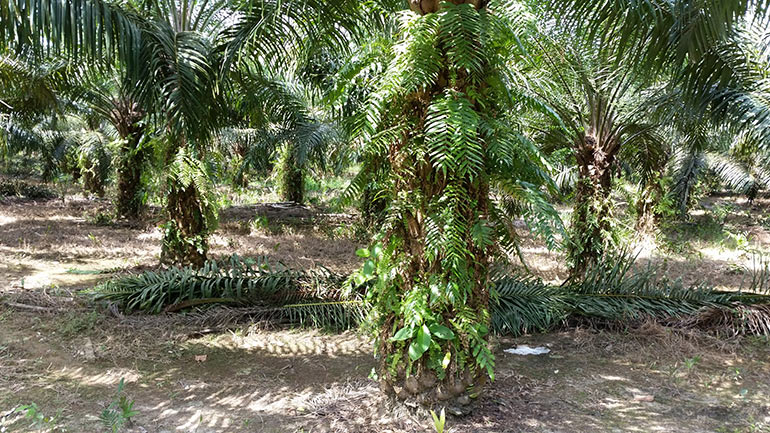
Oil palm plantation on peat in Sarawak, Malaysia. Plantations are one of the main land uses on drained peatlands in SE Asia.


A new international study involving a University of Leicester expert on peatlands has found that the long-term decomposition of drained bogs, fens, and swamps is responsible for about 3 percent of human-caused climate warming.
Peatland ecosystems like bogs and swamps perform an important balancing act: Their vegetation takes up huge amounts of carbon dioxide, while their soil microbes produce methane. Although methane is a potent greenhouse gas, peatlands exhibit a net cooling effect on the planet because of the sheer scale of carbon dioxide they remove from the atmosphere, which has amounted to hundreds of gigatons globally over thousands of years.
That balancing act is shattered when peatlands are drained, which has been happening with increasing speed over the last 200 years as people seek to use the land for agriculture, forestry, and other development. But the global impact of peatland drainage on greenhouse gas emissions and climate change has been difficult to calculate.
Now, researchers including Professor Sue Page from the University of Leicester and led by MIT have combined data on worldwide drainage with models on how carbon dioxide and methane emissions change as a result of drainage. In a study published in Nature, they estimate that the drainage of peatlands around the world has contributed about 2.7 percent of present-day human-caused warming.
The researchers say the work makes clear how important peatlands are to climate and adds support for peatland restoration projects across the globe.
“The hope is that these results are a wakeup call for policymakers and people responsible for restoring land,” says César Terrer, an MIT associate professor of civil and environmental engineering. “The first message is to stop draining peatlands, because a drained peatland can keep emitting carbon dioxide for centuries. The second is to restore the peatlands that are already drained, which means raising their water table.”
Joining Terrer on the paper are first author Jevan Yu, an MIT doctoral student in civil and environmental engineering; Etienne Fluet-Chouinard, an earth scientist at Pacific Northwest National Laboratory; Susan Page, a professor at the University of Leicester; Chris Evans, a biogeochemist at the UK Center for Ecology and Hydrology; and Charles Harvey, an MIT professor of civil and environmental engineering.

Professor Sue Page from the University of Leicester School of Chemical, Earth and Environmental Sciences said: “Understanding the role that peatlands play in carbon storage and carbon loss is essential for predicting the future of our climate. This study provides the clearest picture yet of the delicate balance that these wetland ecosystems maintain between carbon removal and greenhouse gas release.
“Our results underscore a critical point: to manage global climate risks, we must first understand the natural systems that have been managing them for millennia and also the role that peatland drainage has played in intensifying those risks. In order to reduce greenhouse gas emissions from drained peatlands, restoration by rewetting is essential to protect their vast carbon stores and strengthen resilience to floods, droughts, wildfires and biodiversity loss.”
Peatlands are wet, oxygen-poor ecosystems that hold huge amounts of partially decayed plant matter, which accumulates as peat. Today they store about 30 percent of the world’s soil carbon despite accounting for only 3 or 4 percent of the planet’s land surface. That’s more than the carbon stored in all the world’s forests combined.
In 2013, the Intergovernmental Panel on Climate Change published a large set of data on emissions from drained peatlands in different parts of the world, which helped researchers begin to piece together the climate impact of draining peatlands.
Draining peatlands exposes their plant matter to oxygen, which releases carbon dioxide for hundreds of years as microbes break down the newly dry soil. It’s generally been assumed that, because of the CO2 release, drainage leads to a net warming effect, despite the fact that it suppresses microbial methane emissions, but the extent hasn’t been determined yet.
To quantify the effects of peatland drainage, the researchers quantified the timing and extent of peatland drainage from 1800 to 2020. They also aggregated a new dataset on emissions from different types of drained peatlands to expand on the IPCC’s emissions estimates. The analysis considered emissions changes at the peat surface as well as in the ditches peatland water drains into, which can be a potent source of methane.
Finally, the researchers combined these datasets with models of greenhouse gas fluxes to quantify the impact of peatland drainage since 1800.
They found that drainage of about 0.5 percent of the world’s land surface — or about 15 percent of all peatland area — is responsible for about 2.7 percent of the warming influence of human activities since the Industrial Revolution. Even without draining more peatlands, maintaining currently drained peatlands could almost double the cumulative warming caused by peatlands by 2100.
“Peatlands have slow decomposition because they are waterlogged, and that allows these ecosystems to accumulate very dense deposits of organic carbon that, when drained, can release carbon dioxide for a very long time,” Yu says.