Pompeii’s pungent past earns Leicester student prestigious Roman Society prize
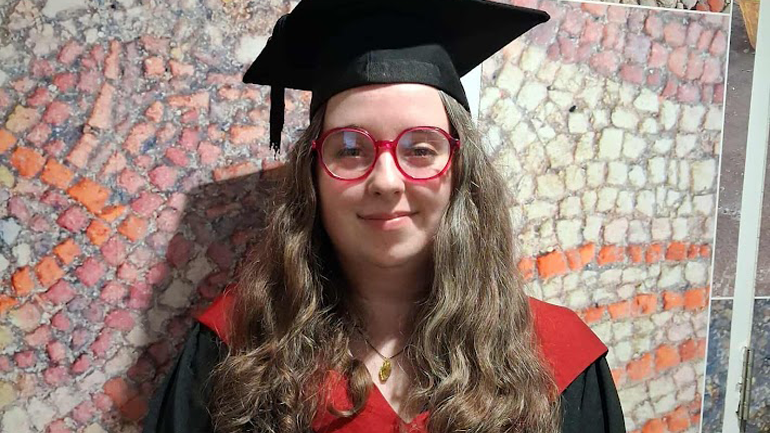
Molly is set to begin her PhD at Royal Holloway, University of London exploring the multisensory environment of Fishbourne Roman Palace.




A University of Leicester Master’s student has won a prestigious national dissertation prize for research into how Roman laundries in Pompeii managed the smell of urine used to clean and whiten clothes.
Molly Mather received the Roman Society’s MA Dissertation Prize for her dissertation, The foulest filth: the relationship between odour and architecture at Pompeii’s fullonicae, which examines specialised Roman laundries and cloth-processing workshops.
These workshops, known as fullonicae, used urine to clean and whiten garments. The urine, which is rich in ammonia, would act as a bleaching agent for Roman clothing but would produce unpleasant smells that would have to be dealt with in creative ways.
By mapping the layout of Pompeii’s fullonicae, Molly found evidence that architectural features such as courtyards, windows and wide doorways may have helped disperse odours. She also found that these measures appear to have benefited customers more than workers.
Molly said she was inspired by reading about sensory experiences in the ancient world, but felt that the role of smell in Roman laundries had not been fully explored.
She said: “The evidence often stopped at people saying these places smelled bad. I felt that didn’t really do the topic justice, so I wanted to investigate it more deeply.”
“I did a sort of reanalysis of all the literary evidence and expanded it by looking at the physical remains that we had. That’s why I focussed on Pompeii because it’s so well preserved.”
Molly decided to expand her research further by looking into the scientific factors that made urine such a popular cleaning agent in Pompeii.
She continued: “The ammonia in urine is really good at getting grease and stains out of cloth and things like diet and the temperature of the urine increase the ammonia content. So, the more ammonia you have, the better it cleans.
“People in Pompeii ate a lot of seafood and grains. The seafood especially would have increased the smell of the urine and the ammonia content in it.”
Explaining how urine was used to clean clothes in the Roman era, Molly said: “The way that the urine was used, they would have been in vats with the cloth that was being cleaned and have people trampling on them, like making grapes into wine.”
Molly then delved into investigating how the Romans mitigated against the pungent aromas coming from its fullonicae. She said: “I then had to look at whether the Romans thought it smelled bad and they did.
“So, I looked at the layout of these laundries and tried to map where the smell would have been to see if there was any way that they tried to manage it to make it more pleasant for the people who worked there.
“I was basically looking for architectural features that would allow the smell to disperse like courtyards, windows or wide doorways and in the end, it turned out they did try to control it but only for certain people.
“There isn’t really much you can do for those people because they’re in it. The smell is going to be pretty bad for them regardless.
“They didn’t seem to care about the actual workers, they just suffered it, but it does seem that they tried to make it more pleasant for customers.”
Molly’s dissertation was submitted to the Roman Society by her dissertation supervisor, Dr Philippa Walton. The Roman Society is one of the UK’s leading organisations for the study of Roman history, archaeology, literature and art. As a winner, Molly has received £200 and a year’s free membership of the Society.
On Molly’s work, Dr Walton said: “Molly’s dissertation is a brilliant example of how innovative research can bring the ancient world to life in unexpected ways. She has proved that studying something as everyday as the design of laundries in Pompeii can reveal exciting new details about social attitudes and inequalities in the Roman period. This award is richly deserved and recognition of the originality and sophistication of her project.”