History of Leicester’s iconic market revealed as revamp resumes
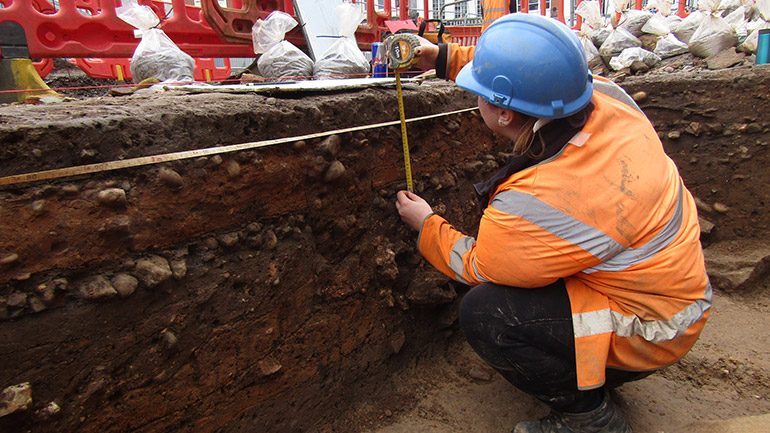
Archaeologist records Roman and medieval layers. Credit: ULAS




Archaeological excavations at the site of the Leicester Market development has revealed exciting clues to its past history, including evidence of its first medieval covered market building from the 15th century through to a hoard of 4th century Roman coins.
Archaeologists from the University of Leicester Archaeological Services (ULAS) have now completed the main excavation of Leicester’s market place, in advance of a new Council-driven project to redevelop the space.
Archaeological Supervisor at University of Leicester Archaeological Services Joseph Peters, who led the site team throughout the excavation, said: “For an archaeologist, opportunities like this come along perhaps once in a career. Investigating such a key part of the historic core has been both a privilege and an extraordinary experience for the whole team, who worked through a cold, wet winter to uncover and record the archaeology with care. These discoveries now contribute directly to our growing understanding of Leicester’s unfolding story.”
During the course of the excavations, the team identified a major historic market place structure: the ‘Shambles and Drapery’. Originating in the 15th century and rebuilt several times over subsequent centuries, this covered market hall once accommodated butchers, drapers, mercers, shoemakers and other trades. Its structural remains provide valuable new insights into the organisation and scale of Leicester’s historic trading quarter.
The excavation also completed the detailed recording of the ‘Gainsborough Chamber’, once a prominent 16th century civic building. Historically used for judicial proceedings, mayoral business, celebrations, and feasting, it stood as a landmark of civic authority until its demolition around 1748. Beneath it lay a subterranean chamber believed to have served as a dungeon, famously described in contemporary accounts as “a most vile prison”. Remarkably, traces of graffiti were also found on the chamber’s surviving plasterwork, consisting of shallow scratched markings rather than any legible writing.
The earliest evidence from the site dates back thousands of years. Archaeologists recovered a small collection of prehistoric worked flints, including finely made flakes and cutting tools characteristic of the Neolithic period. These artefacts show that people were active in this landscape as early as 4000–2500 BCE, using the tools for tasks such as hunting, processing animal hides, and working wood.
Although only a handful of pieces were found, they offer a rare glimpse into one of the earliest phases of human activity on the ground that would, millennia later, become part of Leicester. Their presence suggests that Neolithic communities passed through or briefly occupied this area, taking advantage of the river terraces and natural resources that later attracted Roman settlement.
Archaeologists have uncovered a far more detailed picture of Roman Leicester than ever previously known. Excavations have revealed several Roman buildings across the site, including evidence for occupation dating right back to the earliest phases of the Roman period. These early structures appear to have been built in timber and were set within a landscape marked by ditches and pits, showing how the area first developed following the Roman conquest. Close by, archaeologists have also identified Roman pottery kilns, highlighting small scale industrial activity taking place alongside domestic occupation.
As the settlement grew, some of these early buildings were replaced with more substantial stone-built structures, demonstrating an evolving townscape. Activity continued into the late Roman period, with further buildings and features indicating long-lived use of the area.
One of the most remarkable discoveries is a hoard of around 30 Roman coins, seemingly deliberately placed within a large pit. All appear to date to the 4th century CE, a period marked by both economic change and political uncertainty across the Roman Empire. Such hoards are often interpreted as either small savings hidden for safekeeping or as deposits marking a particular moment of activity reflecting a ritual or symbolic act. The precise purpose in this case is not yet clear, the coins will now undergo detailed cleaning and conservation in the laboratory, allowing specialists to refine their dating and better understand the circumstances of the hoard’s deposition.
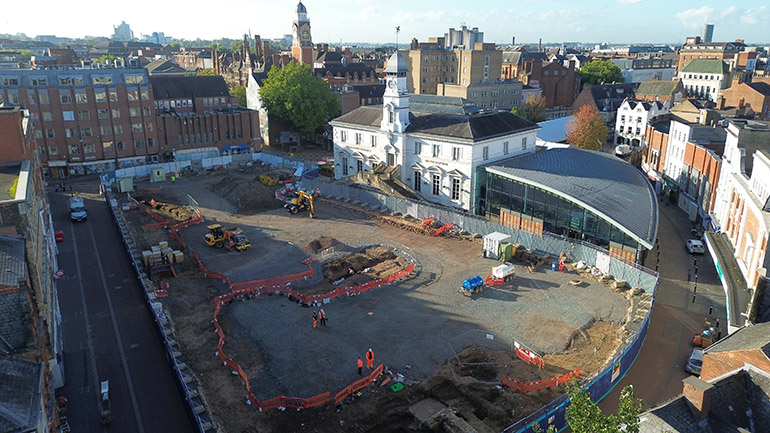
Wide view showing archaeological works. Credit: ULAS
Archaeologists have focused their work only on the areas directly impacted by the new development—such as the routes of new drainage and electrical services. Even within these narrow trenches, the team uncovered hundreds of postholes, the structural traces of former market stalls, together with several compact pebble surfaces. From these layers many objects from the medieval market were discovered, including coins, keys, pottery sherds, glass bottles, animal bones, and even leather items such as a complete shoe were discovered. These layers and the objects within them represent what remains of more than 800 years of market activity. The analysis of these will help chart the evolution of Leicester’s Market Place from the medieval period through to modern times.
With the main phase of excavation now complete, construction of the city’s new market square can begin in full. ULAS will maintain a watching brief throughout the groundworks phase, with an archaeologist remaining on site to record any further archaeology as new service trenches are dug. Since the archaeological work started in July, the ULAS team have uncovered an extraordinary range of archaeological remains, revealing layer upon layer of Leicester’s long and complex history. The discoveries span multiple eras — from the Roman period through the Anglo Saxon and medieval phases and into the post medieval town — shedding new light on an area of the city that had remained largely unexplored.
Reflecting on the work, Dr Gavin Speed, Project Manager at University of Leicester Archaeological Services, who managed the excavation, added:
“Whilst we know a great deal about other parts of Roman and medieval Leicester, this central area had remained largely untouched beneath centuries of redevelopment. This excavation has allowed us, for the first time, to understand how this part of the town developed from the Roman period onward.
“We have uncovered Roman buildings, early medieval deposits, and the earliest phases of the medieval market — all stacked one above the other. To stand in the middle of the city and peel back nearly two millennia of history has been remarkable.
“Our work in the field is now complete, but the next stage is just as important. The finds and records require detailed analysis if we are to fully understand what we have discovered. These results will be published in due course, and we hope that many of the most significant finds will ultimately be made available for the public to see.”
City Mayor Peter Soulsby said: “It’s been extraordinary to watch the archaeologists reveal evidence of thousands of years of human activity in the heart of Leicester.
“We knew that the market was located in what would have been the south-east corner of Roman Leicester, but the discoveries that ULAS have made have surpassed our expectations.
“The analysis of their findings will help chart the evolution of Leicester’s market place – from the Roman settlement to the post medieval town – shedding new light on an area of the city that has remained largely unexplored.
“Now that the archaeologists are completing their fieldwork, it’s time for us to look ahead to the next phase in this site’s long and fascinating history.”
More information about the extraordinary discoveries recorded by ULAS can be found at ulasnews.com.
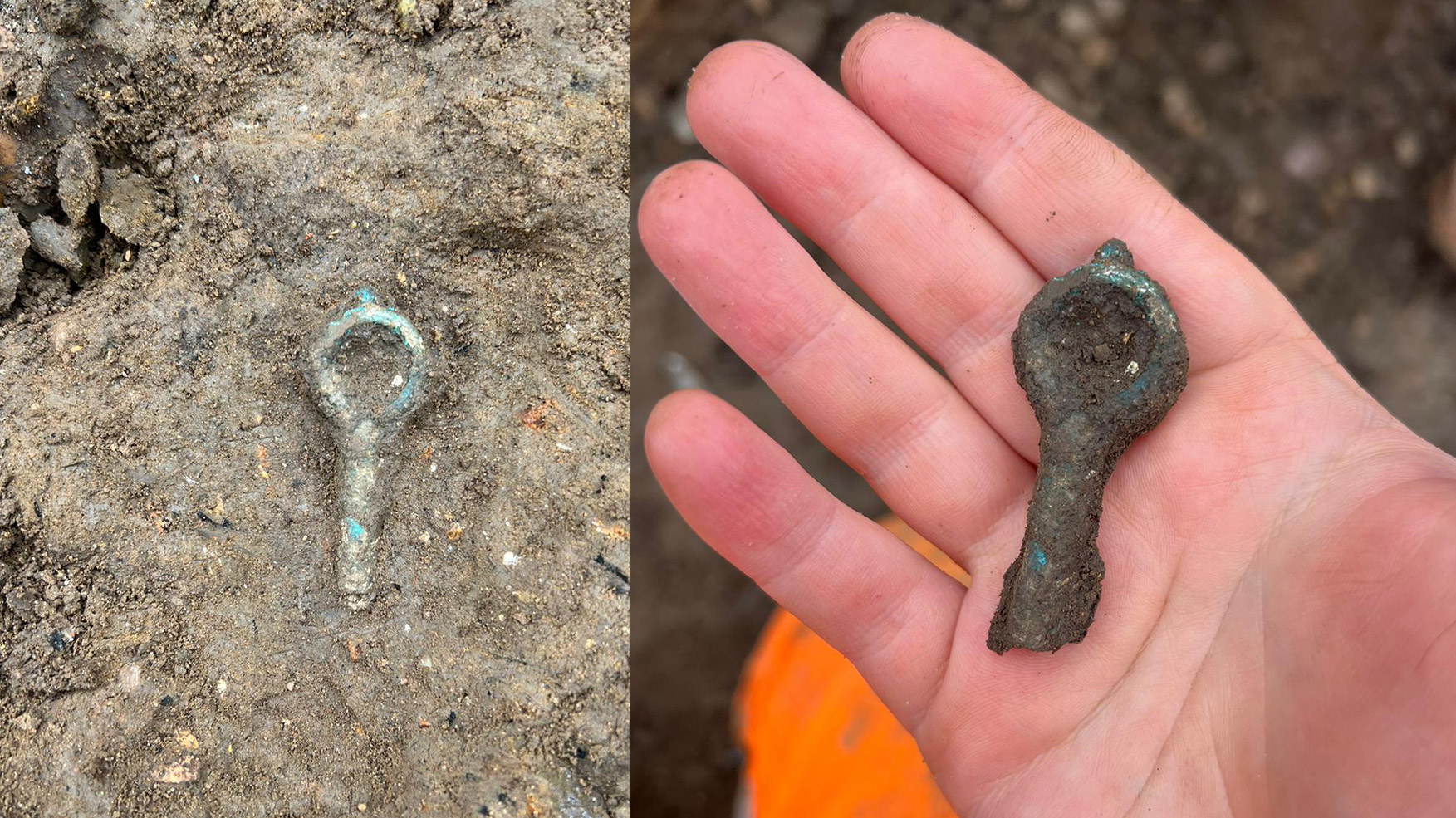
Medieval key. Credit: ULAS