Leicester planet-forming research presented in Parliament
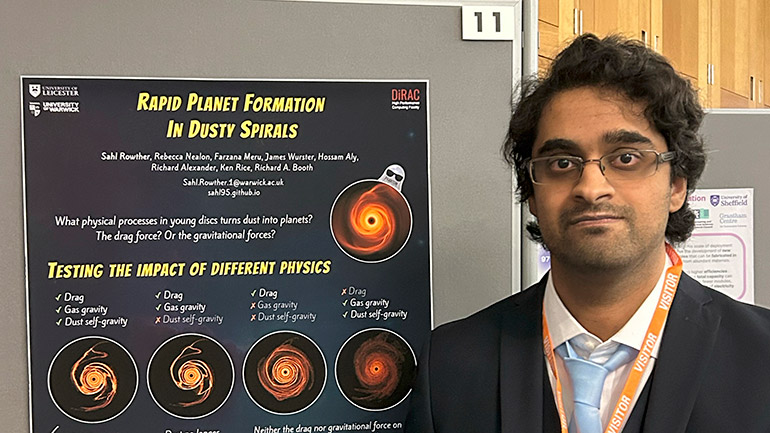




University of Leicester research on the huge discs of dust that act as the birthplaces of planets was showcased to politicians and policymakers this week.
Dr Sahl Rowther from the University’s School of Physics and Astronomy attended Parliament to present his research to a range of politicians and a panel of expert judges, as part of STEM for BRITAIN on 17 March.
STEM for BRITAIN is a major scientific poster competition and exhibition which has been held in Parliament since 1997, and is organised by the Parliamentary & Scientific Committee. Chaired by George Freeman FRSA MP, its aim is to give members of both Houses of Parliament an insight into the outstanding research work being undertaken in UK universities by early-career researchers.
Dr Sahl Rowther studies protoplanetary discs, the birthplaces of planets that harbour the material that will eventually coalesce into the array of planets that we see in the Universe.
In the last decade, our understanding of protoplanetary discs has been revolutionised by the discovery of diverse sub-structures visible across a wide range of spatial & temporal scales. Many of these protoplanetary discs exhibit a pattern of bright rings and dark gaps, which is often interpreted as a signature of a massive planet carving open a path around its orbit. However, the young ages of the protoplanetary discs poses a major challenge: how do planets form quickly enough to generate the sub-structures we observe?
In his work, Dr Rowther uses 3D simulations to investigate how the conditions in young, massive discs provide efficient breeding grounds for rapid planet formation. A characteristic feature of these young discs is their large spiral arms. These simulations show that dust can become trapped in the spiral arms where it clumps together to create the building blocks of planets and provides a pathway to explaining the ring and gap structures observed in the youngest discs.
Dr Sahl Rowther said: “I was delighted to present my work on rapid planet formation in gravitationally unstable discs at STEM for Britain. It's a rare and invaluable opportunity to share directly with members of parliament how research into planet formation advances our understanding of planetary systems and drives innovation in modelling and high performance computation. Engaging with policy-makers helps ensure that long-term investment into astrophysics continues to be supported.”
Most of the simulations in Dr Rowther’s work involve 3D hydrodynamics coupled with algorithms termed ‘Monte Carlo radiative transfer’. These are incredibly computationally expensive and are only possible with the availability of high performance computing resources. Among other facilities, Sahl’s work uses DiRAC’s Data Intensive (DiAL) service based at the University of Leicester.