University of Leicester’s herbarium collection joins project to unlock millions of biological records for climate research
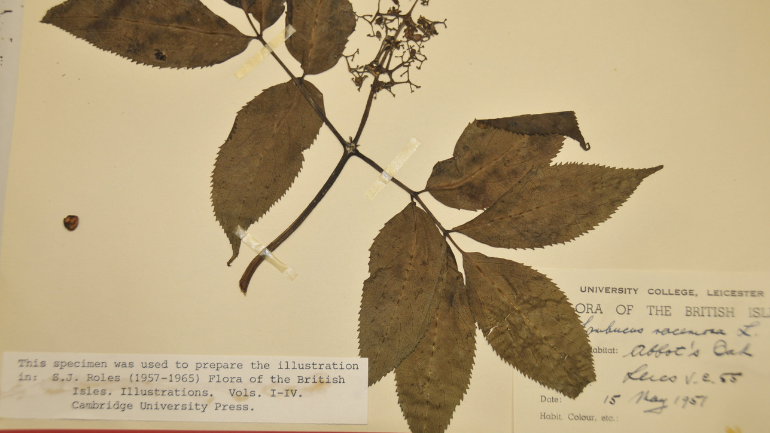




The University of Leicester has joined a major new partnership to digitise over 1.1 million natural history specimens, including 50,000 specimens held by Leicester’s Herbarium, creating a step-change in how researchers and conservationists access vital biodiversity data.
The project, led by the Universities of Oxford and Cambridge, is part of DiSSCo UK (Distributed System of Scientific Collections UK), a £155 million national programme to digitise and connect the UK's natural science collections.
Together, the universities steward over 12 million specimens – the largest natural science collection in the UK outside London and Edinburgh. Over the next two years, they will establish the Central England DiSSCo UK Hub, a strategic network supporting 23 museums and herbaria, including the University of Leicester Herbarium, to prepare their collections for a digital future. The project aims to contribute 1,195,419 specimen records to the national dataset using cutting-edge technologies, including high-throughput imaging and AI.
The project focuses specifically on British plants and insects collected over the last two centuries, with a particular emphasis on East and Southeast England. This region has witnessed some of the most dramatic environmental shifts in the country over this time, such as the drainage of wetlands, agricultural intensification, and rapid urbanisation.
By digitising these records – including nearly 771,000 newly digitised specimens – the hub will provide a high-resolution historical baseline. This data is essential for understanding species turnover and shifts in flowering times (phenology) caused by climate change. These records will directly support flagship regional restoration efforts, such as the Wildlife Trust’s Great Fen project, allowing conservationists to set recovery targets based on historical evidence.
As part of this initiative, 50,000 specimens from the University of Leicester Herbarium will be digitised using a state-of-the-art imaging capture station here at Leicester, as well as a full-time digitiser for six months. Led at Leicester by Dr Richard Gornall, Dr Stuart Desjardins and Professor Pat Heslop-Harrison from the School of Biological and Biomedical Sciences, its internationally recognised botanical collection will be made available online to researchers and conservationists around the world copyright-free.
Founded in 1945 by Professor T.G. Tutin FRS, the University of Leicester Herbarium is an internationally important botanical collection containing approximately 150,000 vascular plant specimens, with a particular focus on Europe and the Mediterranean Basin. Among the collection’s notable holdings are specimens collected in the mid-1940s by a teenage Sir David Attenborough, then an undergraduate at Clare College, Cambridge.
Dr Stuart Desjardins from the University of Leicester Herbarium said: “The three university herbaria included in the project (Oxford, Cambridge and Leicester) represent a remarkable continuity in British botanical science, bringing together the authors and reference material that underpin virtually every major flora of the British Isles over the past century: from George Claridge Druce’s List of British Plants at Oxford, through Tom Tutin’s Flora of the British Isles and Clive Stace’s New Flora of the British Isles at Leicester, to Peter Sell and Gina Murrell’s Flora of Great Britain and Ireland at Cambridge.
“The digitisation project will help ensure that historically and scientifically important material such as this can be accessed, studied and shared by future generations.”
Professor Pat Heslop-Harrison, from the University of Leicester School of Biological and Biomedical Sciences, said: “Digitising Leicester’s rigorously identified and curated botanical specimens will put a century of foundational knowledge about plant biodiversity into the hands of researchers, conservationists and plant breeders worldwide. This reference collection documents the genetic baseline of crop wild relatives and native species, the resources we need to measure changes in the natural environment and to develop more climate-resilient, sustainable and productive crops to eat. Making this knowledge freely available online makes our physical archive both a reference for identifying species but also a tool for seeing the range of characters available for improving agriculture.”
The resulting data will also be freely available through the Global Biodiversity Information Facility (https://www.gbif.org/) (GBIF), allowing researchers worldwide to access the collections.
This project is a key component of DiSSCo UK, a 10-year national programme funded through the UKRI Infrastructure Fund and delivered through the UKRI Arts and Humanities Research Council (AHRC) in partnership with the Natural History Museum and over 100 partners across the UK.
UK natural science collections hold more than 140 million items spanning an incredible 4.6-billion-year history. Over the next decade, DiSSCo UK aims to make around half of these digitally accessible. This includes creating millions of new digital specimen records, mobilising existing data, and bringing unpublished collections information into wider use.
Through digitisation, coordination, innovation and community building, DiSSCo aims to create a unique infrastructure that builds UK digital capacity and maximises the impact of natural science data to help find solutions for global problems like food security and biodiversity loss.
AHRC Executive Chair Professor Christopher Smith said: “For hundreds of years the UK has gathered and grown one of the world’s most comprehensive and diverse collections of scientific material in museums across the UK. It has been a long-held ambition to bring this collection together – and now this dream can come true.
“AHRC is proud to have led UKRI’s largest ever investment in the Galleries, Libraries, Archives, and Museums sector, yet another contribution to our leadership of the creative and cultural economy.”
Hub partners
In addition to the Cambridge and Oxford leads, the partnership includes: University of Leicester Herbarium; Norwich Castle Museum; Colchester Museum; Discover Bucks Museum; History of Science Museum (Oxford); Ipswich Museum; Peterborough Museum; Pitt Rivers Museum (Oxford); Royal Agricultural University (Cirencester); Sedgwick Museum of Earth Sciences (Cambridge); Abingdon County Hall Museum; British Antarctic Survey; British Entomological & Natural History Society; North Hertfordshire Museum; Northampton Museum & Art Gallery; Royal Holloway University of London; Saffron Walden Museum; Southend Museums; and Wisbech & Fenland Museum.