University of Leicester bestows award on world-leading pioneer of the nuclear industry
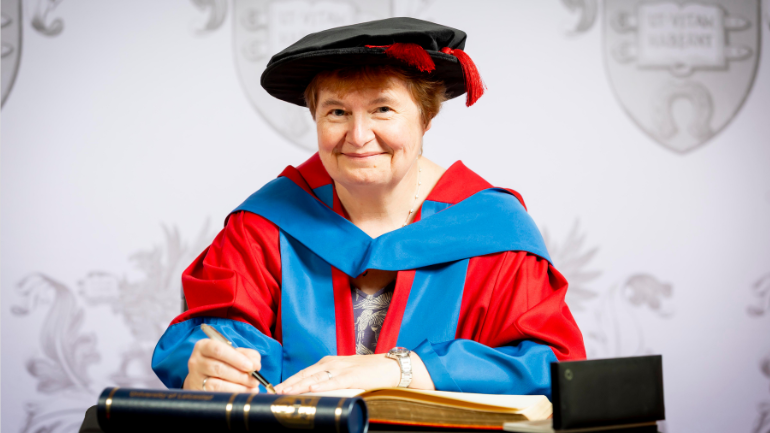




A pioneering figure in the nuclear industry has been recognised by the University of Leicester.
Dame Fiona Rayment DBE has today (Tuesday 14 July) been awarded an honorary Doctorate of Science at a graduation ceremony held at De Montfort Hall, Leicester.
A chartered chemist and engineer, Dame Fiona has had a profound impact on the nuclear industry across three decades.
She was named an OBE in the Queen’s birthday honours in 2017, a chevalier of the French legion of honour in 2020 and a DBE in the King’s 2026 New Year honours, in recognition of her outstanding services to the industry.
Her career has seen her leading research on complex reprocessing operations, robotic handling systems and novel technical breakthroughs. This includes initiating the science and subsequent engineering work that led to the wide adoption of Americium battery technology in the space industry. It is in this area that Dame Fiona has collaborated with the University of Leicester, where’s she has worked with a team of researchers at Space Park Leicester.
Dame Fiona has also overseen international cooperation on next generation reactor systems and developed new systems to solve nuclear waste problems, including accident-tolerant fuels. Through her previous leadership of the Nuclear Skills Strategy Group and as Immediate Past President of the Nuclear Institute (NI), she promotes nuclear engineering and works to inspire students and foster equality and diversity in the profession.
Reflecting on her award from the University of Leicester, Dame Fiona said: “It is such an honour to receive such a distinguished degree, especially in relation to the ongoing work with Leicester in the advancement of heat and power systems for space exploration. As a scientist (and engineer) I cannot think of a greater accolade than receiving this honorary degree.”
Dame Fiona has been a Fellow of the NI since 2014 and currently serves as Immediate Past President of the Institute’s Board of Trustees.
She received a BSc and PhD in Chemistry from the University of Strathclyde and studied for an MBA at Manchester Business School. In 2017 Dame Fiona was appointed Executive Director of the Nuclear Innovation and Research Office, a division of the National Nuclear Laboratory (NNL). From 2020 to 2024 she served as Chief Science and Technology Officer at NNL.
She is a Fellow of the Royal Academy of Engineering, the Royal Society of Edinburgh, the Royal Society of Chemistry and the American Nuclear Society. She served on the Science and Technology Committee of Euratom (the European Atomic Energy Community), on the Nuclear Science and Technology Advisory Committee of the Idaho National Laboratory, on the board of the UK Space Agency, on the Science and Technology Advisory Council at the Department of Energy Security and Net Zero, and on the Chief Nuclear Inspector’s Independent Advisory Panel at the Office of Nuclear Regulation.
Dame Fiona chaired the Nuclear Skills Strategy Group, the OECD Nuclear Energy Agency High Level Group on Gender Balance, and the Scientific Advisory Committee of the Energy Division at CEA (the French Alternative Energies and Atomic Energy Commission) and was Vice Chair of the Nuclear Energy Agency’s Steering Committee.
Dame Fiona is currently a Professor and BNFL Chair in Nuclear Policy and Capability at the Dalton Nuclear Institute, University of Manchester, and an honorary professor at the Nuclear Futures Institute, University of Bangor.
President and Vice-Chancellor of the University of Leicester, Professor Sir Nishan Canagarajah, said: “I would like to congratulate Dame Fiona on her honorary Doctorate of Science from the University of Leicester.
“Her world-leading expertise and skills have contributed significantly to the advance of the nuclear sector, not least here at Leicester, with her invaluable input into our research into alternative fuel for deep space probes.
“A true Citizen of Change, Fiona has also made it her goal to inspire students to follow her into the nuclear engineering profession and promote equality and diversity within it.”