Transatlantic collaboration boosted as US space research organisation joins Space Park Leicester
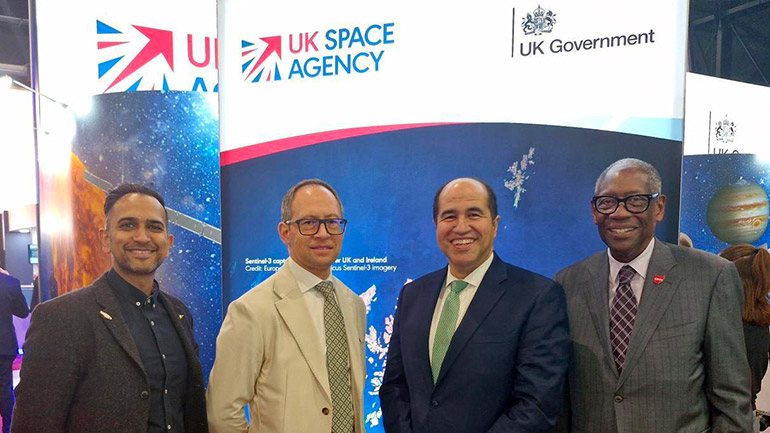
L-R: Vinay Patel (Head of Commercial & Innovation, Space Park Leicester); Professor Richard Ambrosi (University of Leicester); Elsayed Talaat (CEO USRA), General Les Lyles (Chair of USRA Board of Trustees).




The Universities Space Research Association, an organisation dedicated to international co-operation on space and advanced aeronautics research, is to establish a new corporate entity at Space Park Leicester.
The University of Leicester’s £100 million science and innovation park will host the USRA’s UK presence, supporting the space economy across Europe and strengthening transatlantic space collaboration. The news was announced today (22 July) at Farnborough International Airshow 2026 taking place this week.
The Universities Space Research Association is a non-profit organisation which is advancing knowledge through space and aeronautics research. Based in Washington, D.C., USRA was formed in 1969 as an entity through which universities and research organisations could cooperate with one another, and with the governments of other nations, to advance the development and application of space-related science, technology and engineering.
For USRA, a consortium of 124 universities which are divided into 10 regions including an international region (Region X), creating a formal UK based entity unlocks direct access to the UK’s burgeoning space economy and its specialized research ecosystems. A localized presence at Space Park Leicester would support growth in programmatic activity within the UK and across Europe, while intimately leveraging Leicester’s globally recognized expertise in the space sciences, space instrumentation and space nuclear power systems.
The University of Leicester has been an active member of the Universities Space Research Association (USRA) for more than 2 decades. For the first time in its 57-year history, USRA recently expanded its governance beyond its original nine North American regions by establishing an additional "Region X"—a new geographic division dedicated exclusively to European universities.
With Professor Richard Ambrosi from the University of Leicester School of Physics and Astronomy elected as the first USRA trustee to represent this new European region in 2023, the groundwork for an expanded international footprint was firmly established. The evolving relationship between the USRA and the University of Leicester highlights a historic pivot towards strengthening transatlantic space collaboration.
Ultimately, a UK corporate entity would transition USRA from a primarily US-centric consortium into a globally integrated research conduit, facilitating talent exchange, hardware development, and deeper research, educational and commercial ties within Europe's rapidly space market.
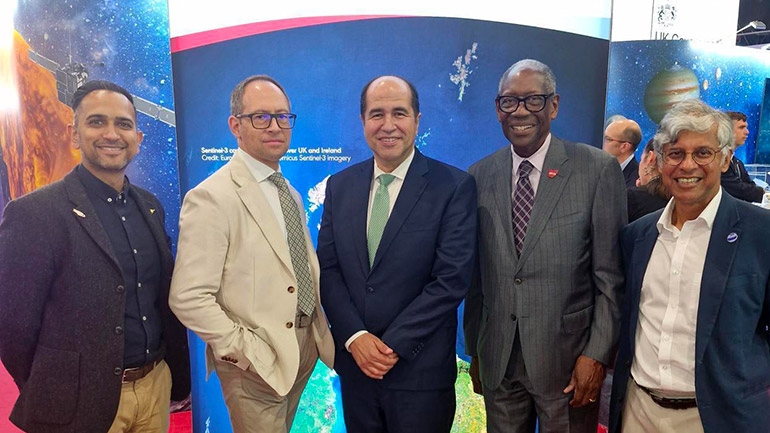
L-R: Vinay Patel (Head of Commercial & Innovation, Space Park Leicester); Professor Richard Ambrosi (University of Leicester); Elsayed Talaat (CEO USRA), General Les Lyles (Chair of USRA Board of Trustees); Professor John Remedios (Executive Director, National Centre for Earth Observation).
Professor Richard Ambrosi said: “This is a great opportunity for the USRA and University of Leicester to build greater transatlantic links between the US and Europe. The establishment of USRA’s Region X and the USRA's expanding footprint in the UK represent far more than geographic growth they are strategic steps to address collaboration in space science, education and cross-disciplinary space research programmes.”
Founded at the dawn of the Space Age, the Universities Space Research Association (USRA) was established through the vision of two leaders: James Webb, NASA Administrator from 1961 to 1968, and Frederick Seitz, President of the National Academy of Sciences from 1962 to 1969. Webb and Seitz recognized that meeting the technical challenges of space exploration would require a sustained partnership between NASA and the university research community. Together, they created USRA to strengthen NASA’s scientific and technical capabilities as new frontiers in space research and technology emerged, while expanding opportunities for university faculty and students to contribute directly to the agency’s mission.
Chartered as an independent, nonprofit corporation USRA was established to advance research, technology development, and education in space science and related fields through collaborative partnerships with universities, the federal government, and other organizations.
Dr Elsayed Talaat, President and CEO of USRA, commented: “The establishment of this new venture marks an exciting milestone in our commitment to innovation, collaboration and long-term growth. By partnering with one of the UK's leading universities, the University of Leicester, we are bringing together world-class academic expertise and industry experience to accelerate the development of leading technologies and solutions. We look forward to building a successful partnership that delivers lasting value for our organizations, our stakeholders, and society.”
Dr Caroline Harper, Head of Space Science at the UK Space Agency: “The Universities Space Research Association establishing a formal presence at Space Park Leicester is a significant moment for UK space science. USRA’s decision to root itself in the UK reflects the strength and ambition of our growing space sector, and the University of Leicester’s expertise makes it a natural home. This partnership will open new pathways for researchers, students and industry on both sides of the Atlantic, and I look forward to seeing the collaborations and innovations it produces.”