Space research legacy explored in UK Space Agency and DSIT visit to University of Leicester’s space hub
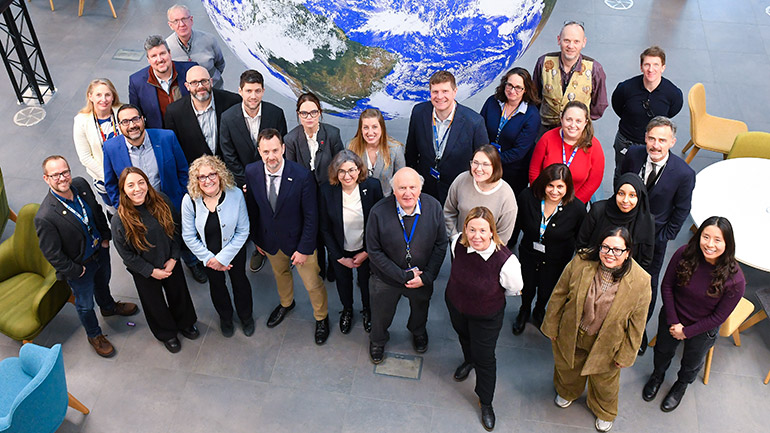




The University of Leicester’s School of Physics and Astronomy welcomed senior staff from the UK Space Agency and Department of Science, Innovation and Technology (DSIT) for a visit that explored the past, present and future of space research at the University.
It is one of a number of visits underway that enable Government to learn about and discuss key academic capabilities in Space across the UK. Future visits are also planned focusing on Space Exploration and Earth Observation.
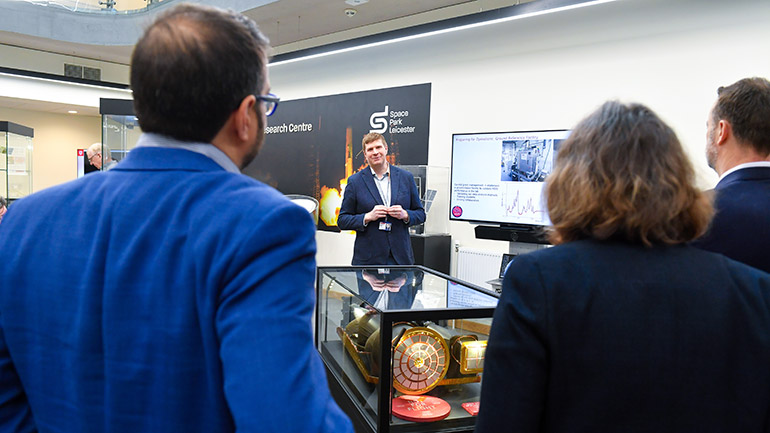
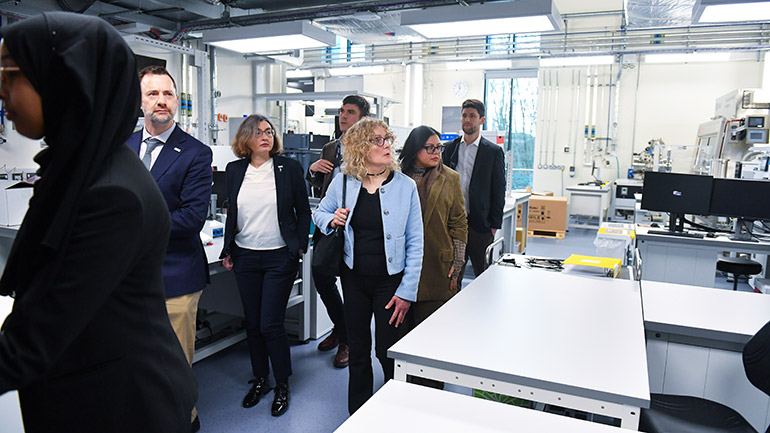
The University’s £100 million research, innovation and teaching hub Space Park Leicester hosted a delegation including CEO Paul Bate, Chief Scientist Adam Amara, Julie Black, Director for Space Science & Exploration, and Head of Space Science Caroline Harper for a tour of the cutting-edge facilities and presentations on 7 January.
The tour included Roundtable discussions with Leicester staff that covered space heritage, capabilities and the future vision of Space at Leicester and Space Park Leicester.
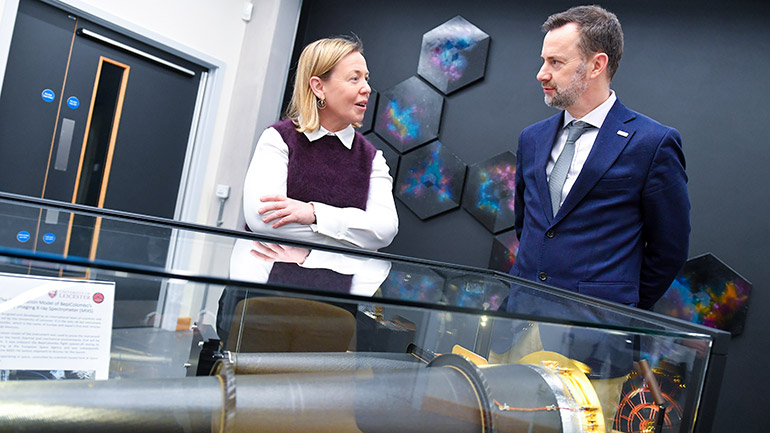
University academics presented on current missions utilising University of Leicester-built instrumentation, including the BepiColombo mission to Mercury, which carries the Mercury Imaging X-ray Spectrometer (MIXS), developed by a Europe-wide consortium led by the University of Leicester. The Space Park Leicester team who worked on the Soft X-ray Imager (SXI) for the European Space Agency’s (ESA) Solar wind Magnetosphere Ionosphere Link Explorer (SMILE) mission, also gave an overview of the project. Launching later this year, the SXI on SMILE is the first instrument to be delivered using facilities at Space Park Leicester.
The delegation also learnt about international projects that utilise University of Leicester expertise, such as the European Space Agency’s Gaia mission, which is creating the most accurate and detailed 3D map of our galaxy. The University’s longstanding involvement in NASA’s Swift mission was detailed, alongside potential contributions to future missions including the Habitable Worlds Observatory, the first telescope designed specifically to search for signs of life on planets orbiting other stars, and the European Space Agency’s M-MATISSE and THESEUS possible future missions with large involvement from Leicester, one of which may be selected for further study and development later this year.
Leicester’s contribution to the Habitable Worlds Observatory is facilitated by the UK Space Agency’s Science & Exploration Bilaterals Programme (SEBP) which also enables a Leicester lunar spectroscopy and exploration programme, built upon a collaboration with the global lunar exploration company ispace.
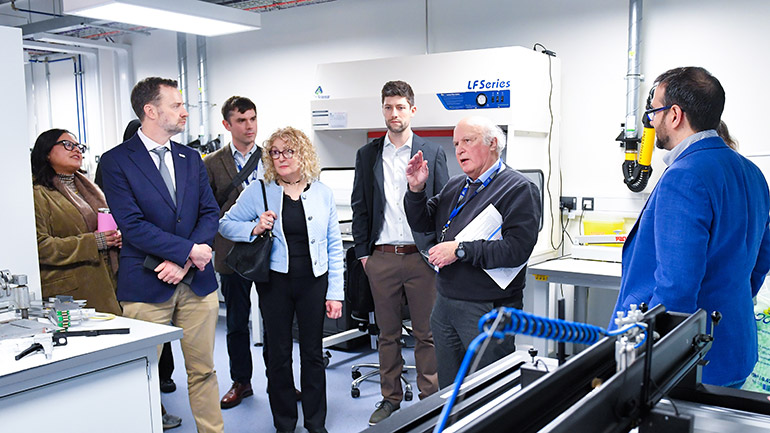
Professor Mark Sims from the School of Physics and Astronomy presented on the UK’s Space Academic Network (SPAN) which aims to represent academia on UK space policy and funding, working with both the Government and Space sector industry. Professor Sims, who co-chairs SPAN, said: “This was an important visit enabling University of Leicester management, scientists and engineers to meet managers of the agency and people from the DSIT Space Directorate, along with the opportunity to discuss future plans, as the sector enters a key period with the merger of the agency into DSIT, the publication later this year of an integrated across Government funding plan for Space and the pivoting of the sector into developing areas prioritised by Government alongside recent developments like the UK’s Industrial Strategy.”
Dr Paul Bate, CEO of the UK Space Agency, said: “The University of Leicester has an extraordinary legacy in space science, and this visit has shown just how that expertise continues to drive innovation today. From instruments travelling across our solar system to those looking out to our galaxy and beyond, Leicester's contributions are genuinely world-leading.
“Space Park Leicester represents exactly the kind of facility the UK needs to strengthen our national capability in space science and technology, bringing together research excellence with the capacity to deliver cutting-edge instrumentation. I’m particularly excited by the University’s involvement in missions like the Habitable Worlds Observatory, which could help answer one of humanity’s most profound questions. This is British space science at its best.”