Leicester leads industry roundtable in national drive for universities to boost UK prosperity





The University of Leicester is at the forefront of a national campaign to shape the way universities can play their fullest part in the country’s future prosperity.
Leicester played host to one of the initial national listening exercises organised by Universities UK (UUK) – the body which represents 142 universities – as part of its Future Universities campaign.
As the UK navigates rapid social, economic and technological change, universities will play a vital role in driving opportunity, sparking innovation and helping shape the ideas that fuel national renewal.
The Future Universities campaign has been set up to allow the sector to listen to those who rely on universities – businesses, communities and students. Their needs are changing and the sector must evolve with them to support skills, employability and multiple pathways into careers.
A delegation from UUK spent Tuesday 17 February in Leicester, for two roundtables involving employers, local policy organisations and authorities, business partners, students and key University of Leicester personnel.
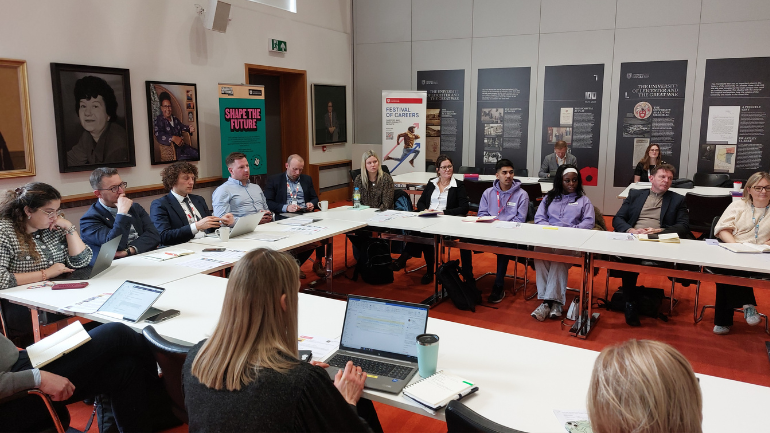
The discussions allowed the University to showcase its newly launched Work-Related Learning Guarantee, which will see every undergraduate degree incorporating a minimum of 100 hours of employer-informed work-related learning, from September 2026.
University of Leicester President and Vice-Chancellor, Professor Sir Nishan Canagarajah, who chaired one of the roundtables, said: “We brought together leaders from across the UK to explore how universities and employers can work together to develop inclusive skills pathways, address labour shortages, and boost the country’s growth mission.
“The message was unambiguous: demand for graduate skills is rising, diverse teams perform better, and businesses want deeper partnerships with universities. And perhaps most importantly of all, our collective ability to address these challenges will be decisive in driving the UK’s growth in a fiercely competitive global economy.
“UUK’s call for action could not be more timely or prescient. Universities can shape the future – and at Leicester we are doing just that.”
Commenting on Leicester’s Work-Related Learning Guarantee, he said: “We are the first research-intensive university to make such a commitment. This will ensure all our graduates leave with applied experience, tangible skills, and the confidence to articulate what they can do.”
He added: “Our roundtable confirmed that embedding employability, embracing inclusivity, and responding at pace to technological and social change is the only viable path forward for universities. Even with the advent of AI, educating, training, and developing people will always be the key to progress.”
Professor Sir Nishan has also penned a thought leadership piece for WonkHE about how he thinks universities can rise to the challenge of an unpredictable future workplace.
Professor Malcolm Press CBE, President of Universities UK, said: “Universities are critical to creating a better future for the next generation, something everyone wants. Given how quickly the world of work is changing, that will only happen if we make sure graduates have the skills that employers are going to need, now and over the long-term.
“Today’s graduates are going to have careers that last into the 2070s. Our Future Jobs roundtables, like this one in Leicester, are about sparking the conversations between business and universities to make sure we’re equipping people with the skills they’re going to need for long, successful careers and that business can access the talent they need to drive the country’s future prosperity.”
Seb Gordon, Director of Communications at Universities UK said: “Challenges and solutions discussed in Leicester will be combined with ideas from other groups across the country to create a ‘Future Jobs Roadmap’.
“This will include a ‘Future Jobs pledge’ which employers and universities can sign to commit to working together to secure a brighter future for the next generation.”
Martin Edmunson, CEO of Graduate Futures Institute, said: “At the heart of the relationship between higher education and society is the creation of greater life and career opportunities. That’s why events like this are so important in uniting employers and universities to ensure that we are shaping the futures of students and graduates together, ensuring all have opportunity regardless of background, and building public confidence in the value of education. This is something we are passionate about at the Graduate Futures Institute and keen to support UUK and the University of Leicester in pushing forward.”