Ancient fossils reveal the oldest known vertebrates had four eyes
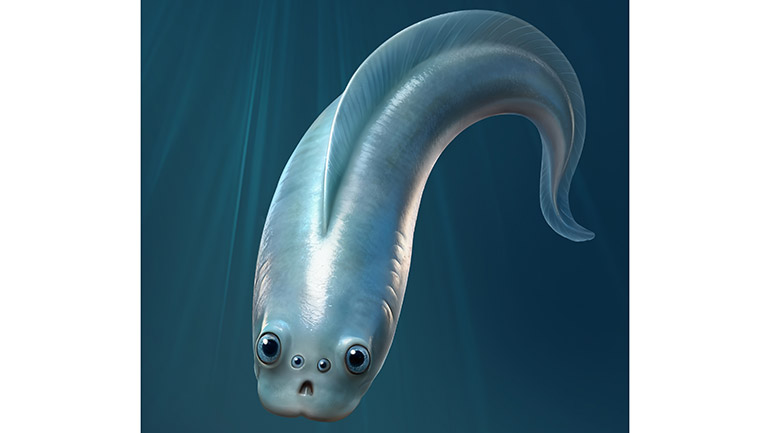
Artist’s reconstruction of a myllokunmingiid, the oldest known vertebrate, with four eyes that helped it see and navigate its ancient world. Credit: Xiangtong Lei & Sihang Zhang




Remarkably preserved fossils show that the earliest vertebrates could see the world using four camera-type eyes, reshaping our understanding of how vision evolved.
A new study by an international team of researchers, including a University of Leicester palaeontologist, reveals that the earliest known vertebrates, living more than 518 million years ago, possessed four eyes, not two. The discovery shows that ancient vertebrates had a far more complex visual system than previously thought — and that organs now linked to sleep once played a key role in seeing.
The research, published in Nature, focuses on exquisitely preserved fossils from the Cambrian period, a time when animals were rapidly evolving new body plans and senses in response to increasing predation.
Four eyes, not two
The fossil vertebrates known as myllokunmingids, were discovered in the famous Chengjiang fossil beds of southern China. Careful microscopic and chemical analyses revealed that these animals had two large lateral eyes and two smaller, centrally positioned eyes. All four eyes were similar to modern camera-type eyes.
Professor Peiyun Cong of Yunnan University, who led the investigation, said: “These fossils preserve the eyes in extraordinary detail. We started by examining the obvious large eyes to understand their anatomy — and it was a complete surprise to find two smaller, fully functional eyes between them. Seeing that was incredibly exciting.”
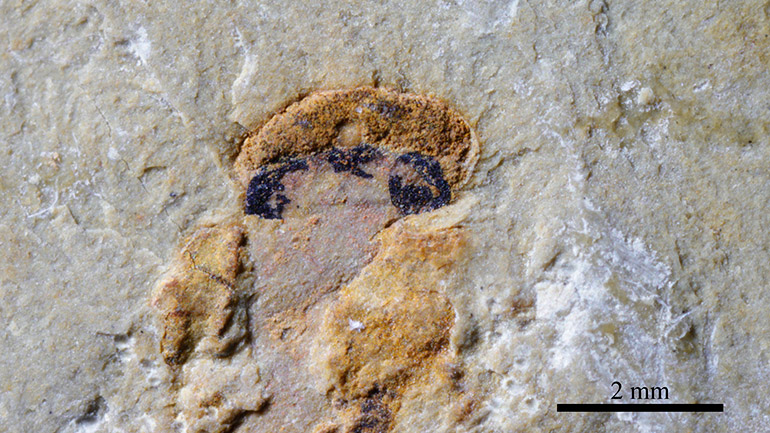
Close-up of the head of a myllokunmingiid fossil, the oldest known vertebrate, revealing four eyes — two large lateral eyes and two smaller central eyes — preserved as dark patches in the fossil. Credit: Xiangtong Lei & Sihang Zhang
Eyes that became our ‘sleep gland’
Today, vertebrates see mainly using two eyes. A structure deep in the brain — the pineal gland — helps regulate sleep by responding to light and producing melatonin. In some fish, amphibians, and reptiles, it can still detect light and is sometimes called a ‘third eye’.
This new study shows that in the earliest vertebrates, the pineal complex was not a simple light sensor — it was a pair of well-developed eyes capable of imaging the world.
Cong “What we’re seeing is that the pineal organs began as image-forming eyes,” said.
“Only later in evolution did they shrink, lose visual power, and take on their modern role in regulating sleep.”
How the discovery was made
Emeritus Professor Sarah Gabbott from the University of Leicester, who is one of the team is an expert on interpreting ancient fossil visual systems, said: “Fossil eyes are incredibly rare — you wouldn’t expect something as delicate as an eye to survive for hundreds of millions of years. Yet under the right conditions they can, and when they do, they open a rare window into how extinct animals saw and experienced their world. It was a long shot, but we suspected the eyes in these Chinese fossils might be preserved — and they were, complete with light-absorbing pigments in the retina and lenses capable of forming images, showing just how well our earliest ancestors could see.”
The painstaking and detailed investigations of the fossil eyes were made by first authors Dr Xiangtong Lei and Dr Sihang Zhang, who used high-powered microscopy to identify melanosomes — pigment-containing organelles responsible for coloration and light absorption in living eyes — in all four eyes. Chemical analysis confirmed melanin, the same pigment used in modern vertebrate vision. Circular structures consistent with lenses indicate these eyes were capable of forming images, not just detecting light, providing direct evidence of advanced visual systems in the earliest vertebrates.
Why four eyes?
During the Cambrian period, the oceans were a dangerous place. Large predators were emerging, while early vertebrates were small, soft-bodied, and vulnerable.
Dr Jakob Vinther of the University of Bristol and one of the team said: “In that environment having four eyes may have given these animals a wider field of view — important to avoid predators.”
A new chapter in the story of vision
The findings solve a long-standing mystery about the origin of the pineal gland and provide the oldest known evidence of camera-style eyes in the fossil record.
“This changes how we think about the early evolution of vertebrates,” said Vinther. “It turns out our ancestors were visually sophisticated animals navigating a dangerous world.”
The study also suggests that the familiar idea of a vertebrate ‘third eye’ may need an update.
“In fact,” Vinther added, “these animals didn’t just have a third eye — they had a fourth.”
- Four camera-type eyes in the earliest vertebrates from the Cambrian Period is published in Nature, DOI: 10.1038/s41586-025-09966-0