School of Physics and Astronomy
Earth and Space Webinars
Upcoming: Ten things you might not know about the Milky Way
Dr Paul McMillan, School of Physics and Astronomy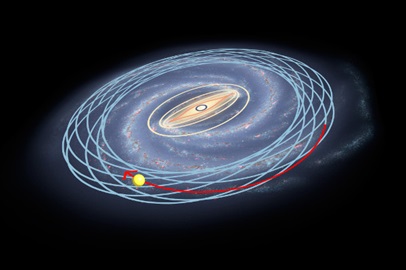
Monday 22nd June 2026, 16:30-17:30
Learn new and fascinating facts about our galaxy in this online lecture!
In the last 8 years, we’ve made huge breakthroughs in understanding of our own galaxy, the Milky Way. We can see it in incredible detail, and are starting to understand all the pieces that came together to make it in the 13.8 billion years since the Big Bang. In this talk you will learn some of the things we’ve discovered, and how researchers in Leicester are playing key roles in uncovering our galaxy’s own secrets.
Past webinars
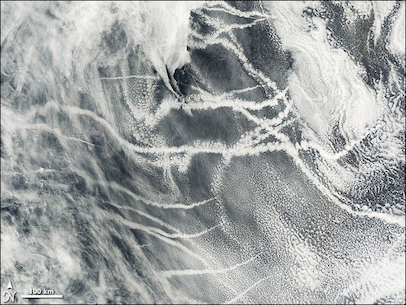
20th April 2026: Smoke and Mirrors: A Satellite View On How Pollution Alters Clouds and Climate
Dr Adam Povey, School of Physics and Astronomy & Space Park Leicester
The seeds for most rain drops are tiny particles suspended in the atmosphere called aerosols. Changing that seed alters where the cloud forms, how long it lasts, and the likelihood of rain. This talk will explain how we use satellites to track releases of aerosols in order to better understand how pollution affects the nature of clouds.
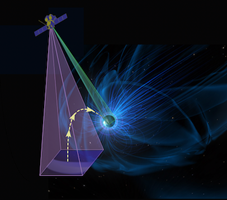
9th March 2026: SMILE! Taking the first pictures of the magnetosphere
Dr Jenny Carter, School of Physics and Astronomy & Space Park Leicester
Launching in spring 2026, SMILE is going to take X-ray images of the region of near-Earth space where the solar wind first encounters the Earth's magnetic field. SMILE will also take pictures of the northern hemisphere aurora, using an ultraviolet camera. This simultaneous view of cause and effect has never been done before, and promises to tell us a lot about how the Sun and Earth interact, helping a research field known as space weather.
7th January 2026: Monitoring Climate Change from Space
Dr Rob Parker, School of Physics and Astronomy & Space Park Leicester
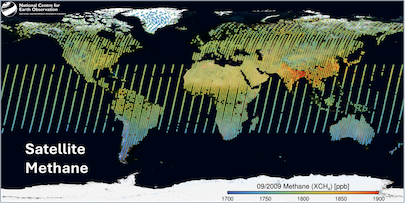 Greenhouse gases in the atmosphere act as a blanket, warming our planet and driving climate change and can be emitted from human activity (like the burning of fossil fuels) as well as natural sources (like swamps). Using sophisticated instruments on Earth-observing satellites, we can measure how these gases vary globally and identify major sources of emissions. This talk will focus on what we’ve learnt so far and look ahead to the next generation of satellite missions that will take this capability even further.
December 10th 2025: Robotic Exploration of our Solar System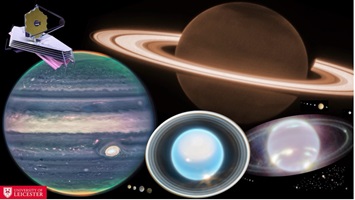
Prof Leigh Fletcher, School of Physics and Astronomy & Space Park Leicester
Join Leigh Fletcher, a member of Leicester’s Planetary Science team, to learn about the fleet of robotic spacecraft currently exploring the worlds of our Solar System: from planetary orbiters like the Juno and JUICE missions at Jupiter, to rovers on the surface of Mars, and complex space telescopes like Hubble and JWST. This talk will provide insights into the cutting-edge planetary research happening right here in the Midlands.
November 12th 2025: Solar Storms and the Northern Lights
 Dr Darren Wright, School of Physics and Astronomy
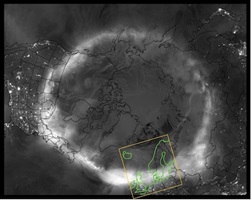
The Northern Lights or aurora have been visible over the UK in recent years, most notably following the large solar storm in May 2024. Aurorae are a manifestation of a very dynamic battle in space between the Sun and the Earth. This interaction has a profound impact on human activities in space and on the ground. In this talk we will look at the cause of the aurora why it is important to society.