Funding boost to tackle Salmonella in chickens with ‘bacteriophage therapy’
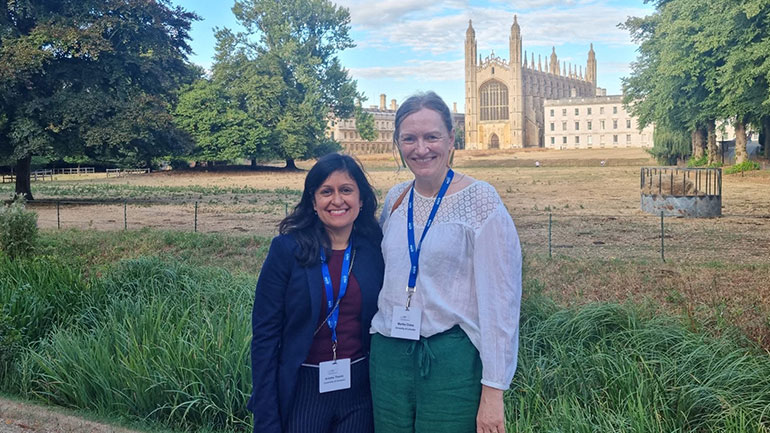
Dr Anisha Thanki (left) and Professor Martha Clokie




Researchers are hoping a funding boost can help bring a new bacteriophage product to combat Salmonella in chickens closer to the market.
Professor Martha Clokie and Dr Anisha Thanki at the University of Leicester’s Becky Mayer Centre for Phage Research, have been awarded £800,000 by the Biotechnology and Biological Sciences Research Council (BBSRC) to help drive forward their bacteriophage work on Salmonella.
Salmonella is a group of bacterial strains that can cause food poisoning and severe intestinal illness in humans and animals. The news follows a recent UK outbreak that saw hundreds of people fall ill with Salmonella linked to imported eggs, with investigations ongoing and a small number of deaths also recorded.
Professor Clokie and Dr Thanki have already successfully developed a bacteriophage product to prevent Salmonella in broiler chickens and through previous BBSRC funding optimised bacteriophage production from ml to litres scale. Early trials of their liquid product, made from bacteriophages, viruses that infect bacteria and kill them, have shown that it prevents the bacterial infection developing in chickens.
Now they hope this new funding will enable them to further test the product against emerging and multi-drug resistant Salmonella strains and understand the impact of bacteriophage treatment on the poultry microbiome.
The work is being undertaken in collaboration with Dr Robert Atterbury at the University of Nottingham; Professor Roberto La Ragione and Dr Jai Mehat at University of Surrey, as well as UK-based veterinary innovation and global animal health company, Carus Animal Health.
Professor Clokie said: "We have shown that our bacteriophages can prevent Salmonella infection in chickens and that we can produce them at scale. Now we need to show that the product works reliably against the strains circulating today and gather the evidence needed to bring it closer to use on farms. We want to stop Salmonella before it reaches the food chain."
Dr Thanki said: "For farmers, a product has to work in real poultry settings, not just in the lab. We’ll test it against a much wider range of Salmonella strains, including resistant ones, and look closely at its safety and its effects on the chickens. That will tell us what we need to improve before it can be used more widely."
Salmonella costs the farming industry billions to control each year. In the EU, around 91,000 people are infected with Salmonellosis annually, a severe form of food poisoning.
Bacteriophages are naturally occurring in the environment around us and can be found where bacteria lurk. They are viruses that infect bacteria and kill them and in this case, prevent the bacterial infection Salmonella from developing in chickens.