Spain-UK collaboration successfully tests hybrid radioisotope and solar power system for planetary exploration
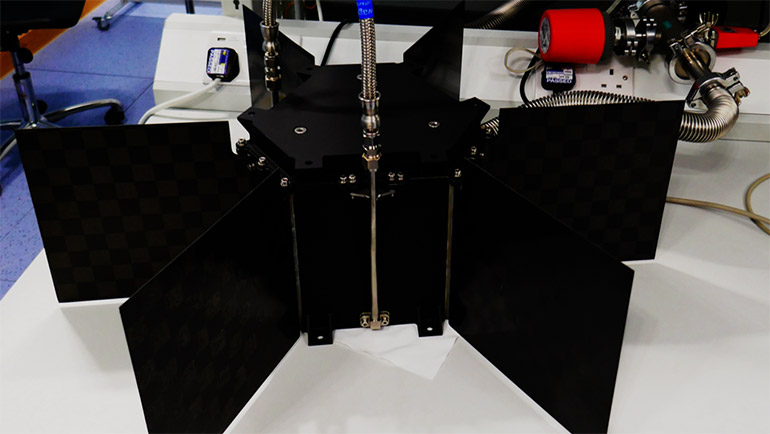
RTG on test in lab.




Spanish and British engineering teams have successfully concluded the first end-to-end testing of a hybrid power architecture that harnesses both nuclear and solar power for space missions.
The result of a joint research initiative combining the Radioisotope Thermoelectric Generators (RTGs) developed by the University of Leicester team with solar arrays, this new system promises to extend the life and range of planetary science missions where traditional power sources fall short.
The partnership, involving leading research institutes the University of Leicester in the UK, and the University of Oviedo and University of Vigo in Spain, as part of a European Space Agency funded project, addresses the ‘power gap’ faced by missions targeting extreme environments, such as the lunar and Mars surfaces.
While solar power is the industry standard its effectiveness drops significantly as spacecraft operations expand into more challenging environments in the Solar System. Conversely, RTGs powered by Americium-241 provide a steady, decades-long heat and power.
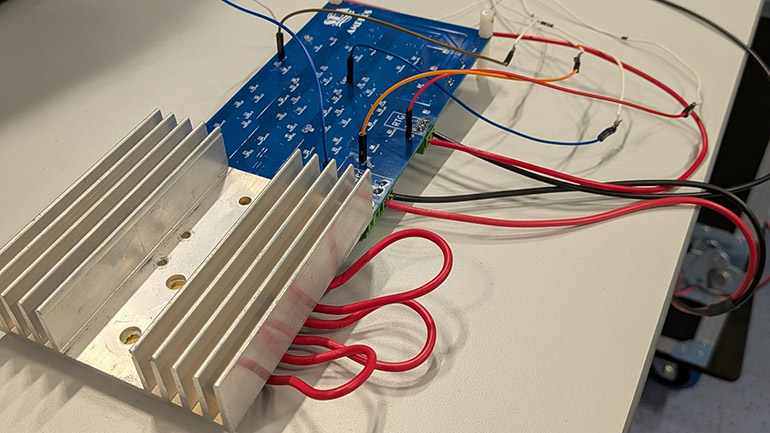
The hybrid architecture uses a sophisticated power management system enabling the use of both power systems as required. This allows the spacecraft to:
- Maximize peak power: use solar energy for operations during peak sunlight.
- Survive the night/continuous operations: utilize the constant thermal output of the RTG to keep scientific instruments warm during cryogenic ‘nights’, during dust storms or when access to sunlight is reduced.
- Reduce mass: by optimizing the ratio of solar-to-nuclear power, engineers can reduce the overall mass of the of the power system, leaving more room for scientific payloads.
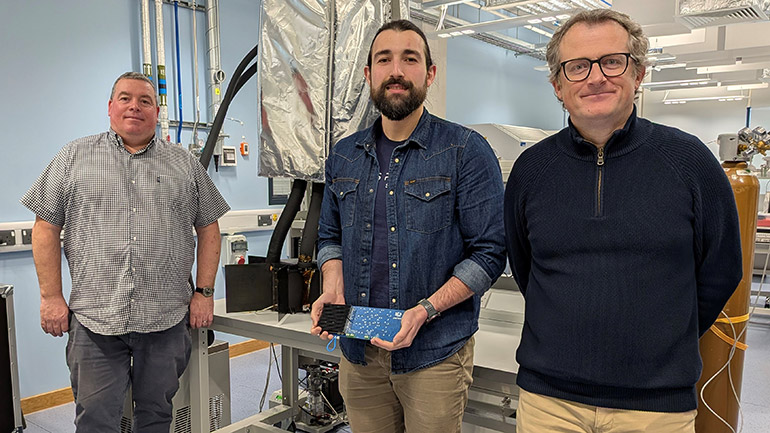
Dr Ramy Mesalam, Project Lead for the University of Leicester team, said: “With this testing campaign, the deployment of americium radioisotope power moves forward via another transformative achievement. The success of this system test paves the way for the technology to be developed further for direct applications to future missions. This collaboration proves that the future of space exploration isn't a choice between solar or nuclear; it’s about the intelligent integration of both.”
The validation took place at Space Park Leicester, the University of Leicester’s £100 million science and innovation park, with spinout company Perpetual Atomics and demonstrated the end-to-end performance of the hybrid system. Perpetual Atomics builds on over 20 years of expertise in deep space nuclear power systems, space science, and space exploration at the University of Leicester. Working across the full vertical—from fuel to heat sources and power systems— its innovative solutions to solve space mission power challenges will enable operations in the most demanding environments.
Dr Pablo Fernandez Miaja from University of Oviedo said: "By pooling UK expertise in thermal management with University of Oviedo expertise in power electronics and backed up by detailed environmental thermal simulations carried out by the University of Vigo, we’ve created a blueprint for the next generation of hybrid RTG-Solar power systems."
The Power Supply Systems Group (SEA) at the University of Oviedo have been performing research on Power Electronics for the last 40 years. Since 2018 it has pursued a line of research on space applications which have addressed from developments to replace and enhance space grade power supply components, power system architecture trade-offs and full power system development.
Dr Carlos Ulloa from University of Vigo said: “International partnership is the fuel of modern space discovery. This joint achievement between Spain and the UK not only strengthens our bilateral ties but also provides the global scientific community with a proven, scalable power solution.”
The AeroSpaceTech Research Group (ATRG) at the University of Vigo is a highly specialized multidisciplinary team with over twelve years of international experience in the space sector, distinguished by its leadership in CubeSat missions such as XatCobeo (the first Spanish CubeSat), Humsat D, and SERPENS.
Its research focuses on spacecraft systems engineering, mission analysis, space thermal control, ADCS, and structural analysis, while also providing industry oriented services including training and advanced testing in space structures, ESATAN based thermal control, and aerodynamic design for extraterrestrial environments.
The group also excels in designing, analyzing, and testing systems capable of withstanding extreme temperature variations in space—expertise that is crucial for lunar rover development, where vehicles must survive the drastic transitions between lunar day and night to protect both structural elements and onboard electronics.