New funding to develop technology for first robots to weld in space
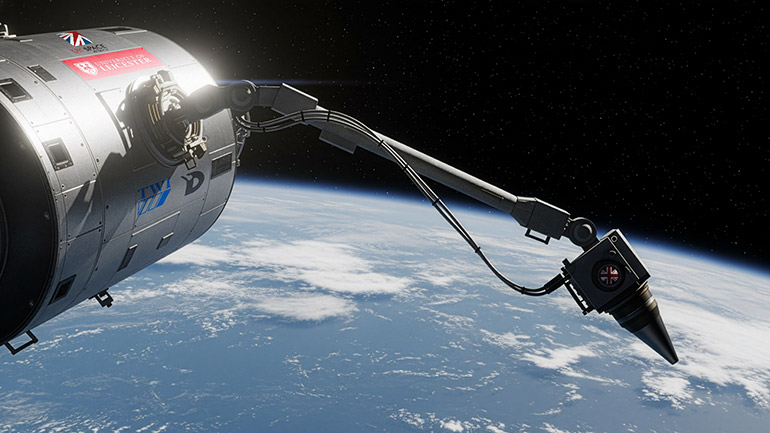
Concept art of the robot-mounted arc-welding system. Credit: ISPARK




The University of Leicester is leading on the development of the UK’s first in-space robotic welding capability.
Scientists at Leicester, in partnership with welding specialist TWI Ltd, have secured funding through the UK Space Agency’s National Space Innovation Programme (NSIP) – Call 2 to develop ISPARK – the Intelligent SPace Arc-welding Robotic Kit.
Valued at £560,000 (including £485,000 from UKSA), ISPARK will develop ultimately a robot-mounted arc-welding system for in-space repair, joining and future orbital manufacturing. It directly supports the ambitions set out in the UK’s National Space Strategy and in the ISAM (In-Space Servicing, Assembly and Manufacturing) roadmap.
Welding in space faces extreme challenges such as vacuum, microgravity, thermal instability, and the danger and intense physical demands placed on astronauts. These barriers mean that space welding remains extremely rare and technologically difficult. This project develops a new, space-qualified robotic welding capability to overcome these challenges and enable autonomous in-orbit repair and manufacturing.
The welder will undergo trials in vacuum to check its performance which will be simulated by and checked against digital-twin modelling, helping to validate key technologies ahead of eventual use in the far more complex thermal, radiative and dynamic conditions of real spaceflight.
The ISPARK project combines the University’s expertise in AI-powered robotics, autonomous control, space engineering and digital-twin weld modelling with TWI’s international leadership in welding and materials joining technologies. It places Leicester at the forefront of the UK’s growing ISAM ecosystem, building on its contribution and involvement in more than 90 space missions over six decades and reinforcing its commitment to enabling the next generation of UK space innovation.
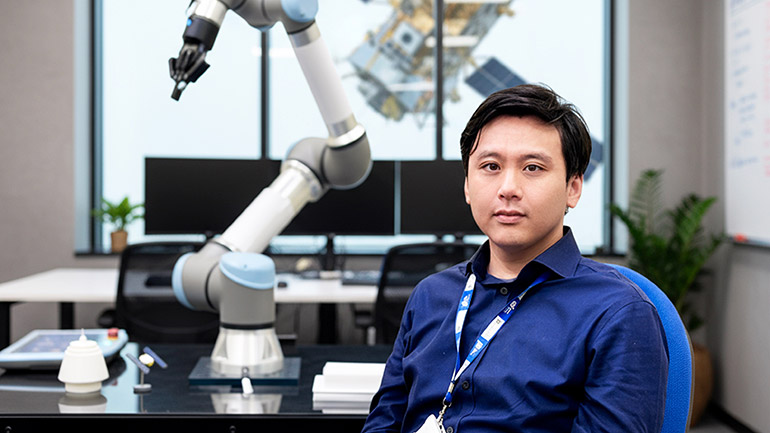
ISPARK Principal Investigator Dr Daniel Hao of the University of Leicester.
Principal Investigator Dr Daniel Zhou Hao, from the University of Leicester School of Computing and Mathematical Sciences, said: “ISPARK advances the UK’s and the world’s capability for in-space repair and manufacturing. By combining Leicester’s strengths in AI robotics and space engineering with TWI’s world-leading welding expertise, we are developing an enabling technology that could redefine how large structures are built and maintained in orbit.”
Dr Nick Ludford from TWI added: “TWI is pleased to be partnering with the University of Leicester on this pioneering effort. Applying advanced welding technologies to the challenges of space is a natural extension of our expertise, and ISPARK provides a unique opportunity to help develop a capability that will be vital for future in-orbit repair and construction.”
Professor Dirk Schaefer, Pro-Vice-Chancellor and Head of the University of Leicester College of Science and Engineering, said: “This award underscores the University of Leicester’s commitment to shaping the future of sustainable space operations and advanced manufacturing. ISPARK exemplifies the collaborative strength of Space Park Leicester, bringing together expertise from across the College of Science and Engineering and beyond, supported by strong industrial partnerships such as our collaboration with TWI.
“Developing the UK’s first in-space robotic welding capability is not only a scientific and engineering milestone, it also supports a more responsible and resilient space economy - where repairing, adapting and eventually manufacturing structures in orbit will reduce waste, extend mission lifetimes and enable new possibilities for sustainable exploration. As the UK continues to strengthen its position in the global ISAM landscape, we are proud to contribute knowledge, talent and innovation to a programme that pushes the boundaries of what is possible both in orbit and on Earth.”
The UK Space Agency has announced £17 million for seventeen UK space projects through its National Space Innovation Programme (NSIP), unveiled today at Space Comm Expo in Glasgow.
The selected projects span five strategic themes critical to the UK’s space ambitions: space domain awareness, in-orbit servicing and manufacturing, Earth observation, satellite communications, and position, navigation and timing.
Together, these projects will deliver transformative technologies to enhance climate monitoring, improve connectivity, enable sustainable satellite operations, and strengthen national security. From quantum communications and robotic servicing tools to AI-powered pollution tracking and refuellable propulsion systems, these innovations will help build a resilient, competitive UK space sector.
Space Minister Liz Lloyd said: “Space technology benefits people’s lives every day - from checking the weather to navigating your car journey home from work. This funding backs the brilliant UK innovators developing the next generation of space technology.
“By supporting our space sector, we’re strengthening the UK’s position as a world leader in space innovation and building technologies that will benefit people across the country for years to come.”