Pro Chancellor Dr Vijay Sharma Reflects on Service, Courage and Community for International Women’s Day
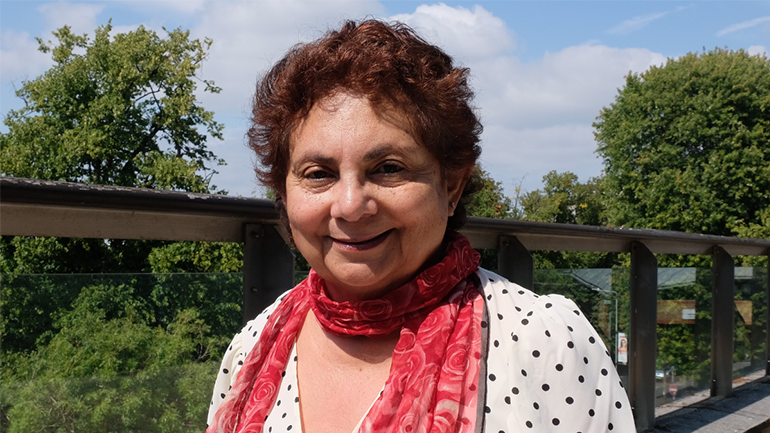




To mark International Women’s Day (8 March), our Pro Chancellor for Community Engagement, Dr Vijay Sharma, reflects on what giving back truly means, how women can uplift one another and why service has guided every step of her leadership journey.
What does ‘giving back’ mean to youand how has it shaped your professional journey?
For me, giving back begins with recognising a need, accepting a responsibilityand finding the courage to respond. True leadership is rooted in bravery - the willingness to take risks, speak up, step forwardand stay focused on creating positive outcomes.
When I arrived in Leicester in the late 1970s, the BBC Asian Network focused almost entirely on music. Important as that was, I could hear what was missing: information about immigration, the NHS, education, health - the things shaping daily life. The Asian community needed answers, not only entertainment.
So I walked into BBC Radio Leicester with no appointment and waited for hours to speak to someone. When the producer finally appeared, he said between mouthfuls of fish and chips, “Well sunshine, if you're that good, why don’t you do it?” So I did.
I began arranging interviews. One day the presenter fell ill, and I was asked to step in - that moment launched my broadcasting career. When the listening figures came in, they were extraordinary. The demand had always been there; the BBC just hadn’t recognised the opportunity, or the obligation, to serve the community fully.
From broadcasting, my community work deepened. I volunteered with the probation service and the police, translated for social workers and supported women facing domestic violence - often under pressure or hostility from those who felt threatened by women seeking help. Every woman I supported reminded me that public service isn’t just what you do, it’s what you stand up for.
Later, at the BBC, I challenged the proposal to close the Asian Network. I was the only Asian person and the only woman in the room. It was uncomfortable, but necessary. The arguments for closure were not evidence-based. I made the business case, challenged the assumptions and in the end, the Director General overturned the decision. The Asian Network is still here today.
So giving back, for me, is about speaking for those not being heard. It means walking into rooms you weren’t invited into and insisting that communities deserve better. It has shaped my whole career and continues to guide everything I do.And on International Women’s Day, it reminds me that when women - especially women of colour - challenge systems not built for them, they are not only changing their own lives, they are opening doors that stay open for everyone who follows.
How have your voluntary roles at the University of Leicester shaped your views on leadership and community?
My work with the University - as Council Vice Chair, Chair of the Equity, Diversity and Inclusion Board, and now Pro Chancellor - has strengthened my belief that leadership is fundamentally an act of service.
Here at the University, we sit at the centre of one of the most diverse cities in the UK. That means we must always ask ourselves: Are we truly connected to the communities around us? Whose perspectives are informing our work? And who is being left out of the conversation?
When I chaired the EDI Board, much of our focus was inward, on our staff and students, on culture, on whether our lived reality matched our values. Leicester is proudly global and our policies needed to reflect that. The gender pay gap was one such example. Naming it was easy. Owning it required courage. To the University’s credit, a clear plan was put in place and improvements followed.
Leadership is not about having all the answers; it is about asking the questions that make progress possible and crucially, it’s about ensuring the work continues even when you leave the room. Momentum should not depend on a single person.
My current role widens that lens. Leicester is full of creativity, potential and community spirit. The University can be a civic anchor, globally minded yet deeply connected to local communities.
What are the most powerful ways women can uplift one another?
I believe the most powerful thing women can do for one another is help build self-belief - something the world often tries to take from us.
In coaching and mentoring I often say: “You can go further than you think you can”. Women are frequently stronger, wiser and more capable than they realise, yet many hesitate to trust their own judgement.
So support begins with encouraging women to listen to the voice that says: You are capable. You are prepared. You can do this.
Supporting one another also means encouraging courage - not aggression, not confrontation, but the clarity and confidence to stand firm. If women shared more openly about the moments they were afraid but acted anyway, the effect would be transformative.
My first radio show taught me this. I didn’t know one end of a microphone from the other. But I sat in the chair because someone needed to and because the community deserved better. I was terrified. But I got through it and realised that surviving fear is often the gateway to lifelong capability.
How can senior leaders create more space and opportunity for women?
Senior leaders have enormous influence on whether women feel they can rise, contribute and thrive and that influence comes far less from what leaders say and far more from how they behave.
The first responsibility is selfawareness. Leaders need to understand the impact their words, tone, body language and daily conduct have on the people around them. A throwaway comment, a hurried dismissal, a closedoff expression - these things land differently with women, because many of us have been conditioned to read the room with great sensitivity. We pick up signals, consciously or unconsciously, that tell us whether we are valued, whether we belongand whether there is space for us to progress.
So if leaders truly want women to rise, they must model behaviours that communicate respect, fairness and genuine support. Not just in formal speeches, not just during performance reviews, but in every meeting, every interaction, every decision.
Senior leaders can either expand a woman’s confidence or quietly shrink it, often without meaning to. That is why selfawareness is not optional; it is a core leadership competency. This applies equally to women in senior roles. Just because a woman has made it to the top does not mean she automatically creates space for others. Senior women also need to remain vigilant about the signals they send. Leadership pressures can make anyone forget the values and behaviours that helped them rise in the first place. But forgetting those values means repeating the same patterns that once held us back.
Ultimately, leadership is not about adding more programmes or policies - although those help. It is about modelling the culture we want others to experience. If leaders live their values, stay conscious of their impactand uphold the behaviours that create belonging, then women will not just rise, they will lead boldly.
Your volunteering spans many sectors. What drives your commitment and what impact does it create?
Volunteering is often difficult to measure, but you can feel its impact. Volunteers are catalysts; real change belongs to the community.
For me, impact begins with something simple: getting something started. Sometimes it’s a conversation that sparks a new idea. Sometimes it’s a connection made at exactly the right moment. Sometimes it’s encouraging someone to try something they didn’t believe they could do. It won’t always change the world, but it can change their world and to me, that matters.
Across decades of volunteering in Leicester, Nottingham and Coventry in health, the arts, higher education and supporting vulnerable women and children - the pattern is clear: people have enormous potential. What they often lack is space, confidence, or someone to listen without judgement.
Coaching has reinforced this for me. Volunteering is simply coaching at a very human level, where the stakes are immediate and real.What drives me is simple: every time someone discovers their own strength, the whole community grows stronger.
What changes do you want to see in how organisations support women, especially from minoritised backgrounds?
The biggest change I want is more honesty: for organisations to look in the mirror and ask whether they are truly living their values.
Policies, statements and awareness days mean very little if the culture does not match the commitment. This affects women from minoritised backgrounds most, because they often carry community responsibilities, family expectations and workplace demands simultaneously.
We speak about inclusion and community engagement, but do organisations model these values internally? Do they create genuine space for volunteering or leadership development? Do senior people lead by example?
What I want to see is a shift from performance to practice.Values only matter when they are lived, consistently, visibly and with accountability. Culture is not shaped once; it is shaped every day. When this happenswomen don’t just feel supported, they feel believed in. That is where transformation starts.
What leadership lessons have stayed with you?
The leadership lesson that guides everything I do is the power of listening- truly listening.
Listening carefully makes people feel heard and respected. It opens doors to insight, trust and genuine connection. There were many times in my career when someone would begin to share a concern and the leader in the room would jump in with, “Oh yes, yes, I know about that.” That instinct, todemonstrate knowledge, to move things along may feel efficient, but it is deeply dismissive. It shuts down the conversation, it shuts down the relationship and it shuts down potential.
Leadership isn’t measured by how much you say, but by how deeply you hear - this shapes how I give back today. Whether coaching, mentoring or volunteering, my first task is to listen, to understand before acting. People are not looking for someone to take over; they are looking for someone to understand.
The leaders who influenced me the most were not necessarily the most charismatic or the most forceful - they were the ones who gave me the space to think, to breathe and to find my own voice. That is the kind of leader I have always tried to be and it is the principle that guides every piece of work I do in the community today.
Which women have inspired you most?
The women who have inspired me most are not always famous; they are women of resilience, wisdom and purpose.
The first is my mother. She had very little formal education. Born in Kenya, she didn’t grow up with the opportunities my generation had. But she was extraordinarily perceptive - sharp, wise and grounded in realworld understanding. I remember bringing a teenage problem to her and watching how she gently but firmly reframed my thinking. She said: “What’s the difference between you and me? You’re educated, I’m not. And yet look at how you’re approaching this. Think about what is in your control. Think about what you can do.”
It stopped me in my tracks. She showed me that wisdom is not the same as educationand that strength comes from how you apply yourself, not from the titles you hold. That insight has travelled through the generations - I find myself having the same conversations with my daughter today.
There are countless women across the world and within our own communities here in the UK, who do extraordinary work without ever seeking the limelight. One woman whose public impact left a lasting impression on me is Elvy Morton, who founded the Leicester Caribbean Carnival 50 years ago. Her journey was anything but smooth. She faced obstacles, refusals, a lack of resources but she persevered. Because of her persistence, the Carnival is now one of the city’s most joyful, inclusive cultural events and something the whole community celebrates.
What I have learned from these women, is that leadership is not about grandeur. It is about focus. It is about asking: What can I influence today? Whose burden can I lighten? What change can I begin, even if I am not the one who finishes it?
That philosophy guides how I lead, how I serve and how I try to give back. I may not be able to change everything, but I can change something and I can do it with the same conviction, courage and humanity that these women modelled for me.