NASA and ESA view Space Park Leicester’s ultra-clean mini-lab for space samples first-hand
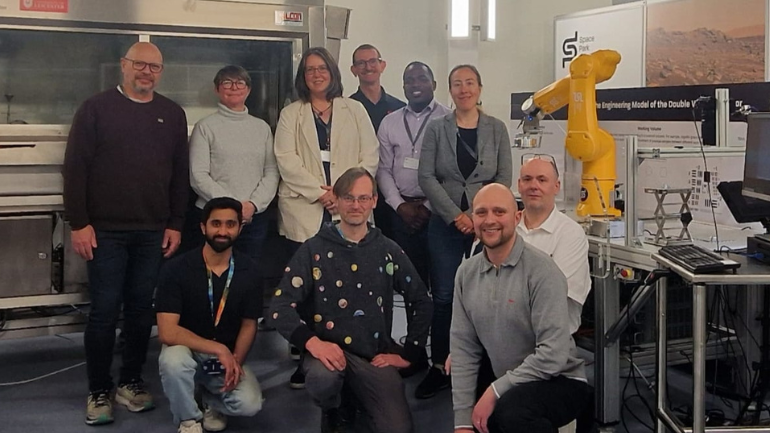
The ESA and NASA delegation with some of the Leicester team at Space Park.




As part of a European Space Agency development contract, a team of University of Leicester scientists and engineers based at its £100 million science and innovation park have designed the Double-Walled Isolator (DWI), an ultra-clean miniature laboratory to safely store and analyse materials from space, such as the first material from Mars. This week, scientists from NASA and the European Space Agency (ESA) visited Space Park Leicester to review progress on this unique technology and discussed how it might be used to support a range of missions.
Initially developed to support a potential Mars Sample Return mission, it provides a high level of containment and cleanliness to avoid cross-contamination, and uses state of the art robotics to carefully handle precious samples to a level of precision that is not achievable by human hands.
Storing and handling rock samples safely is an important aspect of planetary protection because while the rocks could help us search for signatures of life, an organism considered to be extra-terrestrial must be kept isolated from our terrestrial environment.
NASA specifically requested the visit to view the technology developed by the Leicester team, partly because of its novel applications in other areas of advanced curation. The visit focused on how the technology uses a state of the art, ultra clean robotic arm to handle rock samples in a way that has not been possible for previous missions.
The delegation from ESA and NASA conducted a technical familiarisation visit on 30 March to be updated on progress made during the design phase of the DWI Qualification Model. This focused on providing an overview of the deliverable hardware, namely the robotic arm, and analytical instruments (Raman spectrometer, macro imager, microscope and mass balance) that are used for the initial characterisation of samples inside the DWI. As part of the visit, the Leicester team demonstrated the robotic arm performing a set of end-to-end movements that sees an analogue sample unpackaged, imaged, weighed and then placed back into its container. This is a key milestone in the project and forms part of a Critical Design Workshop due in April 2026.
It also included a two-day visit to two DWI QM sub-contractors in London. The Natural History Museum are world leaders in curation of extra-terrestrial samples and the DWI team at Leicester has drawn on their extensive expertise to ensure the DWI design is capable of providing curators a piece of technology capable of performing cutting edge science with pristine samples.
The Francis Crick Institute in London is also supporting the project by providing specialist expertise in containment. The Crick is a key partner in developing the DWI due to their experience in handling highly infectious pathogens, such as influenza, to research how the virus is evolving and the effectiveness of vaccination. The delegation had the rare opportunity to go inside the Crick’s Bio-safety Level 4 (BSL-4) facility and see first-hand how specially trained scientists work in such a facility.
John Holt, DWI QM Principal Investigator at Space Park Leicester, said: “NASA’s request underscores their continued interest in the technology developed by Leicester and its potential applicability beyond the original Mars Sample Return context, including to future missions such as Artemis. Over the coming years, NASA is expected to return new lunar samples, which will require efficient cataloguing and initial characterisation.
“While the full containment capability of the DWI is not required for lunar materials, the system’s ability to facilitate automated handling and scientific characterisation within an ultra-clean environment offers a significant advantage. In particular, the integration of robotics can streamline routine analytical processes, reducing bottlenecks and accelerating the release of samples to the scientific community. This has the potential to materially enhance the pace and scale of scientific return from such missions in the future.”